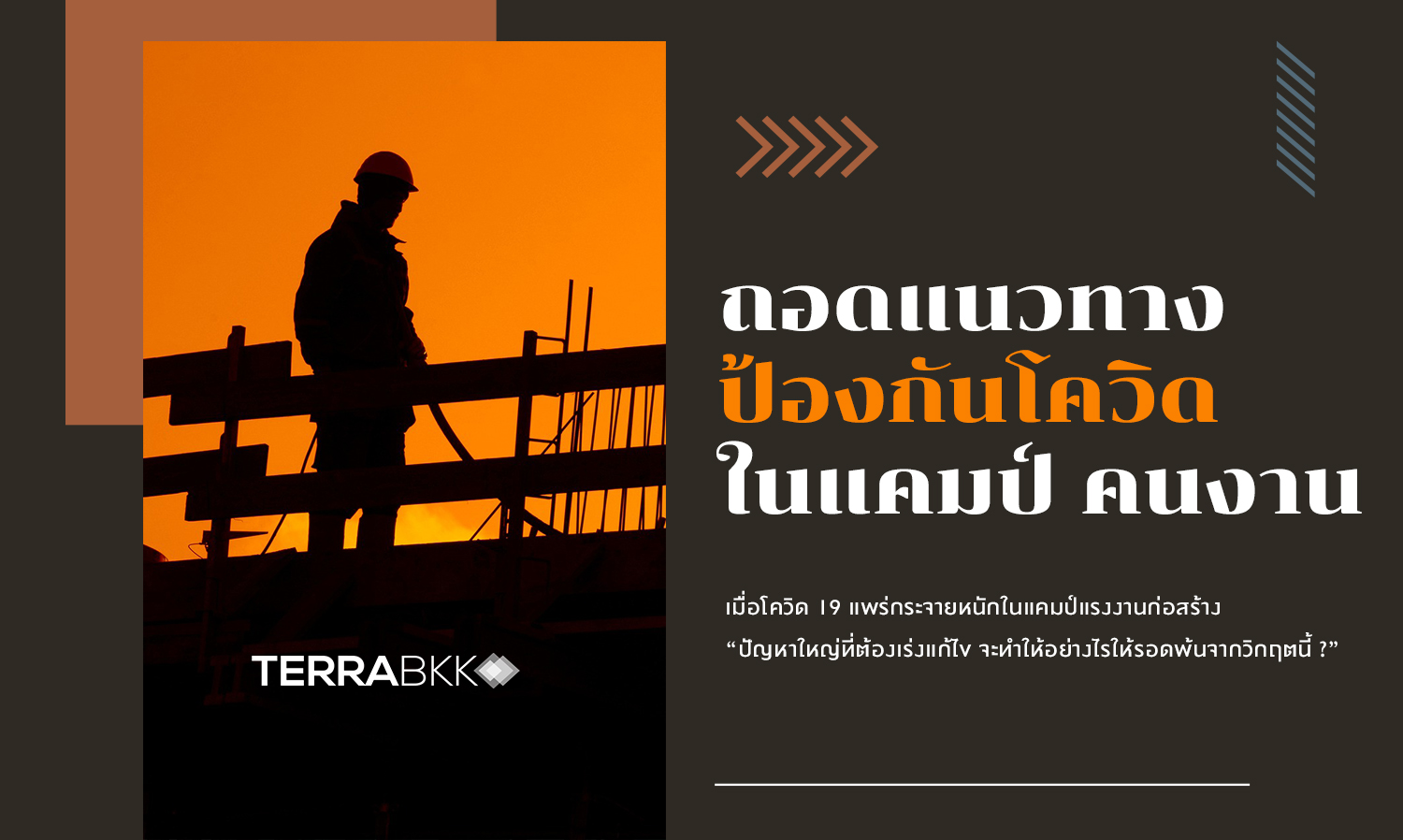
Preventing COVID-19 in Worker Camps
Preventing <\/strong>“<\/strong>COVID-19 in Worker Camps<\/strong>”<\/strong><\/span><\/p>
The outbreak of COVID-19<\/strong><\/span><\/a> in construction worker camps is a significant issue that requires strategies to prevent infection, as these camps house a large number of people, mostly migrant workers. A major outbreak could directly impact businesses, as over 20% of migrant workers are in the construction sector. Therefore, both the public and private sectors must urgently find ways to control the spread of COVID-19<\/strong><\/span><\/a>. During the online seminar titled “Managing Construction Worker Camps Amid COVID-19: A Participatory Approach EP1,” organized by the Thai Real Estate Association, various stakeholders shared their perspectives to accelerate the prevention of COVID-19 spread to construction worker camps. Dr. Wanna Harnchaoworakul, a field epidemiologist and expert from the Department of Disease Control, Ministry of Public Health, stated that Thailand has continuously developed its healthcare system but still has weaknesses in investment in medical science and technology. During the second wave in Samut Sakhon, the Ministry of Public Health implemented the Bubble & Seal measures to control the outbreak, which were applied in both factories and communities by restricting travel and daily activities. The Department of Disease Control has been preparing to manage construction worker camps since the first wave of COVID-19. The construction industry has strengths, as most workers are of working age and in good health, with systematic work and living mechanisms. Organizations also have penalties to reduce risky behaviors. However, there are still vulnerabilities due to workers' lifestyles, particularly during meal breaks, after-work gatherings, smoking areas, restrooms, and accommodations, as well as the entry of outsiders into the camps. Therefore, clear control measures in camps are necessary, such as prohibiting leaving accommodations after designated hours to timely control the spread of the virus. The Department of Disease Control has also prepared guidelines for managing high-risk areas by randomly testing 100 at-risk individuals every 1-2 weeks. They have also suggested implementing the Bubble & Seal measures in worker camps, where densely populated areas with positive rates above 5% may require integrating Bubble & Seal strategies, including adjusting preventive measures to separate living arrangements by family and avoiding connections with other families. If successful, this would help ease living conditions and reduce the risk of transmission to larger groups, keeping infections contained within these Bubbles & Seals. These are strategies that the construction industry should adopt and experiment with by dividing workers into smaller groups, such as by accommodation zones or work departments. Adjusting Plans to Address Outbreaks in “Construction Worker Camps” Mr. Adisorn Kerdmongkol, coordinator of the Migrant Working Group, stated that migrant workers account for over 20% of the total workforce in the construction business. As of May 19, 2021, there have been over 116,951 COVID-19 cases among migrant workers across three waves. The majority of migrant workers are located in the Bangkok metropolitan area, totaling 1.1 million. The key issues causing the spread of COVID-19 in worker camps during this third wave stem from five main points: 1. Lack of access to healthcare systems, including quarantine and recovery transfers. 2. Lack of communication, as seen during the COVID outbreak in Samut Sakhon, where most workers use prepaid phone systems and could not recharge their phones during quarantine, preventing communication with the outside world. 3. Stigmatization and loss of hope, as workers are labeled as the source of social problems, making them reluctant to disclose information. 4. Basic living issues, such as being evicted by landlords, forcing them to stay with friends or relatives, which facilitates the spread of the virus. 5. Legal status is a significant issue, as many workers lack documentation or have fallen out of the workforce system. During the disease control measures in construction worker camps, it will be necessary to revisit how these issues can be addressed. The network of civil society organizations for migrant workers has begun implementing measures during the COVID-19 outbreak among migrant workers by producing information in local languages for better understanding, providing basic assistance in food and protective equipment, supporting access to public services such as medical care and compensation, and facilitating government work by providing interpreters for public screening centers, working alongside health volunteers to improve communication and understanding within communities, and advocating for clearer policies on managing migrant workers to integrate informal workers into the system. However, in Bangkok, it is crucial to monitor “markets” as new clusters, such as Klong Toey Market, Pratunam, Mahannak, Bobae, Bangkapi, Din Daeng-Huai Khwang, Saphan Mai, Phra Khanong, and Min Buri, where migrant workers shop and work, and which are also points for vendors to deliver goods to construction worker camps. <\/p>
“Lessons learned from implementing the Bubble & Seal measures in Samut Sakhon will need to be adapted to create appropriate mechanisms for managing labor. It is believed that not moving workers will be a crucial strategy for effectively controlling the disease.”<\/strong><\/p>
<\/p>
Ensuring Worker Camps are Safe to Handle COVID-19 Dr. Ampon Janthawiboon, a public health scholar and expert from the Department of Health, Ministry of Public Health, stated that to prevent the spread of COVID-19, construction workers must begin to adjust their traditional lifestyles. If the Bubble & Seal measures are implemented, construction worker camps may need to enhance three main areas: eating, living conditions, and transportation. Starting with living conditions, for example, adjusting eating behaviors by communicating knowledge and information in a language that workers can understand about cleanliness and the need to separate food. Regarding living conditions, it is essential to manage restrooms to ensure they are hygienic and sufficient, with increased cleaning, safe drinking water, and sanitation at contact points, including adding handwashing stations with soap for workers to wash their hands before preparing and eating food. For transportation between accommodations and workplaces, if the Bubble & Seal measures are implemented, workers may be asked to limit conversations during transit, such as restricting the number of people in transport vehicles to avoid overcrowding. <\/p>
The Real Estate Association Urgently Seeks Ways to Assist Contractors in Preventing COVID-19 in Worker Camps Mr. Pornnaris Chuanchaisit, President of the Thai Real Estate Association, stated that the spread of COVID-19 is a matter the association is urgently prioritizing, as both operators and contractors are concerned that an outbreak in construction worker camps could severely impact the business cycle. Therefore, this seminar serves as another platform for exchanging views with hygiene experts on preventive measures that the real estate business can adopt. Although there have been no infections in construction worker camps within the real estate sector, it is crucial to find preventive measures, with real estate developers willing to invest in establishing safety standards in construction worker camps to control the outbreak and prevent the emergence of new variants. <\/p> 1.jpg) <\/p>
<\/p>
 <\/p>
<\/p>
.jpg) <\/p>
<\/p>