Summary of the Thai Social Situation in Q3
Unemployment decreases, household debt increases, patient numbers decline, and crime rates drop: key developments in Thai society during Q3 of 2020
As we officially enter the end of the year, the festive atmosphere of the New Year approaches, yet the atmosphere of Thai politics remains heated, particularly concerning the ongoing protests and the voting on the people's constitutional amendment draft. Beyond politics, we will delve into the significant movements within Thai society during Q3 of 2020 based on a report from the National Economic and Social Development Council to see how Thailand has changed.
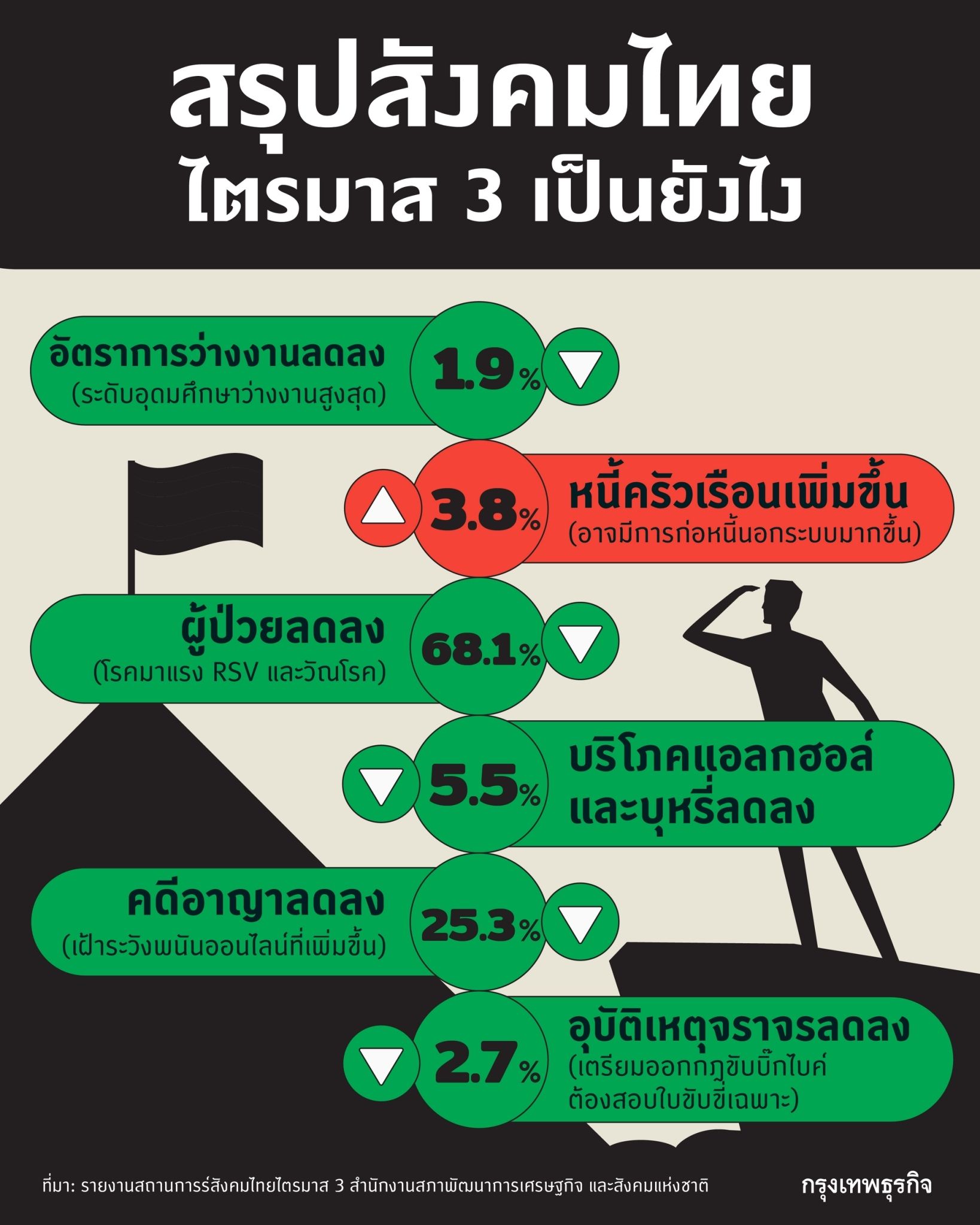
- Unemployment rate decreases by 1.9%
The unemployment rate remains high, and working hours continue to decline, impacting household income and living conditions in various aspects. Moreover, new graduates, young workers, and those with higher education face significant unemployment challenges.
In Q3, the unemployment rate was recorded at 740,000 people, translating to an unemployment rate of 1.90%, close to the previous quarter's rate of 1.95%, which was during a severe COVID-19 outbreak. Young workers and those with higher education experienced more unemployment than other groups.
Systematic unemployment has continued to rise from the previous quarter, while overall unemployment appears relatively stable, indicating that workers who lose their jobs are increasingly moving to informal work, such as self-employment or agriculture, which affects labor productivity. Temporary unemployment has decreased.
According to the Department of Labor Protection and Welfare, 1,387 establishments requested to use Section 75, covering 330,000 workers, a decrease from 790,000 in the previous quarter.
- Household debt increases by 3.8%
The household debt situation in Q2 of 2020 was valued at 13.59 trillion baht, increasing by 3.8%, slowing down from 4.1% in the previous quarter, and accounting for 83.8% of GDP, continuing to rise from the last quarter. The main cause is the severe economic contraction, along with the persistent increase in household debt.
This reflects the growing financial vulnerability of households, particularly those affected or at risk of income loss and unemployment due to the economic crisis and the COVID-19 outbreak. Meanwhile, the overall quality of credit remains at risk and requires close monitoring.
Data on non-performing loans (NPLs) for consumer debt that does not generate income from commercial banks at the end of Q2 of 2020 was valued at 152.501 billion baht, expanding by 19.7% and accounting for 3.12% of total loans, down from 3.23% in the previous quarter due to measures to assist debtors and relax classification criteria, which improved the overall debt quality situation.
- Patient numbers decrease by 68.1%
Cases of monitored diseases decreased by 68.1%, with reductions across almost all diseases. For instance, flu cases dropped by 93.4%, pneumonia cases by 44.9%, and dengue fever cases by 34.4%. This decline is attributed to the COVID-19 outbreak, which has led people to be more vigilant and take better care of themselves, including self-isolation and social distancing.
However, there are still health issues to monitor, with potential increases in patient numbers as we enter the winter season, such as pneumonia, flu, and health threats like deaths from cold weather, PM 2.5 dust issues, and rising cases of diseases like RSV and tuberculosis.
- Alcohol and tobacco consumption decreases by 5.5%
In Q3 of 2020, the consumption of alcoholic beverages and tobacco decreased by 5.5%, with alcohol consumption down by 7.5% and tobacco consumption down by 2.5%. Previous efforts to control alcohol and tobacco have mainly focused on national-level measures, including campaigns, public awareness, access restrictions, marketing controls, and tax and pricing measures.
However, there is still a lack of emphasis on developing community-level management mechanisms that could directly create change, as they are closer to the public and consumers and understand the social, cultural, and economic contexts of the area. This requires cooperation from all sectors, including government, private sector, civil society, public health volunteers, and local communities, to collaboratively learn and address local issues seriously, leading to a community agreement that enhances the effectiveness of alcohol and tobacco control efforts.
- Crime rates decrease by 25.3%
Overall crime rates decreased by 25.3% compared to the same quarter in 2019, with drug-related cases down by 27.4%, bodily harm and sexual offenses down by 10.1%, and property crimes down by 13.6%. However, there remains a need to monitor the vulnerability of children and youth to easily enter the gambling cycle, especially online gambling, which is three times more severe than other forms of gambling.
Currently, many online gambling websites operate around the clock, accessible via the internet on smartphones or computers, with teenagers being the most likely to engage in gambling due to targeted advertising strategies.
Regarding human trafficking in Thailand in 2020, the U.S. Department of State's 2020 Trafficking in Persons (TIP) Report ranked Thailand in the "Tier 2" category for the third consecutive year, citing the country's ongoing significant efforts to prevent and address human trafficking issues, along with important recommendations for Thailand's operations.
- Traffic accidents decrease by 2.7%
The situation of road traffic accidents and fatalities decreased by 2.7% and 12.4% compared to the same quarter last year. The leading cause of accidents is sudden lane changes, accounting for 36%, followed by speeding beyond legal limits at 35.6%.
Motorcycle accident statistics remain the highest, with a growing trend in the popularity of high-powered motorcycles, such as big bikes. Frequent accidents on the roads have prompted relevant agencies to recognize the importance of preventing accidents involving big bikes by establishing safety standards for riders, reducing the risk of injury or loss of life and property.
The significant social movements in Thailand during Q3 of 2020, despite decreases in various areas, require us to remain vigilant for the Q4 report, which will summarize the overall impact on Thai society over the past year.
------------------------
Source: nesdc.go.th
Source: www.bangkokbiznews.com