Ministry of Possibilities
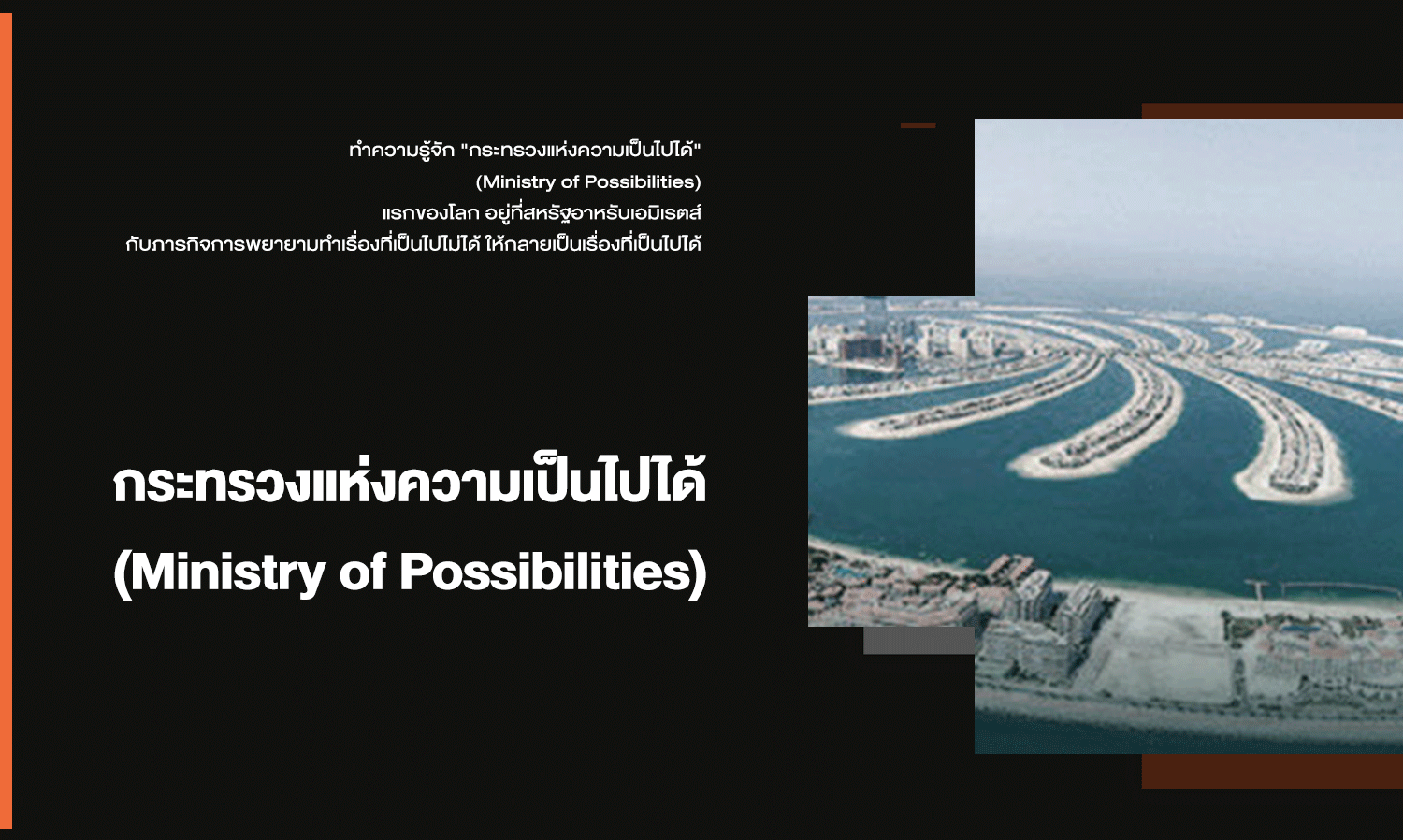
Introducing the "Ministry of Possibilities," the world's first of its kind located in the United Arab Emirates, with the mission to turn the impossible into the possible.
In today's world, every country is facing difficult challenges amidst rapid changes that have interconnected impacts across various dimensions, such as the spread of COVID-19, which has posed a daunting task for nations worldwide.
Looking ahead, every country will also confront challenges from advancements in artificial intelligence (AI) that will affect the future of employment, climate change, an aging society, and many other issues.
These challenges exemplify significant issues that are too complex for any single ministry to handle alone, and each country has different approaches to tackling these future challenges.
One intriguing initiative in the global public innovation arena last year was the establishment of the "Ministry of Possibilities" by the United Arab Emirates (UAE), the first of its kind in the world, with the crucial mission of attempting to make the "impossible" possible.
The UAE's Ministry of Possibilities is a virtual ministry without a traditional minister, unlike other ministries, but it is directly empowered and guided by the Cabinet. This ministry brings together personnel from the public sector, private sector, academia, and civil society, working either full-time or part-time, with the primary mission of designing and developing new solutions that can lead to significant change.
Under the ministry, new departments are established based on key challenges, working in an agile manner to create new experiments with the potential for scalability. Each department operates for a maximum of one year before dissolving, with new departments formed to address other impossible challenges.
The origin of the Ministry of Possibilities arose from the UAE facing challenges that many viewed as nearly impossible to solve, such as issues in public procurement, pension systems, and social welfare. It was discovered that the most deeply rooted problems were those that did not fall under the specific authority or responsibility of any one ministry, leading to a lack of accountability. Many believed that the country lacked an agency and a central space dedicated to addressing major issues that extend beyond current general matters.
The Vice President and Prime Minister of the UAE recognized the need for a central space that is close enough to the government’s power center to address its mission, yet distant enough to avoid being constrained by politics, authority, traditional measures, and bureaucratic systems.
In April 2019, the UAE government established the Ministry of Possibilities, with the main mission of identifying challenging problems or issues deemed impossible, exploring the realm of the impossible, and creating innovative proposals, as well as educating and training personnel on public experimentation and design thinking, while inspiring other governments.
Within the ministry, various departments are supported by ministers who select the executives of each department, along with decision-making leadership teams that include key stakeholders. Each department appoints a Possibility Advisor to act as a coach.
Initially, the ministry launched four departments: 1. Department of Proactive Service aims to design new experiences for citizens in using public services by anticipating needs and initiating service offerings before citizens demand them, identifying service needs across all age groups and collaborating with citizens to design a holistic new experience.
2. Department of Behavioral Rewards aims to shift from punitive measures to approaches that encourage positive behavior, which may take the form of a reward system that can be used to pay for public services.
3. Department of Government Procurement aims to improve the public procurement experience for all parties, both providers and users.
4. Department of UAE Talent aims to encourage all citizens to be part of the development and design of the country's future, focusing on creating mechanisms to identify, nurture, and align according to individual capabilities, enabling everyone to set their own goals and receive support, including fostering new skills and abilities among the youth, as well as creating sustainable leaders.
Ultimately, the departments will present findings, solutions, and the impact of projects to the Cabinet, advising on potential outcomes, including adjustments to current operations and approaches within existing ministries, or possibly expanding the role of these temporary departments into fully established offices or ministries, which could take the form of new agencies or even replace existing ones.
In Thailand, similar initiatives have begun in the form of Policy Labs from various agencies, and if in the future this could be elevated to a Ministry of Possibilities like that of the UAE, it could enhance Thailand's capacity to tackle challenging issues by harnessing the collective intelligence of the nation.
SOURCE: www.bangkokbiznews.com