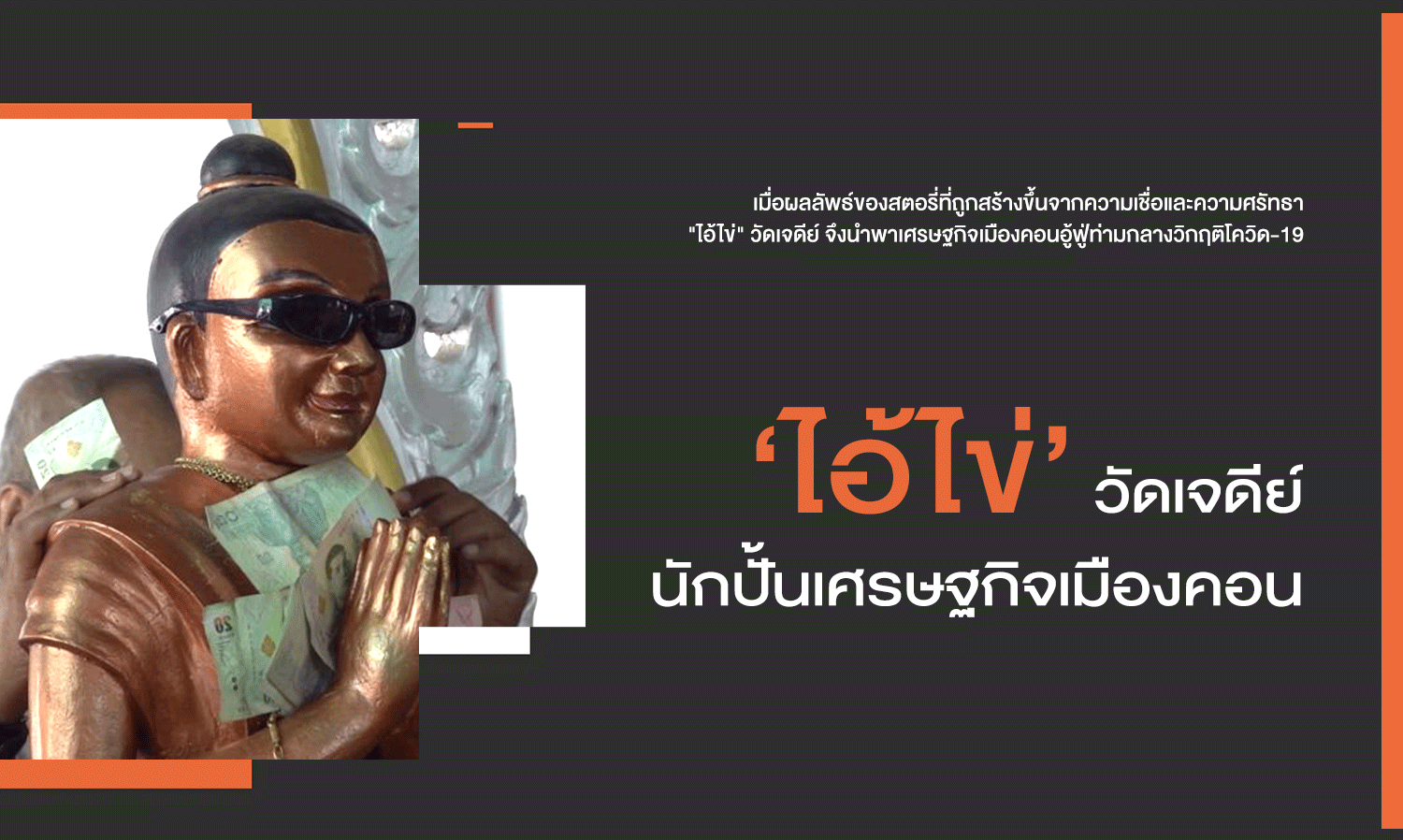
'I-Kai' of Wat Chedi: The Economic Booster of Nakhon Si Thammarat
The story of 'I-Kai' from Wat Chedi, born from belief and faith, has led to a flourishing economy in Nakhon Si Thammarat amidst the COVID-19 crisis.
When it comes to sacred objects that serve as a source of hope for Thai people nationwide, none surpasses 'I-Kai' from Wat Chedi in Chalong, Sichon District, Nakhon Si Thammarat. It represents a new hope for happiness and success as desired.
Competing for the 'I-Kai Yod Sap' edition, with some versions priced in the millions.
People flock to see the lucky numbers from the holy water basin of 'I-Kai Wat Chedi', which has provided direct luck for three consecutive draws.
The miracles of 'I-Kai Wat Chedi' bring jobs to those who seek them and money to those who ask.
Headlines from various sources show that 'I-Kai' of Wat Chedi has gained significant media attention and financial support for the temple. Since the lockdown was lifted, all roads have led to Nakhon Si Thammarat, creating a lively atmosphere in this culturally rich city, defying the COVID-19 trend.
- The Legend of the Wat Chedi Boy
According to legends passed down, some say 'I-Kai' is the spirit of a temple boy who followed 'Luang Pu Toad', a revered monk from the Srivijaya region 300 years ago, who came to practice at the now-abandoned Wat Chedi. He granted the spirit of a boy named 'Krua Thong' to look after this area. Others believe that I-Kai was a boy who drowned in the vicinity, thus forming a bond with the temple.
Another local legend shared by anthropologist Ajarn Apapirat Wanliphod tells that villagers saw the spirit of a boy running into an ancient Buddha statue within the temple, which was widely recognized by the locals and posed no threat. In fact, when villagers lost their cattle and prayed for help, the spirit assisted them in finding them, making the boy's spirit a local guardian.
However, around 1982, a local named Phuyai Tiang, or 'Tiang Hakelek', dreamt of the boy saying he had no home. He then carved a wooden figure of a 9-10-year-old boy to serve as a dwelling for the spirit and offered it to Wat Chedi. At that time, the abbot named 'Phor Than Tiem' referred to the carved wooden figure as 'I-Kai' and produced the first amulet in the form of a coin in 1983, which is now valued at hundreds of thousands.
“At that time, Nakhon Si Thammarat was a pink zone, or communist area, with soldiers patrolling for safety. However, at night, there were stories of being pulled by a child ghost, and in the morning, villagers would recount their experiences, unanimously attributing it to I-Kai. They advised the soldiers to acknowledge I-Kai and share offerings. Once the soldiers complied, they were no longer disturbed and even distributed I-Kai coins to those soldiers. This marked the beginning of I-Kai's story spreading beyond the local community,”
From 'Jatukam Ramthep' to 'I-Kai', the Guardian Spirit
Although the origins of I-Kai cannot be traced clearly, the miraculous tales of the Wat Chedi boy have become widely recognized and have not diminished even as times change. What keeps this belief powerful in Thai society? Anthropologists have an explanation.
“Belief exists continuously and often answers questions that science cannot. The unseen beliefs fill the gaps immediately and address the human need for psychological support. A clear example is illness, where the true cause is sometimes elusive, and medicine cannot provide clear answers. Even when we try every means to recover from illness, it may coincidentally relate to supernatural elements, which is normal,”
Ajarn Apapirat states that belief and faith exist in every part of Thai society, but what is interesting is that famous amulets and various feverish trends often originate in 'Nakhon Si Thammarat'.
Interestingly, famous amulets and feverish trends often originate in 'Nakhon Si Thammarat'
If you recall, several years ago, there was a wave of faith in 'Jatukam Ramthep', which also began in Nakhon Si Thammarat. The same anthropologist analyzed and compared, starting with the word 'Kai', which is a term used in Southern Thailand to affectionately refer to boys as 'Kainui'.
Additionally, there is another hidden meaning: the name 'I-Kai' coincidentally resembles the ancient kingdom of Tambralinga (an ancient kingdom centered around present-day Nakhon Si Thammarat) because 'Tam' means copper or red, while 'Linga' is a symbol or sign of gender or genitalia.
“I-Kai is born from the kingdom of red eggs, and this land, during the Hindu period, had a prominent ancient object, especially in Sichon District, which includes various sizes of Shiva Lingams, or what could be called the Egg Grove of Shiva. Thus, I-Kai is connected to this area,” Ajarn Apapirat observes.
The era of Jatukam Ramthep began around 1997 and peaked in 2007, when the Fiscal Policy Office (FPO) estimated the circulating value of Jatukam Ramthep at that time to be as high as 22 billion baht, boosting the country's GDP by 0.1-0.2 percent during an economic downturn.
“Both phenomena occurred in Nakhon Si Thammarat similarly, but Jatukam has faded away. It was once famous over a decade ago, but then gradually disappeared. When it peaked, everyone was producing Jatukam, resulting in hundreds of versions, making the trend increasingly difficult. Additionally, as more people produced it, they had to find selling points, which became increasingly complex,”
After the Jatukam Ramthep trend faded, no amulet has reached such heights again until Phra Khru Phutthajetiya Phimon, or 'Ajarn Wian', the current abbot of Wat Chedi, devised a strategy to attract people to make merit at the temple, which became crucial in promoting the I-Kai phenomenon.
“At that time, Wat Chedi was not well-known. Ajarn Wian wanted to invite people to make merit, so he negotiated with the highway department to put up signs along the highway saying Wat Chedi (I-Kai). When people drove by, they would notice and wonder if this was a famous temple,” Ajarn Apapirat recounts the origin.
What made I-Kai famous was also about management. It is said that some amulet experts collaborated to learn from the fading Jatukam Ramthep trend, aiming to revive something new, and I-Kai was relatively accessible and uncomplicated compared to the floating form of Jatukam. Besides various miracles, I-Kai is also a 'crafted child' born from the collaboration of those managing behind the scenes,”
- 'Kai' from Faith to Cultural Product
Currently, not only has I-Kai sparked tourism in Nakhon Si Thammarat, but the I-Kai in the form of amulets has also been established in various temples across the country, including those closer to Bangkok, such as Nonthaburi, Pathum Thani, Ratchaburi, Ang Thong, etc., resembling a franchise of I-Kai that has rapidly expanded. However, this expansion did not arise from mutual agreements to create it, as I-Kai from Wat Chedi has been copyrighted with the Department of Intellectual Property as an artistic work 'I-Kai Wat Chedi' since July 10, 2008, along with another 10 items derived from I-Kai.
Ajarn Apapirat views the copyright issue as a business model that seeks sustainability for the origin, creating authenticity and originality. From the perspective of survival, it is not wrong because the temple itself needs to generate income, and the temple's income can also help the local community, supporting nearby businesses. Therefore, it is essential to manage the copyright stating that the original and authentic must come from Wat Chedi only.
“What we are experiencing here is no longer Buddhism but a 'spirit religion' focused on survival in life, prioritizing the present over accumulating merit for the future. However, this is understandable because how can we move forward if our stomachs are not full?”
From the academic article 'Buddhism: Sorcery, I-Kai of Wat Chedi, and the Process of Becoming a Commodity' by Boonying Prathum, from the Community Development Program, Faculty of Humanities and Social Sciences, Nakhon Si Thammarat Rajabhat University, it explains the legend of I-Kai of Wat Chedi and the sacred area, the emergence of spirit worship linked to the spatial context, intertwined with beliefs and rituals, the fulfillment of vows, and the process of modernity and commodification.
Starting from the process of creating space, the meanings related to the original source, and the creation of identity to assist the local community, such as the legend of fulfilling vows regarding villagers' pets or lost items.
When one fulfills a vow with I-Kai Wat Chedi, they will receive back what they asked for, leading to the creation of coins shaped like I-Kai, the first Wat Chedi boy, and many other amulets, including talismans, carved figures, coins, and various statues, resulting in replication, value creation, and becoming a cultural commodity.
This is linked to the replication of rituals and beliefs. One of the research topics 'Wat Chedi I-Kai: Constructing a Sacred Space Amidst Modern Crises' by Sitthipong Boonthong, from the Human Development and Society Program, Faculty of Arts, Prince of Songkla University, explains that once one receives what they asked for, they must fulfill their vows. Nowadays, this includes lighting firecrackers, offering fighting cock statues, military sets, and various toys, with services available for fulfilling vows when one cannot come personally. The prices for firecrackers for fulfilling vows start from 1,000 shots at 100 baht up to 100,000 shots at 1,000 baht, while fighting cock statues range from hundreds to 1.5 million baht, with a height of 11 meters prominently displayed in front of the temple's ubosot.
However, Ajarn Apapirat invites a reinterpretation of vow fulfillment to ensure I-Kai's sustainability by leaving permanent footprints, using this wealth to invest in the environment, contributing to crab banks, fish banks, and participating in beach clean-ups, or interpreting wealth in a way that does not enrich just one person but distributes it widely and collectively.
“Ecology and the environment must be the yardstick for determining everything, even political policies, and using this belief as a driving force for both the environment and the economy,” Ajarn Apapirat expresses his views on the new normal of vow fulfillment.
Currently, Wat Chedi has undergone significant changes, with a large ubosot replacing the old chedi, a meditation hall, a place for lighting firecrackers for vow fulfillment, and ample space for shops. All of this is a result of the influx of people driven by their beliefs and faith in I-Kai, leading to its recognition as the 'God of the Common People', a beloved figure for those in distress.
SOURCE: www.bangkokbiznews.com