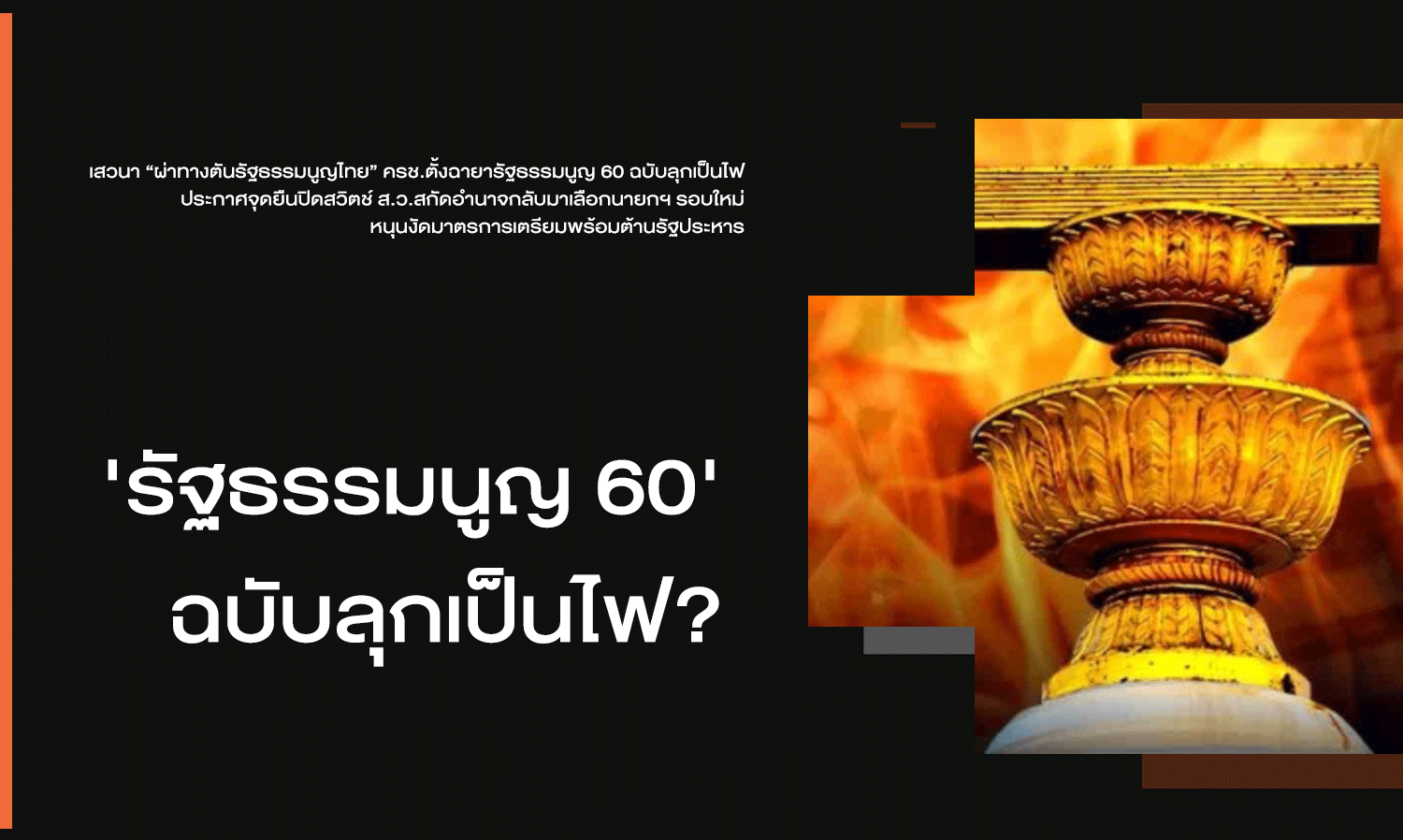
'Constitution 60' A Fiery Edition?
Discussion on "Breaking the Deadlock of the Thai Constitution" - The Campaign for the People's Constitution (KraCh) nicknames the 60 Constitution as 'Fiery', declaring a stance to shut off the Senate's power to prevent a new Prime Minister selection and support measures to prepare against a coup.
At the 14 October Memorial (Kok Wua Intersection), the Campaign for the People's Constitution (KraCh) organized an academic seminar titled "Breaking the Deadlock of the Thai Constitution: No Amendments, Only a New Draft", featuring speakers including Prof. Dr. Thanet Apornsuwan from the International College of Pridi Banomyong, Thammasat University, Assoc. Prof. Dr. Somchai Preechasilpakul from the Faculty of Law, Chiang Mai University, Dr. Decharat Sukganet from the Faculty of Economics, Kasetsart University, and Assoc. Prof. Dr. Samchai Srisan from the Poey Ungpakorn School of Development Studies, Thammasat University.
Prof. Dr. Thanet stated that the movement to change the constitution has been highly significant, carrying different political implications compared to previous versions. The legitimacy of the government stems from the sovereignty of the people. Following protests from the People's Alliance for Democracy, which previously represented a conflict among the elite, the public was excluded from participation. However, the People's Alliance represented another layer of public struggle, leading to prolonged conflicts that escalated into the coup on September 19, 2006, and continued with protests from the Red Shirt movement during Abhisit Vejjajiva's government, followed by the emergence of the People's Democratic Reform Committee (PDRC) during the Pheu Thai government.
"If power outside the system cannot be utilized, then external power will intervene, leading to the revival of old conflicts as no one is willing to concede. Regardless of which government comes into power, they cannot sustain themselves, as seen with the NCPO, which was largely rejected by the public," he said.
"This movement differs from all previous groups; it does not focus on numbers but calls for drafting a constitution that the majority can recognize, rather than being written in isolation, and aims to create broad acceptance to establish a standard that various parties can agree upon," he added.
Prof. Dr. Thanet also mentioned that the current student movement has already succeeded in igniting thought and awareness, opening doors for upcoming changes. This time, it is not about October 14 or October 6, but a new generation of youth in the new century, initiating a process to establish legitimacy based on principles, without money or tanks, but through the rationale of justice, thus representing a pure force from students.
Assoc. Prof. Dr. Somchai remarked that when discussing the 2017 constitution, some will say it was passed by referendum, but in his view, this constitution was opposed even before its announcement. It has been dubbed as an anti-corruption measure, yet we see problems arising from its implementation.
1. It distorts the law to legitimize the wrong, such as the selection committee for senators reverting to being senators.
2. It is a constitution that resists change, as it cannot be amended, even though constitutions should allow for self-amendment. The pathways to amend this constitution are fraught with traps, from consideration by the Senate to the Constitutional Court, making it clear that amending it through the system will take time. Thus, I would like to nickname this constitution as one that sets the country ablaze, a distorted constitution that cannot be amended.
Assoc. Prof. Dr. Somchai further noted that regarding the current movement stemming from protests, with three demands, two stances, and one dream, it is evident that the ongoing threats necessitate preparation for other actions, such as halting classes to ensure students' safety, which must be done collectively. Additionally, if a coup occurs, there must be measures in place to respond accordingly, as the people cannot fight the state if there is an uprising.
Moreover, we must distinguish between what constitutes a struggle against the power structure, such as the Senate, and cultural struggles, as well as differentiate between allies and opponents, since we see many people turning back to a democratic stance. Therefore, isolating the authoritarian side remains essential.
"The three demands, two stances, and one dream represent a tacit consensus that will push forward in the near future. If we are to expand the issues, we must broaden the political space significantly. From here, we will see movements from various groups, starting with the drafting of a new constitution by the Constitution Drafting Assembly, which aims to completely abolish the 2017 constitution. However, I acknowledge that this process will certainly take more than a year,"
"Meanwhile, another group proposes amending the constitution article by article, addressing issues such as the Senate and the electoral system to better reflect the people's sentiments. Although the internet-based public law initiative may take time, the rapid collection of signatures reflects the people's desire for change," Assoc. Prof. Dr. Somchai stated.
Dr. Decharat mentioned that the timeframe for amending the constitution would take about two years at the earliest. Currently, the economy is in a deep downturn, recovering slowly and precariously, which is expected to take about two years, coinciding with the constitutional amendment process. Economic pressures will compel the government to amend the constitution.
The government's retreat at this time must be acknowledged as a careful consideration, at the lowest point they can stretch with the need for a Constitution Drafting Assembly that will take another two years. However, in four months, the government is always looking for opportunities to turn the game around, as they do not feel inclined to amend the constitution, only retreating.
The establishment of the Constitution Drafting Assembly or article-by-article amendments is necessary, but the existence of the Assembly should genuinely aim for a common agreement. The drafting of the constitution must involve intense debate over content, including election methods, the formation of the government, and whether the Senate is necessary, as well as discussions on justice processes, independent organizations, and citizens' rights and freedoms. Therefore, I believe there will be discussions on these matters.
"If we have a Constitution Drafting Assembly, there are proposals to elect provincial governors and agricultural officials, which are regional civil service positions that need to be prepared. Once we have the Assembly and reach a referendum, it will lead to elections and a new government. I propose shutting off the Senate's power from now on during these next four months, as otherwise, there may be another selection of a Prime Minister, since this government will still have tools under this constitution to operate. Thus, the next two years will be a continued struggle, and part of it must support students to succeed," Dr. Decharat stated.
Assoc. Prof. Dr. Samchai emphasized that a complete new constitution must be drafted, with the broadest consensus from all societal factions regarding constitutional amendments. This constitution was designed for certain individuals. We see the production of new terminology from independent organizations to create legitimacy in their interpretations, such as the 'tiptoe card'. The Senate justified the selection of General Prayuth Chan-o-cha to return as Prime Minister to continue the country's reform, but the Senate's support for General Prayuth to continue his role is a design that does not serve the people.
Additionally, this constitution is designed to make Thai society a military society where subordinates cannot argue. It is noted that many laws use the term 'state security' more than 'citizens' rights', allowing the military to interfere in administrative regulations at all levels.
"The youth movement has been interfered with by military personnel, with many cases reflecting that they have been negotiated to prevent any movements, suppressing the youth because they must come out to demand change as they cannot rely on adults," Assoc. Prof. Dr. Samchai stated.
Assoc. Prof. Dr. Samchai added that this constitution has turned the country into a home that tells everyone to live together peacefully, while soldiers occupy the home, using citizens as a fence and sending resources to care for the military instead. Regardless of what people in the house say, it is claimed to affect state security, leading to various distortions in this country.
SOURCE: www.bangkokbiznews.com