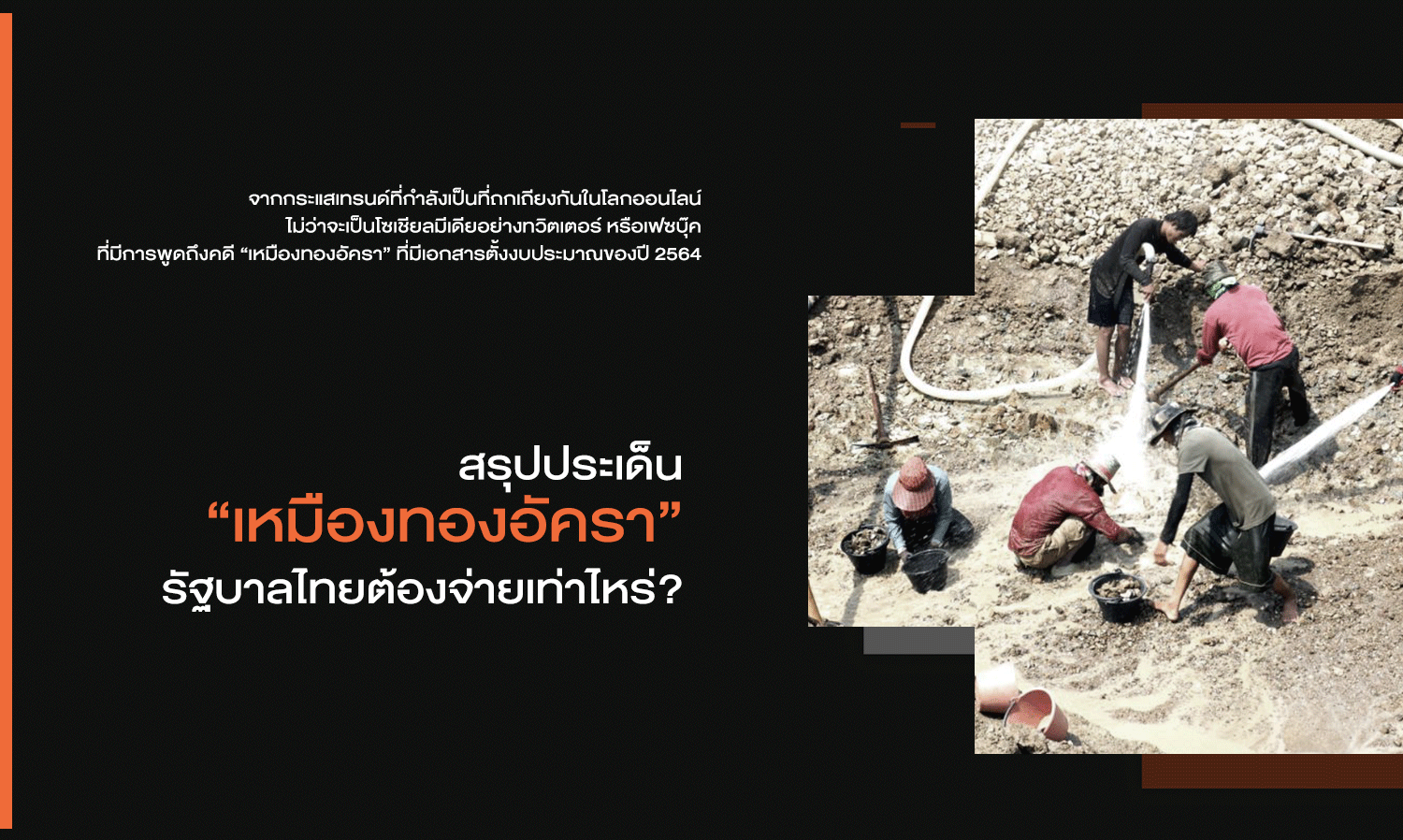
Summary of the 'Akara Gold Mine' Case: How Much Will the Thai Government Have to Pay?
The Akara Gold Mine Case
- Amid the ongoing debate on social media platforms like Twitter and Facebook, the 'Akara Gold Mine' case has come to light, especially after the budget documents for 2021 revealed that the Thai government might have to pay over 30 billion baht to an Australian mining company. This stems from the closure of the Akara gold mine due to a military order in 2016. Today, we will summarize the key points for your understanding.
<\/li> <\/ul>Key Points from the Akara Gold Mine Case
- In 2000, Kingsgate Consolidated Limited from Australia was granted mining rights for gold in the areas bordering Phichit, Phitsanulok, and Phetchabun provinces, covering 5 plots of land totaling 1,259 rai, with operations conducted by Akara Mining Limited (a subsidiary of Kingsgate).
<\/li> - Seven years later (2007), a group of villagers affected by the gold mining operations complained to the government that they could no longer use natural water due to heavy metal contamination, resulting in widespread illness in the community.
<\/li> - In 2008, the government conducted an inspection, during which Akara Mining was granted additional mining rights for the Chatree gold mine in Phichit province, covering 9 plots totaling 2,446 rai, with a concession lasting 20 years.
<\/li> - In 2014, blood tests of villagers living near the gold mine revealed elevated levels of manganese and cyanide beyond the standard limits.
<\/li> - In 2015, the Department of Primary Industries and Mines (DPIM) conducted random health checks on villagers and found heavy metals in their bodies, leading to a 30-day suspension order for Akara Mining. The company then made improvements regarding heavy metal discharge. Subsequently, DPIM hired Bear DoBear International, a gold mine assessment expert, to inspect the Chatree mine, but no cyanide leaks were found.
<\/li> - Conflict arose in the area, with groups of villagers both supporting and opposing the mine, until December 14, 2016, when the National Council for Peace and Order (NCPO) issued order 72/2016, mandating the suspension of gold mining operations starting January 1, 2017, using Section 44 to resolve the conflict.
<\/li> <\/ul>What Happened After the Suspension of Mining Operations?
- Following the suspension, Akara Mining laid off all 715 employees and officially ceased operations on January 1, 2017.
<\/li> - However, over 5,000 affected employees and villagers submitted a letter to the Prime Minister stating that the mine's existence did not cause any adverse effects.
<\/li> - By November 5, 2017, Kingsgate entered arbitration proceedings against the Kingdom of Thailand, seeking compensation of $750 million or 22.67 billion baht due to the mine's closure, which they claimed violated the Thailand-Australia Free Trade Agreement (TAFTA).
<\/li> - In March 2019, rumors circulated that the Thai government was willing to pay to resolve this case, but the legal proceedings have continued to drag on. Most recently, on August 27, 2020, budget documents for 2021 indicated expenses for resolving the dispute between the Kingdom of Thailand and Kingsgate Consolidated Limited amounting to over 111 million baht.
<\/li> - The investigation process for this gold mine case is set to begin on November 18, 2020. Therefore, those following this news should anticipate a conclusion in the next 3-5 months.
<\/li> <\/ul>SOURCE: accesstrade.in.th<\/p>
- Following the suspension, Akara Mining laid off all 715 employees and officially ceased operations on January 1, 2017.
- In 2000, Kingsgate Consolidated Limited from Australia was granted mining rights for gold in the areas bordering Phichit, Phitsanulok, and Phetchabun provinces, covering 5 plots of land totaling 1,259 rai, with operations conducted by Akara Mining Limited (a subsidiary of Kingsgate).
Discussion
Follow breaking news Investment property articles on Facebook, click here.