Decoding 'Thai Purchasing Power': No Signs of Recovery
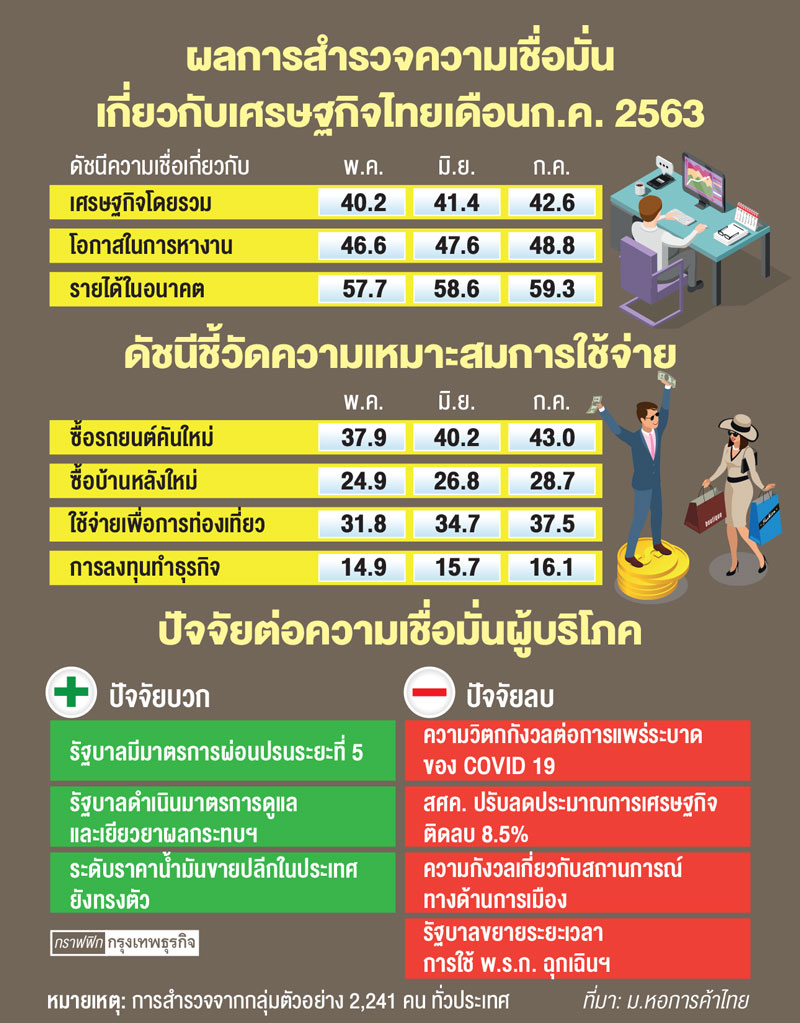
The University of the Thai Chamber of Commerce, through its Economic and Business Forecasting Center, conducted a survey on the Consumer Confidence Index for July. The survey sampled 2,241 people nationwide, revealing that 60.7% of respondents expressed negative confidence regarding the Thai economy.
"Index" serves as a measure of various situations, and the "Consumer Confidence Index" is another important economic indicator. The University of the Thai Chamber of Commerce found that in July 2020, the overall Consumer Confidence Index showed a continuous increase for the third consecutive month after the government relaxed restrictions allowing businesses to reopen in phases 1 to 5 from May to July.
Additionally, the government implemented measures to support and alleviate the impacts of the COVID-19 situation, including financial and fiscal measures to assist the general public and businesses. However, consumers remain highly concerned about the economic situation and future unemployment due to the negative impacts of COVID-19.
The various confidence indices include the overall economy, which stood at 42.6 in July, up from 41.4 in June; the job opportunity index at 48.4, up from 47.6; and the future income index at 59.3, up from 58.6.
The improvement in all consumer confidence indices this month resulted in the Consumer Confidence Index (CCI) rising for the third consecutive month, increasing from 49.2 to 50.1.
Therefore, it is expected that consumers will continue to delay spending until at least the fourth quarter of 2023, until the COVID situation eases and economic and business activities can resume widely, along with the government implementing clear economic stimulus measures to revive the economy post-COVID and restore consumer confidence.
Thanawat Phonvichai, President of the University of the Thai Chamber of Commerce and Chairman of the Economic and Business Forecasting Center, stated that the consumer confidence index remains at historically low levels since the survey began 21 years and 10 months ago, starting from October 1998, which is lower than during the Tom Yum Kung crisis.
"The consumer confidence index has improved for three consecutive months, indicating that the Thai economy has passed its lowest point in the second quarter, but it is still not better than before COVID-19, and the situation returning to normal is still far off. Despite the improvements, consumers are expected to continue delaying spending until the fourth quarter due to concerns about whether their income will increase and whether the economy will truly recover."
Although the Thai economy has passed its lowest point, as evidenced by the rising consumer confidence index and inflation rates, the high cost of living resulting from the economic slowdown means that people do not have enough money to purchase goods or spend, which is a risk factor causing consumers to delay spending, including postponing home and car purchases, impacting the automotive and construction industries.
Additionally, a significant risk factor is the index of opinions regarding the political situation, which has been declining for over a year, both in the present and future, as the public is concerned about the political situation, especially regarding cabinet reshuffles and whether they will stabilize the political landscape, even if it involves adjustments within the ruling party. The key issue is the coordination of work within the coalition parties and their stance towards the government.
Political protests by various groups are currently ongoing, particularly among students, and with the new semester starting next week, it is believed that political activities will increase, further raising consumer concerns about the political situation combined with the COVID-19 situation. It has been noted that next week, students from the University of the Thai Chamber of Commerce will also participate in political protests, and I have emphasized that these gatherings must remain within legal frameworks and adhere to social distancing measures.
Concerns regarding economic factors continue to persist, including worries about global trade wars, as tensions between the United States and China have reignited, which may add pressure to the recovery of the global economy and could negatively impact Thai exports and the economy in the future.
The SET Index in July decreased by 10.5 points, and the Thai baht slightly weakened from 31.15 baht per dollar.
Furthermore, the forecasting center conducted a survey on public attitudes and behaviors regarding Mother's Day, which reflects the financial health of the general public. From a sample of 1,324 respondents, it was found that spending amounted to 9.984 billion baht, a decrease of 28%, marking the first time in 12 years that spending fell below 10 billion baht. This decline is attributed to reduced consumer spending due to the poor economy, the COVID-19 outbreak leading to insufficient income to cover expenses, debt burdens, and job security, particularly regarding employment. There has been an increase in borrowing from informal sources, especially pawn shops and loans from relatives.
SOURCE : www.bangkokbiznews.com