Decoding Foreign Exit from Thai Stocks: Experts Cite Political Instability and Government Policies as Investment Deterrents
Analysts dissect the reasons behind the continuous selling of Thai stocks by foreign investors, revealing a net outflow exceeding 800 billion baht over the past eight years, with over 220 billion baht sold this year alone. They attribute this trend to the "political and economic policy" instability that hampers investment decisions.
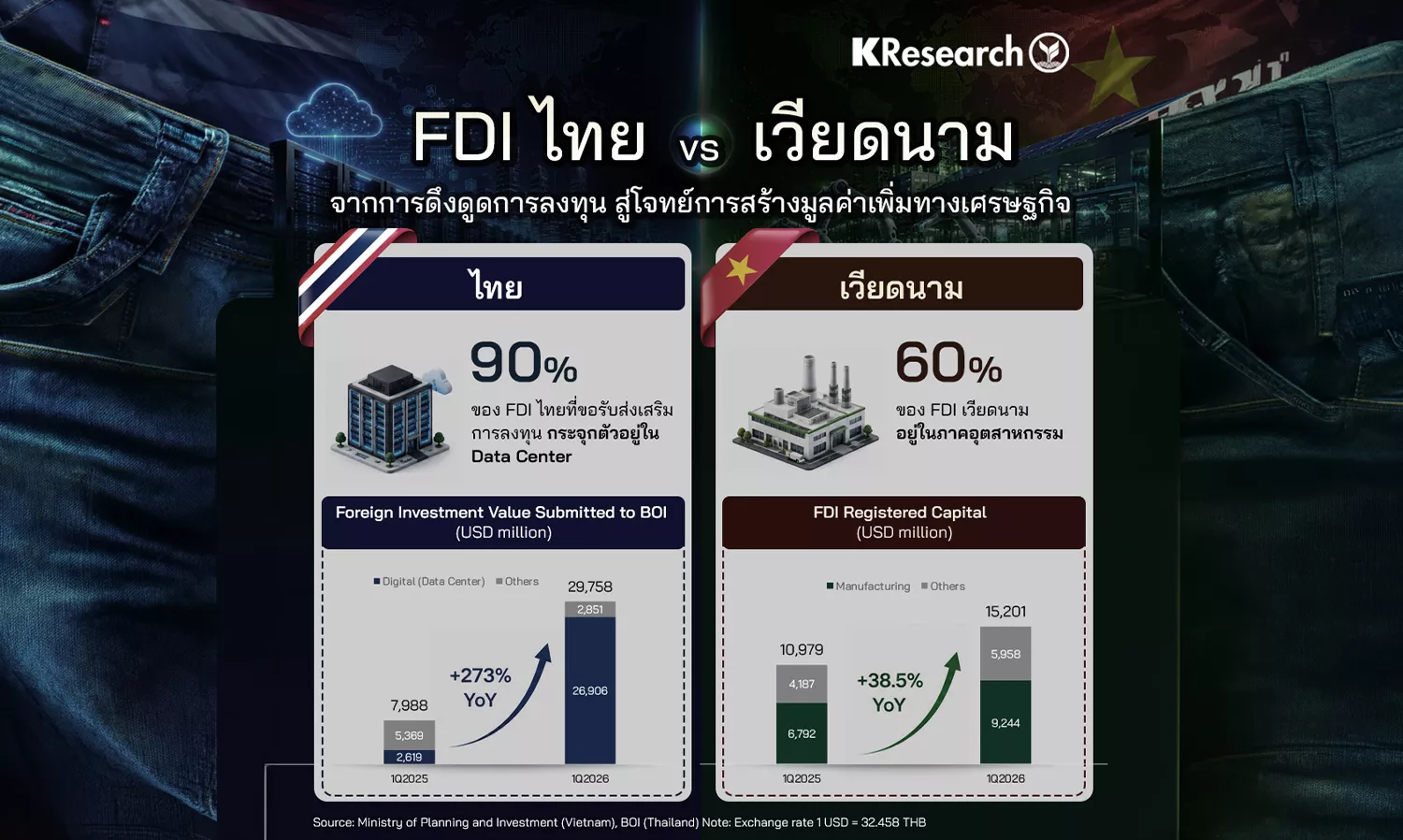
KKP Research from Kiatnakin Phatra Financial Group has analyzed the factors leading to foreign investors consistently being net sellers in the Thai stock market since 2013, totaling over 800 billion baht. Furthermore, there has been a gradual decline in foreign direct investment (FDI) in Thailand compared to ASEAN countries, dropping from a 44% share in 2006-2010 to just 14% today.
In 2020, foreign investors continued to sell a net 220 billion baht in the Thai stock market, following panic in the market due to the COVID-19 pandemic. The ongoing sell-off by foreign investors caused the SET index to plummet by as much as 30% in March. Although the market has improved from its lowest point, foreign investors have continued to sell net every week.
A key reason for the ongoing sell-off by foreign investors, in contrast to Thai investors, is that Thailand appears less favorable compared to other nearby countries.
KKP Research believes that the lack of political stability and economic policy uncertainty creates an unpredictable economic direction, deterring investment decisions and resulting in low investment levels in the country. This is particularly evident in policies that do not promote fair and free competition, as well as state investment models that do not encourage private investment.
While foreign investors have global investment options, Thai investors predominantly keep their capital within the country due to limitations on overseas investments and a lack of understanding of other markets. Additionally, Thai citizens primarily spend in baht, leading them to prefer domestic assets.
Interestingly, statistics show that each time uncertainty in the country rises, whether from economic policies or political issues, the Thai stock market index tends to decline. On average, when uncertainty spikes (as indicated by relevant metrics), foreign investors sell approximately 8 billion baht worth of Thai stocks within ten days.
Looking back at the growth trend of the Thai stock market, based on the MSCI Thailand Index compared to other countries, it is evident that the Thai stock index has barely grown over the past seven years, remaining at the same level as in 2013. In contrast, the MSCI index for the United States has grown over 100%, and the overall Asian index has increased by more than 50%.
These factors not only pressure the returns of the Thai stock market but also signal that Thailand is facing economic challenges that could lead to persistently low economic returns in the future, or even permanently.
Meanwhile, Thailand's economic growth rate has consistently declined, from an average of 7% before the 1997 financial crisis to about 5% from 1999 to 2012, and only 3% over the past seven years. When considering the well-being of the population, often measured by GDP per capita, Thailand has developed much slower than other countries. For instance, China has seen a remarkable leap in GDP per capita from $959 twenty years ago, lower than Thailand's $2,007, to $10,261 today, while Thailand's figure stands at $7,808.
The decline in Thailand's economic potential is a result of persistently low domestic investment, with the investment-to-GDP ratio at only 20-25%, below the average of 30.5% for similarly developed countries.
When examining individual companies using financial data from the Thai stock market, a similar picture emerges: Thai companies have been continuously reducing their investments, reflected in capital expenditure figures that have dropped from an average annual growth of 16% between 2004 and 2008 to just 1.6%. The sectors that have significantly cut back on investment include energy, construction, transportation, IT, distribution centers, electronics, and automotive parts, with only the tourism-related sector maintaining growth levels.
According to Mr. Nattachat Mekmasin, Assistant Managing Director of Securities Analysis at Trinity Securities, the ongoing selling by foreign investors is partly due to strategic shareholders, such as GIC, reducing their investment portfolios in Thailand, leading to a rapid decrease in foreign ownership. Additionally, there is selling pressure from large funds.
A significant reason for the continued selling is that the valuation of Thai listed companies is not appealing, especially compared to similar countries, due to relatively low profit growth. Furthermore, the unstable political climate and unattractive policies and incentives have led foreign investors to overlook Thailand.
"The outflow of foreign investment does not only affect the stock market; direct investment is also impacted. We may see foreign companies requesting rights but ultimately not investing. When considering several large active funds, it can be said that they have excluded Thailand from their investment options," he stated.
For foreign investment to flow back continuously, the first step is for the profits of listed companies to start growing again, which is a significant issue as the IMF currently forecasts slow economic growth for Thailand.
Moreover, a critical issue in the structure of the Thai stock market is the heavy weighting of old economy businesses, which have a substantial share and are growing slowly. In contrast, new economy businesses still lack the weight and liquidity necessary for foreign investment to flow in.
SOURCE: www.bangkokbiznews.com