The Great Lockdown and the Countdown of Remaining Lease Rights for Property Funds and REITs
<\/em><\/strong>The Great Lockdown <\/strong><\/span> refers to the significant lockdowns imposed by governments worldwide to curb the spread of Covid-19. As a result of these efforts, the global number of infections has surpassed 10 million within less than six months since the outbreak began in Wuhan. Furthermore, the pandemic is still ongoing in many countries, with risks of a second wave in places like China and South Korea. The IMF predicts that the global economy will be severely impacted, comparable to the Great Depression<\/strong> nearly 100 years ago, when the economy plummeted and unemployment rates rose from 3% to 25% over five years from 1929 to 1933.
 <\/p>
<\/p>
In terms of tenant businesses and the leasing of properties by Property Funds<\/strong> and REITs<\/strong>, the impacts are unavoidable due to the emergency measures aimed at reducing the spread of Covid-19, which have disrupted business operations and will inevitably affect the economy in the future. This is reflected in the following:
- The Thai and global economies in 2020 are projected to slow down, with the Monetary Policy Committee (MPC) and the IMF estimating declines of 8.1% and 4.9%, respectively (according to estimates from June 2020 2 3<\/sup>).
- Debt restructuring requests have reached 15 million during the outbreak, leading to a short-term decline in consumer spending and tourism in Thailand, as people still need to repay existing debts and spend cautiously, even as the outbreak in Thailand shows signs of easing.
- New investments or business expansions by companies and tenants will remain limited during this period of high economic uncertainty due to the impacts of Covid-19, as reflected in the Business Sentiment Index, which has dropped to 32.6, the lowest since the index was established in 1999 2<\/sup>. <\/ul>
Therefore, the overall economy and business landscape may worsen for some time, although the impact may vary for different types of tenant businesses and property types. If the investments of Property Funds and REITs are in freehold properties, even if the economy takes years to recover, the properties will still have an indefinite lifespan for leasing to generate income for the fund and unit holders, and they can be sold more easily.
<\/p>However, if Property Funds and REITs invest in leasehold interests with limited ownership duration, there is a possibility that the fund may not be able to benefit from the remaining lease rights for long if the recovery to normalcy takes as long as the Great Depression, which took years to recover. Although we can expect a Covid-19 vaccine to be discovered around mid to late 2021, which could help businesses return to normal in the following period.
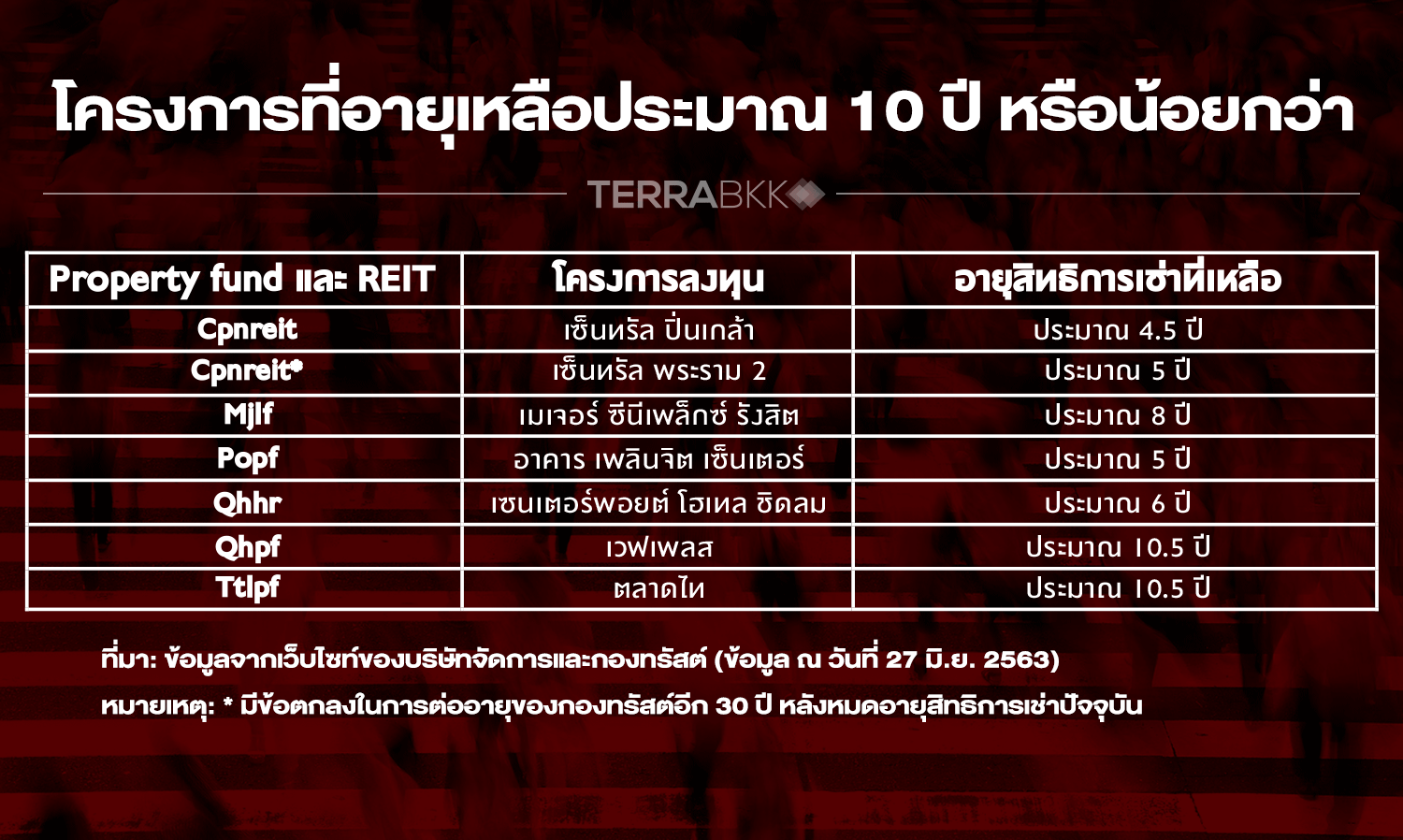
Investors in Property Funds and REITs with properties nearing the end of their lease terms must remember that once the lease expires, the fund will have a net asset value (NAV) of zero. In the industry, there are projects with about 10 years or less remaining on their leases, as follows:
 <\/p>
<\/p>
Nevertheless, investors should not forget that each fund may have multiple investment assets, and the average remaining lease term of the fund may be longer than that of some individual assets nearing lease expiration. Analyzing the remaining lease terms of the fund is just one factor that investors should consider when investing in Property Funds and REITs; they should conduct further research before making investment decisions.
1<\/sup>Source: Economic History Association (2008). Economic Recovery in the Great Depression<\/em>. <\/p>