Confronting 6 Deceptive Spirits: Connecting to End Corruption in Thai Society
Understanding the concept of "deceptive spirits" comes from the knowledge management and public communication team at TDRI, drawing lessons from an interview with Assistant Professor Dr. Thanee Chaiwat, Director of the Economic Research Center and the Center for Behavioral and Experimental Economics (CBEE) at Chulalongkorn University. This was discussed in the book "The Corruption Equation: Solving the Addition, Subtraction, Multiplication, and Division in Thai Society," where Assistant Professor Dr. Thanee Chaiwat shared the following insights:
“Behavioral economics includes a theory called Self-Concept Theory, which suggests that each person has an internal standard of goodness. If someone behaves poorly, they will feel guilty and try to compensate by doing good. Conversely, if they do a lot of good, they might feel that a little wrongdoing is acceptable. Each individual has a different standard of goodness.”
“The thought process of individuals involves something called Self-Concept Maintenance. Whenever someone does better or worse than usual, they will have a process to maintain their feelings about their own standard of goodness. For example, when you decide to cheat, your thought process will work to maintain the balance of your own goodness standard. This process occurs in two phases: what you think before cheating and what you think after cheating.”
“Before cheating, there are three factors that make it easier for someone to decide to cheat. The first is Ambiguity, where unclear rules make people feel less guilty about cheating. For instance, if regulations state that travel expenses can be claimed as appropriate without clear criteria, you might claim a high-priced hotel because you feel it suits you, and you won't feel guilty due to the ambiguity of what is right or wrong.”
“The second factor is Self-Serving, meaning when someone wants to cheat, they might think it’s just a small cheat or that it doesn’t harm anyone. For example, if you accept a bribe from a large company that you believe is already making a lot of profit, you might think it’s okay, or when cheating on a budget funded by taxes, you might feel it doesn’t affect anyone negatively, thus reducing your guilt.”
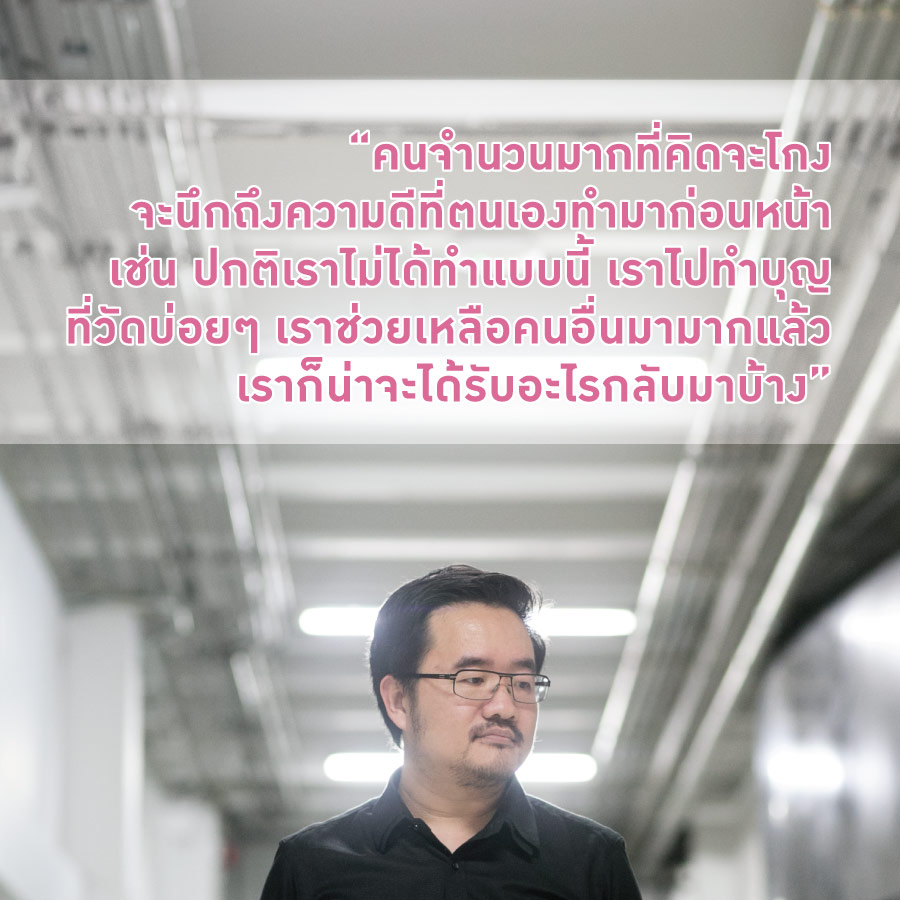
“The third factor is Moral Licensing, which is very evident among Thais. For instance, many people who consider cheating recall the good deeds they have done previously. They might think, 'I usually don’t do this; I often donate at temples and help others, so I deserve something in return.' This past goodness gives them a sort of license to do wrong.”
“After cheating, individuals can maintain their Self-Concept in three ways. The first is called Moral Cleansing, which is about washing away the bad feelings from your mind. This is similar to Moral Licensing; after cheating, you might try to wash away the bad feelings by doing something good, like donating money or helping others. The act of charity is thus meant to cleanse or compensate for the guilt (of course, the donation must be of lesser value than what was cheated).”
“The second method is Confession. When you confess, your feelings return to normal. If you make another mistake, you confess again. This is often discussed in the West.”
“The third method is Distancing, where one feels that everyone does it, so what they did isn’t different from what others do. Thinking this way can bring comfort, even after committing a wrongdoing.”
“In summary, in behavioral economics, individuals have a certain level of Self-Concept, although this level varies among people. Psychologically, a person’s Self-Concept forms before the age of 7, depending on how they were taught at home.”
“For example, if you ask what Thais fear, they might say they fear the police, lizards, geckos, and ghosts because as children, parents warned them not to cry, saying the police would come and catch them, or that lizards and geckos would eat their liver, or that ghosts would haunt them.”
This connects to the accumulation or importance of virtues in the minds of people in Thai society, as it relates to childhood teachings. A survey of values once asked what the three most important virtues parents would teach their children are. For Thai parents, these three important teachings are: first, to be grateful; second, to study hard and achieve high education; and third, to obey elders.”
“In contrast, Scandinavian countries emphasize three key values they teach their children: first, to respect public rights; second, to respect others and listen to their opinions; and third, to care for the community they live in. Clearly, what Thai society teaches is more family-oriented rather than public-oriented.”
“When Thais teach their children this way, Thai society values family members above all. This strong emphasis on family leads us to do everything possible to ensure our family members survive, even if they do wrong. This implies that our trust is primarily reserved for this group, while those outside this circle, whom we do not know, are excluded from our lives. With this mindset, we contribute to the persistence of corruption within our networks.”
Additionally, the book "The Corruption Equation: Solving the Addition, Subtraction, Multiplication, and Division in Thai Society" incorporates the corruption framework of Professor Robert Klitgaard, an American economist, to understand the corruption issues within the context of Thai society, while inviting discussions on sustainable solutions to combat corruption in Thailand through interviews with scholars, journalists, and social activists.
SOURCE: www.tdri.or.th