Finance Ministry Accelerates 3 Measures to Mitigate the Impact of Coronavirus, Phase 1
The COVID-19 pandemic is spreading globally, with a continuous rise in the number of infections, significantly impacting the Thai economy both directly and indirectly. The service sector, particularly tourism, which accounts for 12% of GDP, has been hit hard. In February 2020, the number of Chinese tourists plummeted by over 85%, and overall tourist numbers decreased by 44%, leading to a sudden downturn in the tourism business. Subsequently, the impact extended to the industrial sector, disrupting production and international shipping chains, halting international trade. Ultimately, businesses faced revenue losses, insufficient liquidity, and risks of closure, while the general public faced income loss and the threat of mass layoffs.

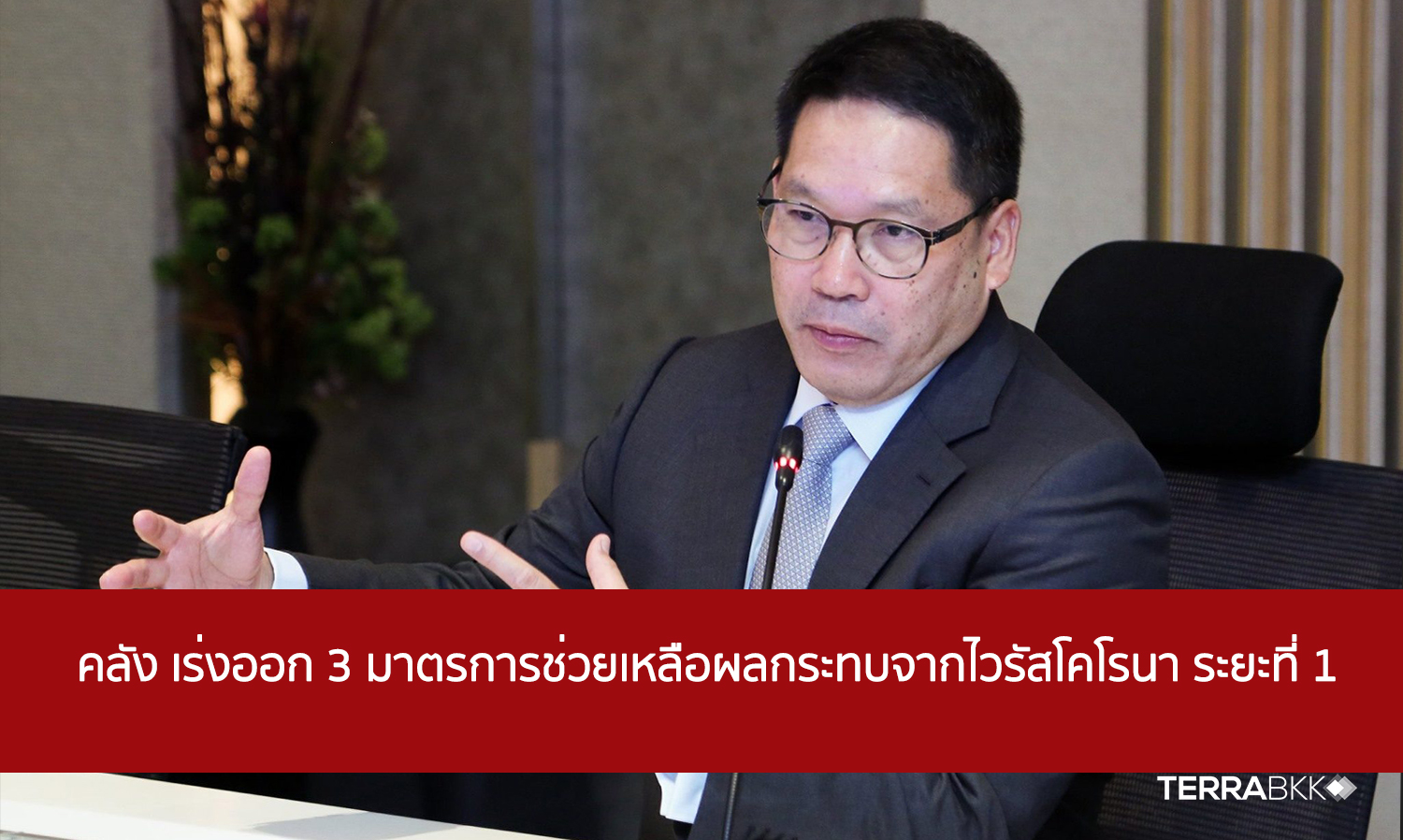
Finance Minister Uttama Savanayana stated that the Ministry of Finance is responsible for overseeing the overall Thai economy and recognizes the risks to it. Therefore, it is necessary to implement measures to support and reduce economic risks promptly. The Ministry proposed measures to assist and remedy the impacts on both businesses and the public, adhering to the principles of "timeliness, targeting, and temporary necessity" to alleviate the impact and enhance liquidity for businesses, as well as to ease the financial burden on the public. On March 10, 2020, the Cabinet approved the measures to address and remedy the impacts of the coronavirus on the Thai economy, both directly and indirectly, Phase 1, as proposed by the Ministry of Finance, with the following details:

1. Financial Measures consist of 4 measures as follows:
1.1 Low-interest loan measures to assist businesses affected both directly and indirectly by the COVID-19 outbreak through the Government Savings Bank, which supports low-interest funding totaling 150 billion baht to financial institutions at an interest rate of 0.01% per annum. Financial institutions will provide loans to businesses at an interest rate of 2% per annum for a period of 2 years, with a maximum loan amount of 20 million baht per business.
1.2 Measures to suspend principal payments, reduce interest rates, and extend repayment periods for debtors affected by COVID-19 from specialized financial institutions (SFIs). SFIs have financial measures to assist those affected by the COVID-19 outbreak by relaxing debt repayment conditions and various guarantee conditions, such as suspending principal payments, reducing loan interest rates, extending repayment periods, and easing conditions for insurance payouts. Additionally, some SFIs have additional loan measures to enhance liquidity, including a low-interest credit card debt refinancing program.
1.3 Measures to assist debtors affected by situations impacting the Thai economy as the Bank of Thailand (BoT) has issued guidelines to assist debtors affected by situations impacting the Thai economy, enabling financial institutions and subsidiaries of specialized financial institutions, as well as businesses providing non-financial institution loans, to proactively assist debtors in a timely manner, such as relaxing normal credit classification criteria and increasing flexibility in loan approvals to ensure debtors have sufficient liquidity to continue their businesses or daily lives.
1.4 Employment promotion loan measures from the Social Security Office in collaboration with financial institutions to support low-interest loans totaling 30 billion baht for businesses registered with social security and contributing to the social security fund for at least 3 months, maintaining at least 80% of their insured employees as of the loan approval date for a period of 3 years to help businesses continue employing workers during the current economic conditions.

2. Tax Measures consist of 4 measures as follows:
2.1 Measures to restore liquidity for domestic businesses by reducing the withholding tax rate from 3% to 1.5% for income payments from April 1, 2020, to September 30, 2020, and reducing it to 2% for income payments under specified conditions from October 1, 2020, to December 31, 2021, paid through the electronic withholding tax system (e-Withholding Tax).
2.2 Measures to reduce interest payment burdens for businesses whereby small and medium-sized enterprises (SMEs) participating in low-interest loan measures to assist businesses affected by COVID-19 and maintaining single accounting can deduct 1.5 times the expenses for interest incurred between April 1, 2020, and December 31, 2020.
2.3 Measures to promote employment stability during the COVID-19 outbreak allowing SMEs to deduct 3 times the expenses paid as wages from April 2020 to July 2020 for employees insured under the Social Security Act, earning no more than 15,000 baht per person per month, provided they maintain employment levels at least equal to the number of insured employees as of the last day of December 2019.
2.4 Measures to expedite VAT refunds for domestic businesses by considering VAT refunds for good exporting businesses, where those filing VAT Form P.P.30 online will receive refunds within 15 days, and those filing at local tax offices will receive refunds within 45 days.
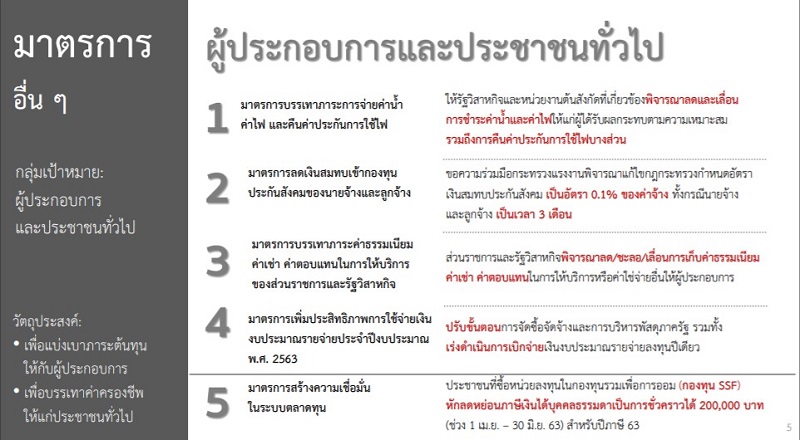
3. Other Assistance Measures consist of 4 measures as follows:
3.1 Measures to alleviate the burden of water and electricity bills by state enterprises, relevant ministries, and regulatory agencies considering ways to reduce and defer payment of water and electricity bills or other appropriate measures, such as partial refunds of electricity usage deposits for those affected by COVID-19.
3.2 Measures to reduce social security fund contributions for employers and employees to reduce the contribution rate to the social security fund for employers and insured persons under Section 33 of the Social Security Act from 5% to 0.1% of wages for 3 months, while the government contribution remains at the original rate of 2.75% of wages, and the contribution amount for insured persons under Section 39 remains the same, to reduce the financial burden on employers and insured persons during the pandemic.
3.3 Measures to alleviate the burden of fees, rents, and service compensation from government agencies and state enterprises by reducing, delaying, or postponing the collection of fees, rents for state property, service compensation, or other expenses to alleviate the burden on businesses affected by COVID-19.
3.4 Measures to enhance the efficiency of annual budget expenditure for the fiscal year 2020 by reducing the time for public consultation on draft terms of reference or specifications and the time for publishing announcements and procurement documents for government procurement and asset management, adjusting to expedite the procurement process, including urging agencies to expedite budget disbursement for single-year investment expenditures for procurement items not exceeding 2 million baht to be completed by May 2020.
3.5 Measures to build confidence in the capital market allowing the general public to deduct the purchase cost of investment units in the Super Savings Fund (SSF) that invests at least 65% of its net asset value in securities listed on the Stock Exchange of Thailand, up to 200,000 baht, separate from the normal SSF investment deduction limit and not subject to the overall retirement fund deduction ceiling, provided purchases are made between April 1, 2020, and June 30, 2020, and held for at least 10 years, with other conditions as per the Director-General of the Revenue Department's announcement.
3.6 Measures to assist those affected by the COVID-19 outbreak by establishing guidelines for government agencies to provide funds for prevention, remedy, and incentives to maintain employment, as well as to develop the capabilities of those affected by COVID-19 specifically and urgently, with a budget of 20 billion baht allocated from the central budget to support these actions.
The Ministry of Finance is confident that the measures to address and remedy the impacts of the coronavirus on the Thai economy, both directly and indirectly, Phase 1, will help alleviate and prevent risks that may arise for the production and related industries, allowing the economy to continue to move forward. The Ministry will closely monitor the situation and is ready to implement appropriate measures to support the Thai economy promptly as circumstances change.

_____________________________________
For more information:
- Financial measures: Call 0 2273 9020 ext. 3235
- Tax measures: Call 0 2273 9020 ext. 3509, 3529, 3512
- Measures to reduce social security fund contributions for employers and employees / Measures to build confidence in the capital market: Call 0 2273 9020 ext. 3643
- Measures to alleviate the burden of fees, rents, service compensation from government agencies and state enterprises / Measures to alleviate the burden of water and electricity bills / Measures to assist those affected by COVID-19: Call 0 2273 9020 ext. 3558
- Measures to enhance the efficiency of annual budget expenditure for the fiscal year 2020: Call 0 2127 7000 ext. 4588
Source: Ministry of Finance