30 Years of Drought and Flood: Nearly 10 Million People Affected Every Year
In the past five years of the first cabinet under the leadership of General Prayuth Chan-o-cha, as head of the National Council for Peace and Order (NCPO), which took power through a coup to govern the country, it was found that from the cabinet's total budget approval data of 6.32 trillion baht, over 1 trillion baht was allocated for "disasters" and "supporting farmers."
In the first case, counting only the general assistance measures for disaster victims without specifying their occupations, the amount was merely 104 billion baht. In the second case, it cannot be denied that disasters such as floods and droughts primarily impact farmers. Often, the government directly uses measures to assist this group, making it difficult to separate whether the aid is from disaster relief or other causes. Over the past five years, the cabinet allocated more than 927 billion baht to support farmers.
However, looking back, it is interesting to note that "drought and floods" are among the problems that Thai citizens face every year, varying in severity from year to year. These issues are characterized by recurring floods and droughts.
Thai Publica online news has compiled additional disaster data from the Disaster Prevention and Mitigation Department, Ministry of Interior, covering the past 30 years from 1989 to 2018, regarding disaster management in different eras, particularly focusing on the main disasters of "drought" and "floods" that occur annually. This includes examining the costs in various dimensions and reflecting on the development or sustainable solutions to these problems.
“Drought” Affects 9.7 Million People – Agricultural Area of 2.57 Million Rai
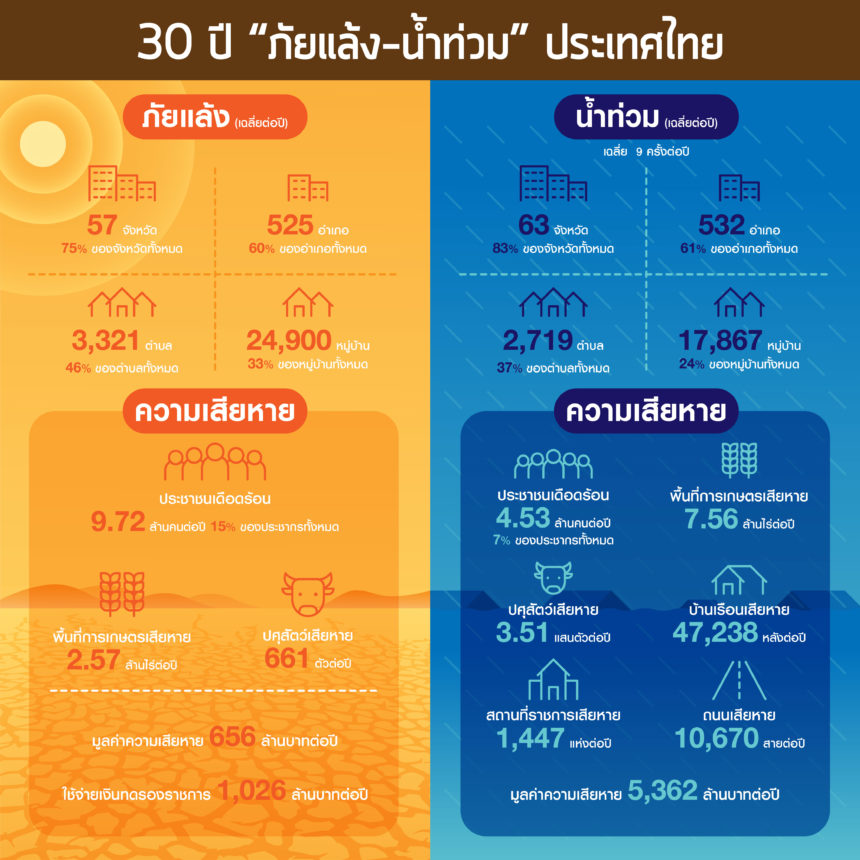
Starting with data on "drought," it was found that over the past 30 years, on average, 57 provinces (or 75% of all provinces), 525 districts (or 60% of all districts), 3,321 sub-districts (or 46% of all sub-districts), and 24,900 villages (or 33% of all villages) have experienced drought.
In terms of damage, an average of about 9.71 million people are affected by drought each year, or about 15% of the total population. Agricultural areas suffer damage of 2.571 million rai per year, with an average loss of 661 livestock, resulting in a total damage value of 656.62 million baht annually. Finally, in terms of assistance, 1,253 water trucks, 2,858 water pumps, and 950 million liters of drinking water are distributed, with an average annual government expenditure of 1,026 million baht (starting from 2002).
Looking at the changes in drought over the past 30 years, on average every five years, it was found that the areas affected by drought remained stable throughout the first 25 years from 1989 to 2013. However, in the last five years from 2014 to 2018, the areas affected at the village level significantly decreased to about half of the previous period, corresponding with a substantial reduction in the number of affected people. This may partly be due to natural cycles, as 2017 saw relatively few drought occurrences, and there was no reported drought in 2018, although news of drought was still present. This may indicate improved water management by the responsible agencies.
“Floods” Affect 4.5 Million People – Agricultural Area of 7.5 Million Rai and Thousands of Houses
For "floods," it was found that over the past 30 years, there have been an average of 9 flooding events per year, affecting 63 provinces (83% of all provinces), 532 districts (61% of all districts), 2,719 sub-districts (37% of all sub-districts), and 17,867 villages (24% of all villages), impacting an average of 4.5 million people annually, or about 7% of the total population.
In terms of property damage, approximately 45,482 houses are damaged each year, along with about 100 hotels, apartments, factories, and rice mills, 50,000 fish/shrimp ponds, and 350,000 livestock annually, with agricultural areas suffering damage of 7.56 million rai, totaling 5,361 million baht in damages. Additionally, in terms of infrastructure damage, about 10,670 roads, 826 bridges, 1,441 dams, weirs, and mines, 1,447 temples, schools, and government buildings, and 1,512 drainage systems require repairs each year.
Similar to drought, changes in flooding over the past 30 years show a clear reduction in recent years. In the last 10 years, the number of flooding events has decreased from about 10-11 times per year in the first 20 years to only 5 times per year. However, the number of villages affected has not decreased significantly, with about 10,000-19,000 villages experiencing flooding, except during 2009-2013 when the number of affected villages increased to 36,000 due to severe flooding during that period, with the number of affected people remaining stable at 2-4 million annually.
Moreover, another interesting aspect of flooding is the damage beyond agricultural areas, which is greater than that from drought and has not decreased significantly in recent years, including houses, buildings, and roads, reflecting the urgency and need for better management.
However, assessing the progress of water management, whether for drought or flooding, by the government over the past 30 years may require more detailed local data. In future reports, data will be drawn at the village level to illustrate the recurring disaster experiences in various areas of Thailand and raise questions about effective management for the future.
SOURCE: www.thaipublica.org