EIC Reveals Relaxation of LTV Regulations Stimulates Limited Housing Market, with Low-rise Homes Benefiting More than Condominiums
Following the Bank of Thailand (BoT) relaxing the Loan-to-Value (LTV) criteria for homebuyers in three main categories: 1. First contracts priced up to 10 million baht, 2. First contracts priced over 10 million baht, and 3. Second contracts priced up to 10 million baht, effective from January 20, 2020, the criteria for calculating risk for first home loans has also been relaxed.
According to an analysis from the Economic Intelligence Center (EIC) of Siam Commercial Bank, the primary beneficiaries of the BoT's relaxed criteria are first-time homebuyers. This relaxation enhances purchasing power through two key points: 1. The ceiling for loan amounts has increased, covering loans for furniture and home decoration, and 2. The cost for commercial banks has decreased due to reserve requirements, which may be passed on to homebuyers, especially those with low risk. The two main groups expected to benefit are low-rise homes, which will see more positive effects than condominiums, and lower/mid-range homes.
However, the overall positive impact on the housing market remains limited due to four key issues:
- The adjustment of the LTV ceiling does not significantly affect the second contract homebuyers, who were the main group expanding before the LTV criteria took effect in April 2019.
- Purchasing power from investors and speculators has decreased, which was a primary driver of the housing market's expansion during 2017-2018, as condominium prices have declined, reducing investment attractiveness.
- The purchasing power of both Thai and foreign homebuyers is weak due to the slowing economic conditions domestically and internationally, low confidence levels, high household debt, and a strong baht.
- Financial institutions remain cautious in lending to individual borrowers due to the slowing domestic economy, which may lead to increased household debt defaults. Nevertheless, the housing market will continue to receive support from state financial institutions (SFI) that are expected to play a larger role following last year.
The Bank of Thailand (BoT) has relaxed the Loan-to-Value (LTV) criteria for homebuyers in three main categories: (1) First contracts priced up to 10 million baht, (2) First contracts priced over 10 million baht, and (3) Second contracts priced up to 10 million baht, effective from January 20, 2020. This change aims to support citizens in obtaining loans for actual housing needs more easily, with the details of the relaxation as follows:
- First-time homebuyers with contracts priced up to 10 million baht can borrow an additional 10% of the collateral value to purchase furniture, decorate their homes, or acquire necessities for living, while the LTV ceiling remains at 100%, relaxed from the previous LTV criteria that began in April 2019, where the total loan amount including top-up loans could not exceed 100% of the collateral value.
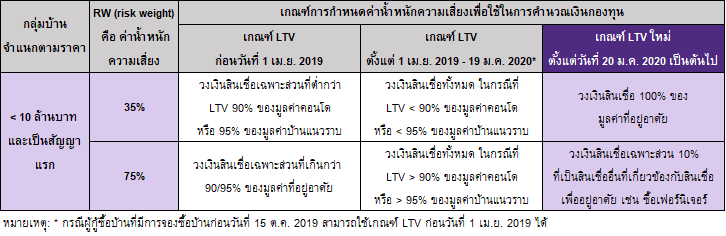
Additionally, the BoT has also relaxed the criteria for calculating risk to determine the capital reserve for first home loans (details in Figure 2). In cases where loans are provided at 100% of the home value, financial institutions will calculate the credit risk asset weight at 35% for first home loans at 100% of the home value, and if a 10% loan is provided for furniture, a weight of 75% will apply only to that 10% portion.
Under the previous criteria, financial institutions had to calculate the risk asset weight for the total loan amount at 75% if they provided loans exceeding 95% of the value of low-rise homes or 90% of the value of condominiums.
- First-time homebuyers with contracts priced over 10 million baht can borrow up to 90% of the housing value or make a minimum down payment of only 10%, reduced from the previous requirement of a 20% down payment.
- Second contract homebuyers with prices below 10 million baht still have a maximum loan amount of 80-90% as before, but the criteria for qualifying for an LTV of 90% for second home purchases have been adjusted from requiring at least 3 years of repayment on the first contract to 2 years.
Figure 1: The LTV criteria for purchasing homes for actual residence have been relaxed to be closer to the previous LTV criteria before April 2019.
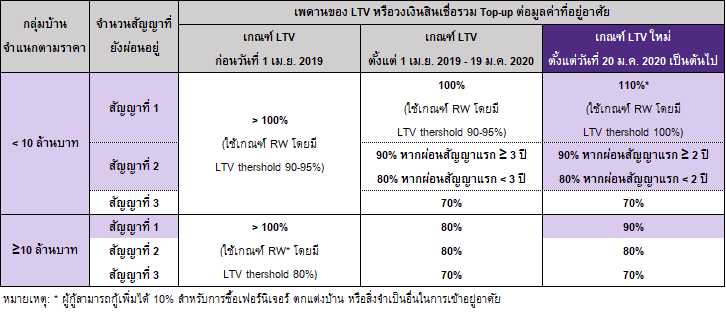
**Other loans related to housing loans (Top-up loans) refer to loans for purposes other than purchasing housing, with the housing serving as collateral, such as for purchasing furniture, etc.
Figure 2: The BoT has relaxed the criteria for calculating risk to determine the capital reserve for first home loans priced up to 10 million baht. baht
The main beneficiaries of the BoT's relaxed criteria are first-time homebuyers, as the relaxation increases their purchasing power through two key points: 1. The ceiling for loan amounts has increased, covering loans for furniture and home decoration, and 2. The cost for commercial banks has decreased due to reserve requirements, which may be passed on to homebuyers.
First Point: The increased loan ceiling for first-time homebuyers allows them to access larger loan amounts, enhancing the purchasing power of consumers in this group, which will positively impact the housing market to some extent, particularly in these two groups:
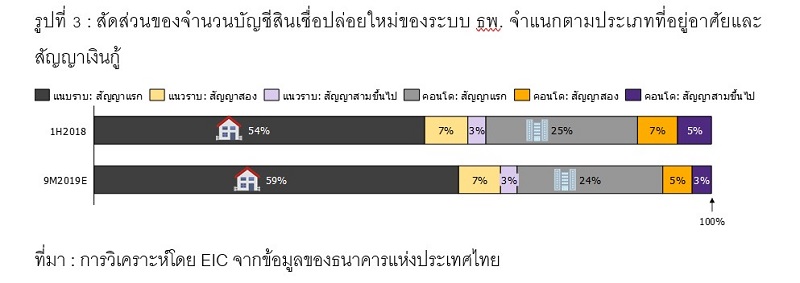
- Low-rise homes since first-time homebuyers predominantly purchase low-rise homes, as reflected in the new loan accounts from the commercial banking system (CB) in two dimensions: (1) First contracts for low-rise homes account for up to 70% of first contracts, with the remainder being condominiums, and (2) Low-rise homes have a first contract proportion of nearly 90%, while condominiums have only 75%.
Figure 3: Proportion of new loan accounts in the CB system categorized by type of housing and loan contracts.
- Lower/mid-range housing as the ceiling for loan amounts for those purchasing homes priced below 10 million baht has been relaxed to levels similar to before the LTV criteria took effect in April 2019, allowing homebuyers to require less money for purchasing furniture, which will encourage consumers to decide to buy homes more easily, especially among lower/mid-range homebuyers with low savings.
Second Point: The relaxation of the criteria for calculating risk to determine the capital reserve for first home loans will help reduce the capital reserve costs for banks, allowing them to pass on the reduced costs to first-time homebuyers, particularly those with low risk. However, for high-risk borrowers, the positive effects of this pass-through may be limited due to increased risk premiums from economic uncertainties.
The overall positive impact on the housing market remains limited, as the demand for housing is unlikely to return to the growth levels seen before the LTV criteria took effect in April 2019 due to four key issues:
- The adjustment of the LTV ceiling does not affect the second contract homebuyers. During 2017-2018 (before the LTV criteria took effect in April 2019), the housing market expanded well, partly due to the high growth of second contract housing, which the BoT views as primarily speculative/investment rather than for actual residence. Data from the BoT shows that more than half of those who purchase two condominium contracts have a gap of less than one year between the first and second contracts, leading the BoT to maintain the LTV ceiling for second home purchases while relaxing only the criteria for qualifying for an LTV of 90% for second home purchases, reducing the gap between the first and second contracts to 2 years from 3 years.
- Purchasing power from investors and speculators has decreased. Historically, the investor group has been a primary driver of housing market expansion, especially during 2017-2018. However, following the establishment of the LTV criteria in April 2019, the trend of housing prices has slowed, particularly for condominiums, which has reduced the attractiveness of the housing market for investment. The EIC estimates that this relaxation may not be sufficient to push condominium prices up, as the majority of beneficiaries are in the low-rise segment rather than condominiums.
- The purchasing power of both Thai and foreign homebuyers is weak. This is due to the slowing economic conditions both domestically and internationally, low confidence levels (as of December 2019, the consumer confidence index regarding new home purchases dropped to its lowest level since data collection began in 2003), high household debt, and a strong baht.
- Financial institutions remain cautious in lending to individual borrowers. The slowing domestic economy may impact the increase in household debt defaults, particularly among those sensitive to income and employment risk factors. This is reflected in the BoT's data on stress tests of Thai households, which found that in 2017, the proportion of households at risk of default (previously without default risk) increased significantly if household income decreased by 20%, with the proportion of at-risk households rising across all income groups.
Additionally, banks must focus on responsible lending practices as recommended by the BoT, particularly considering the residual income of borrowers after paying off all types of debts with their own and other service providers (Residual Income), which may affect lending decisions, especially for low-income groups.
However, the housing market may still receive support from state financial institutions (SFI) that are expected to play a larger role in the housing loan market, continuing from last year, due to government policies aimed at encouraging SFIs to help stimulate the housing market during economic slowdowns, such as low-interest housing loan measures.
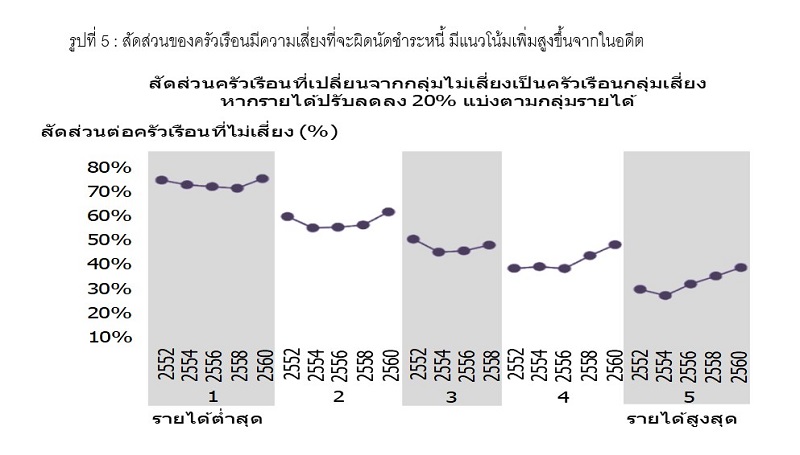
Figure 5: The proportion of households at risk of default has been increasing over time.
**The BoT used data from the household economic and social situation survey from 2009-2017 by the National Statistical Office to study the stress test results of Thai households.