
Economy and Investment in 2020
Article by Dr. Thanapoom Damraks, CFA.
Economy and Investment in 2020
The year 2019 was a period when the Thai stock market yielded relatively low returns (around 1%) compared to global stock markets.
Returns of Stock Markets in Various Countries in 2019
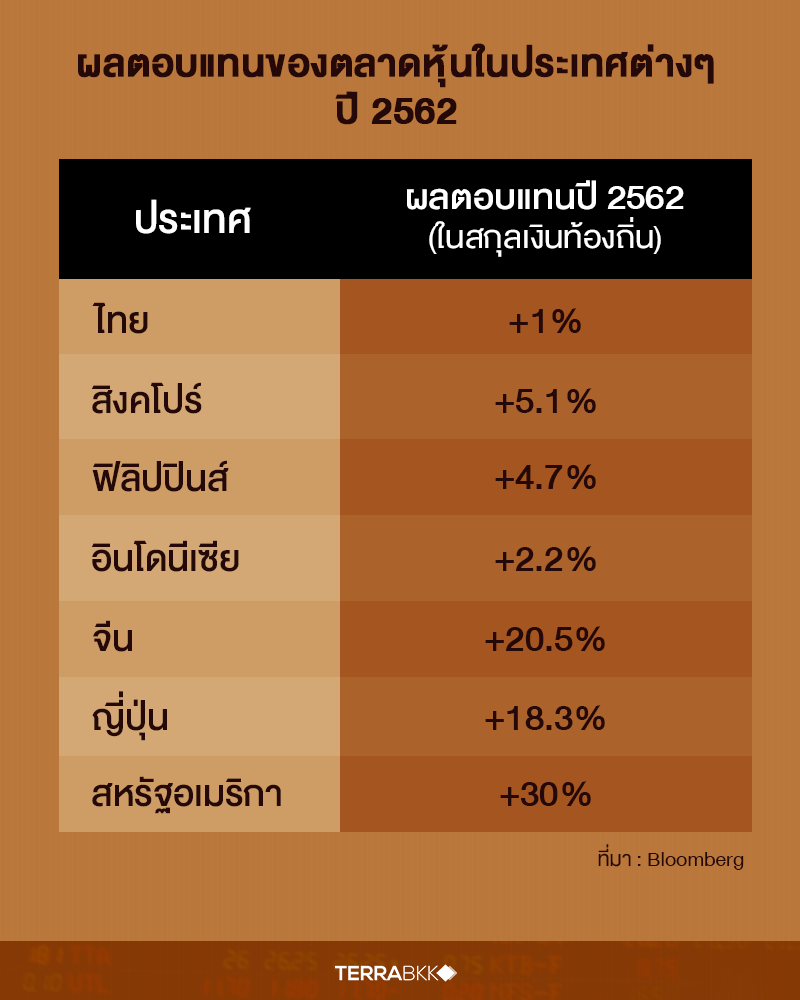
Source: Bloomberg
However, 2019 was also the year when the Thai Baht strengthened by approximately 8.8% compared to the beginning of the year. Therefore, when considering the returns from currency as well, the returns from foreign stock markets may not be as high as they seem, but foreign stock markets (especially in developed countries like Japan, Europe, and America) still provided good returns compared to the Thai stock market, despite the overall economy not experiencing significant growth. This may be due to the increase in money supply in the system and historically low interest rates (negative rates in Europe and Japan), leading to exceptional liquidity that needs to find a place in various assets.
GDP Growth Rate in 2019
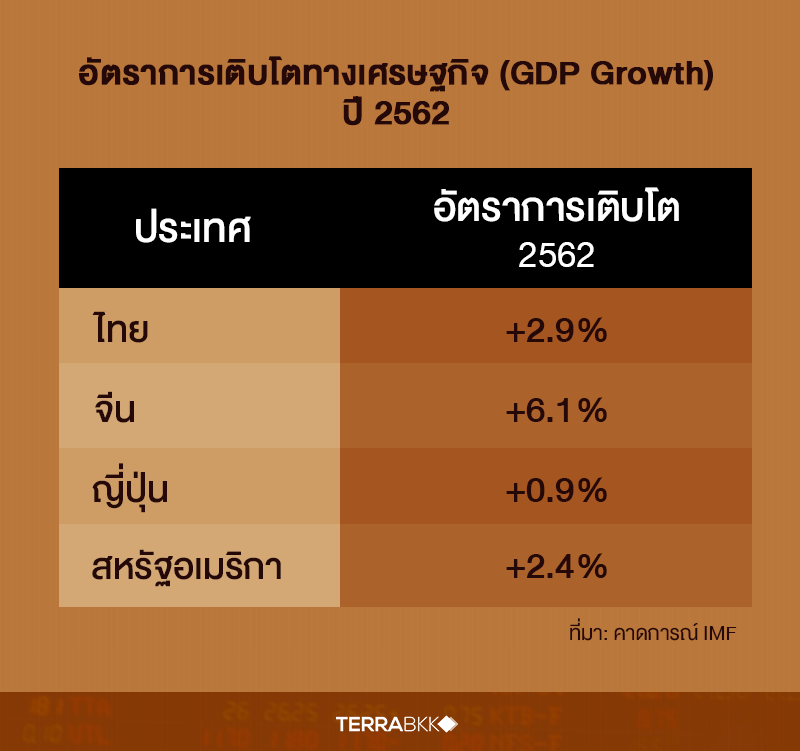
Source: IMF Forecast
These circumstances make investment in 2020 particularly challenging, as many asset types have seen significant price increases over the past few years, making investment riskier. However, keeping cash would yield low long-term returns.
This article will analyze the economic direction in 2020 and the following years, along with investment opportunities in various assets.
The first issue is how long the low interest rates in developed countries, including Thailand, will persist, and what factors might lead to a shift in direction and an increase in interest rates. Currently, if we were the central banks of various countries, we might have limited options. Raising interest rates or withdrawing liquidity from the system could risk causing an economic recession, especially since the economy has not been growing much despite significant monetary stimulus. Reducing liquidity could lead to a potential economic crisis. Imagine if we had a debt of 100 Baht and an interest rate of 1%, or 1 Baht per year. If the interest rate rises by just 1% to 2%, the interest burden would immediately double. For someone with a regular job or a business that must pay significantly higher interest, it may become impossible to meet those obligations, leading to defaults. Defaults would impact the banking system and ultimately lead to an economic crisis, which no central bank or government leader wants to initiate an economic crisis.
If interest rates remain low and liquidity continues to flood the system, there is a risk of asset prices becoming overvalued and a potential collapse of risky asset prices in the future. The low-interest policy has been implemented (and continues to be used) in Japan for several decades and has proven that it cannot stimulate the economy back to growth.
However, interest rates cannot remain low indefinitely. Factors that could lead to a shift in direction and an increase in interest rates include rising inflation, which would necessitate higher interest rates, or if the capital market perceives that a country is at risk of defaulting on its debt or that its currency is rapidly depreciating (as seen in Venezuela, for example). These adjustments may not happen suddenly but could occur gradually over time, or they might happen in a short period. However, it is highly likely that interest rates will eventually need to rise.
In the case of currency depreciation and rising interest rates, investors holding bonds will be most affected by negative returns (rising interest rates lead to negative bond returns) and the principal value decreasing due to depreciation. Therefore, all types of long-term bonds carry risk in the current situation, and investors should avoid them.
In the stock market, the current high valuation also has the potential to decline if interest rates rise. However, company profits are likely to increase if the currency depreciates (strong companies can raise prices), and good companies may expand their operations, leading to profit growth. Therefore, stocks can still be a viable investment if strong companies are selected and valued reasonably.
Gold has proven to maintain its value over a historical period of more than 5,000 years (for example, we can use 1 ounce of gold, currently valued at about $1,550, to buy a high-quality suit, just as we could in Roman times). Investors concerned about the risks of currency depreciation or inflation can invest in gold to preserve asset value. However, the downside of investing in gold is that it does not generate interest income or dividends.
Real estate holders may receive rental income and there is a tendency for prices to rise if the currency depreciates. However, in the event of an economic crisis, liquidity may decrease, making it harder to find buyers or tenants.
Cash may be safe in the short term, but in the long run, we know that returns cannot compete with inflation or other risky assets. Thus, investing in 2020 is indeed a challenging year as mentioned earlier.
So what should investors do? This is a question everyone is likely wondering. The answer is that we cannot clearly state which asset will provide the best returns in 2020 or in the coming years. Therefore, investors should diversify their risks and spread their investments across various asset types, such as Thai stocks, foreign stocks, gold, real estate, and cash, in appropriate proportions (except for long-term bonds, which the author finds uninteresting to invest in). If any market declines, we will have the opportunity to buy that asset at a lower price, but if it rises, it can generate good returns. Predicting the market in the short term is difficult. If the currency depreciates, gold and real estate may provide good returns. If interest rates remain low, stocks may also yield good returns. Therefore, diversification is likely the best strategy currently.

Dr. Thanapoom Damraks, CFA.
Article by Terra BKK from Dr. Thanapoom Damraks, CFA. Email: [email protected]. Article by TerraBKK, a knowledge repository for investment to increase wealth, find good homes, value, and affordable prices.