Government Economic Stimulus Measures: What Will the 316 Billion Baht Be Used For?

As the Thai economy slows down, it needs a boost! The government led by Prime Minister Prayuth Chan-o-cha has implemented strong short-term measures with a budget of over 316.813 billion baht, aiming to increase economic growth this year by 0.5%. Originally, the Thai economy was expected to grow by 3%, but with these measures, it is projected to grow by 3.5%.
After the Cabinet approved the economic stimulus measures with a budget of 316.813 billion baht, the public is curious about who will benefit from these measures. Today, TerraBKK summarizes the details for you.
It should be noted that the 316.813 billion baht allocated for the economic stimulus measures comes from off-budget funds from the Bank for Agriculture and Agricultural Cooperatives (BAAC), Government Savings Bank, and Krung Thai Bank totaling 270 billion baht, along with 20 billion baht from the state welfare card project, and 40 billion baht from the budget. The four main measures to stimulate the Thai economy in 2019 focus on assisting low-income individuals, farmers, providing low-interest loans to SMEs, supporting housing loans, and encouraging domestic consumption through travel allowances for inter-provincial spending using an electronic system, which will help distribute income to tourist communities.
Increased Welfare Card Funds
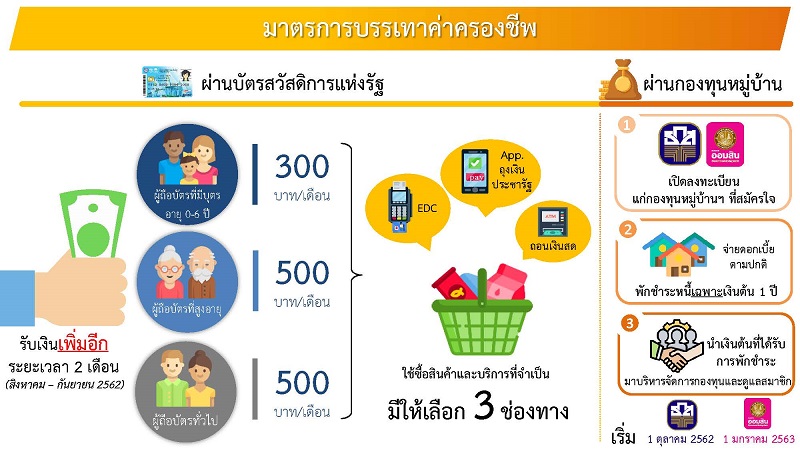
The government has organized a set of economic stimulus measures expected to address the insufficient living costs of low-income individuals by injecting funds through the state welfare card continuously. This time, over 14.5 million welfare cardholders will receive an additional 500 baht per month for two months. Elderly cardholders aged 60 and above will also receive an additional 500 baht per person per month for two months. Additionally, parents with children aged 0-6 years holding welfare cards will receive an extra 300 baht per child per month for two months, and there will be a suspension of principal repayments for village and community fund debts owed to BAAC and the Government Savings Bank.
Debt Suspension - Low-Interest Loans for Thai Farmers
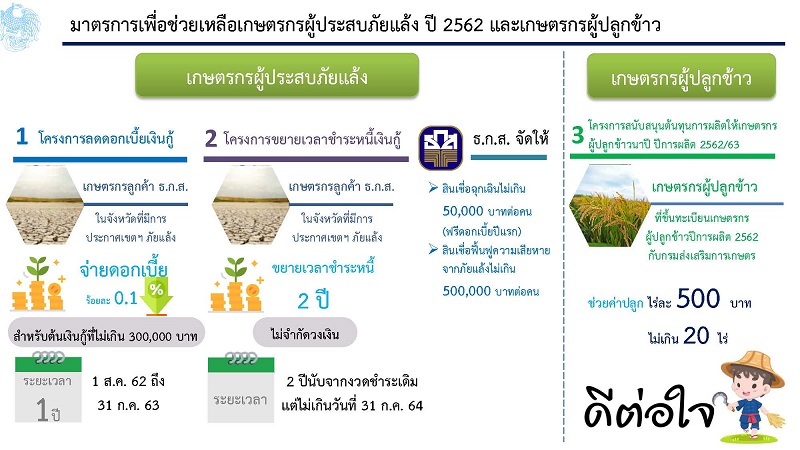
Furthermore, the government is accelerating relief for farmers affected by drought by extending the loan repayment period for two years for those impacted by drought. The BAAC will suspend drought-related debts and provide emergency loans to disaster-affected individuals (drought) at an interest rate of 0.1% per year, with a loan limit of 300,000 baht for one year, starting from August 1, 2019, to July 31, 2020. For rice farmers in the 2019/20 production year, the government will support production costs with 500 baht per rai, with a maximum of 20 rai per household.

Stimulating Domestic Consumption: 1,000 Baht for Inter-Provincial Travel
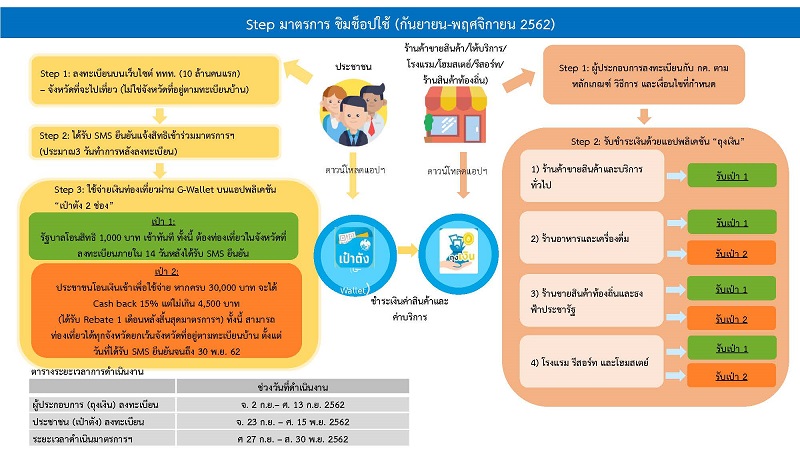
As the economy slows down, stimulating consumption is crucial. This economic stimulus measure includes various support initiatives, such as promoting domestic tourism through the “Chim Shop Chai” program, where the government will provide 1,000 baht per person to purchase goods and services from participating businesses, but cash withdrawal or fuel top-ups are not allowed. If spending on food, accommodation, or local products increases, the government will reimburse 15% of the actual payment, up to 4,500 baht per person, equating to a maximum spending limit of 30,000 baht.
This measure has conditions: participants must be 18 years or older on the registration date through the website. After receiving an SMS confirming successful registration, participants must use their travel rights within 14 days; otherwise, they will lose their rights. Spending must occur in provinces different from the participant's registered residence and must be done through the “Pao Tang” application to purchase goods and services from businesses accepting payments via the “Tung Ngern” application, valid only for three months from September to November. The Ministry of Finance will start reimbursing after the project ends, within 15-45 days, and the refunded money can be withdrawn as cash or spent through the Pao Tang application.
Investment Stimulus: 1.5 Times Expense Deduction - Low-Interest SME Loans of 10 Billion Baht
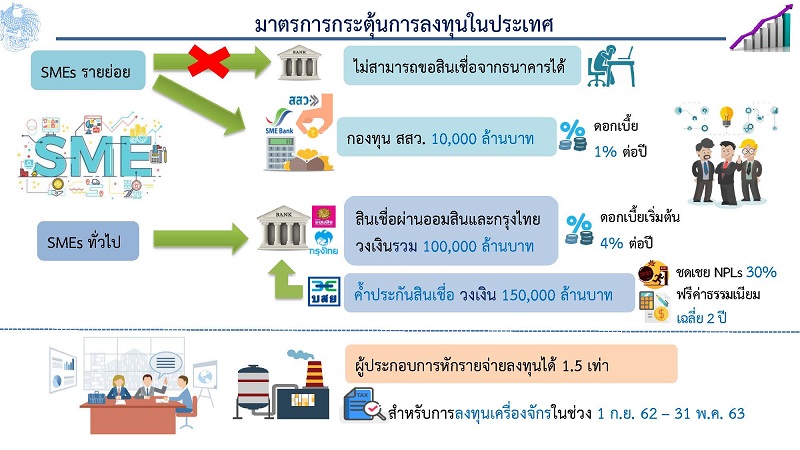
For domestic investment, there will be tax measures to stimulate investment by private companies or corporate partnerships, allowing them to deduct 1.5 times the actual expenses for machinery investments from September 1, 2019, to May 31, 2020. Meanwhile, small SMEs will receive support through the SME Promotion Fund in collaboration with the SME Bank, providing a loan limit of 10 billion baht at an interest rate of 1% per year, along with the 8th phase of the loan guarantee program (PGS8) with a budget of 150 billion baht and a guarantee period of 10 years, with an average guarantee fee of no more than 1.75%. Additionally, there will be loans through Krung Thai Bank and the Government Savings Bank with a budget of 100 billion baht and low-interest housing loans through the Government Savings Bank and the Government Housing Bank with a budget of 52 billion baht.
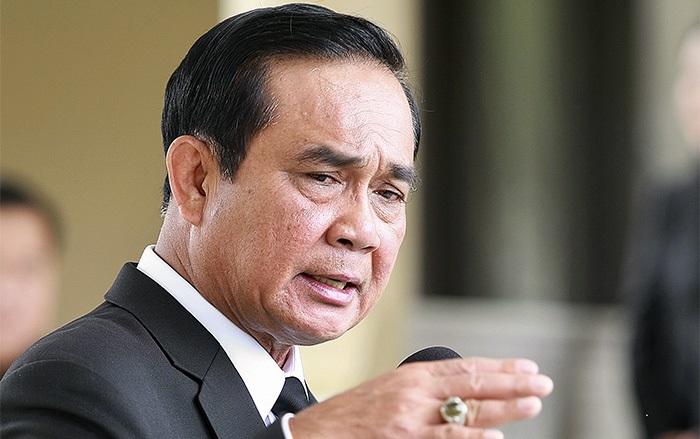
With all these measures, Prime Minister Prayuth Chan-o-cha believes they will serve as a remedy to stimulate the Thai economy in the second half of the year. For long-term solutions, structural economic reforms are necessary, along with changes in business models, thinking, and working methods. The government aims to support not only rice farmers but also palm oil and rubber farmers. All measures are intended to bolster GDP figures in the third and fourth quarters, as the government expects to utilize the 2020 budget in the following year. Economic stimulus measures must be reviewed quarterly; if the economy declines, the government must assess what actions can be taken, and some aspects may require further careful consideration.
Thai Chamber of Commerce University Predicts Government Stimulus Will Boost GDP by 0.4%
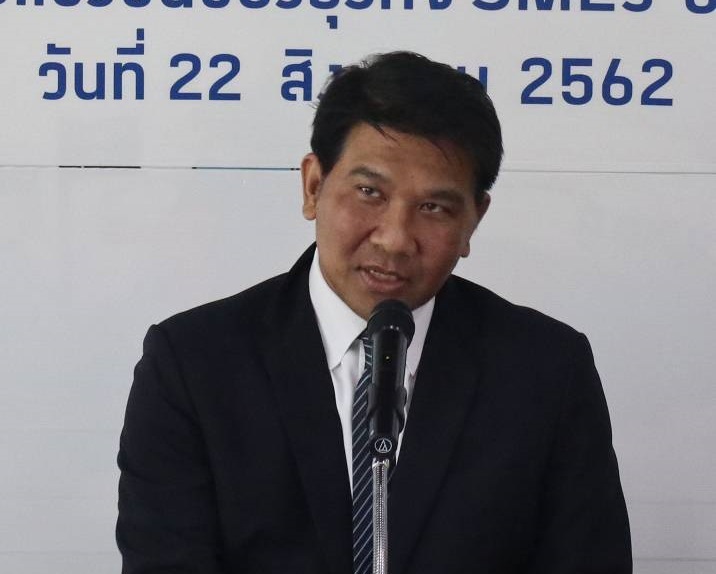
Mr. Thanawat Phonvichai, Senior Vice President for Academic Affairs and Research and Director of the Economic and Business Forecasting Center at the Thai Chamber of Commerce University, estimates that the government’s economic stimulus measures with a budget of over 316 billion baht will effectively address both direct and indirect issues, assisting citizens and farmers while providing liquidity to SMEs. It is expected to stimulate the economy to grow by at least 0.4% this year, allowing GDP to expand by 3.0-3.4%, which may be slightly lower than the Ministry of Finance's estimates due to the risk that the measures may not stimulate the economy in time this year, along with ongoing uncertainties in the global economic situation.