Thailand and Indonesia Collaborate to Develop a Global Creative Industry Hub
Currently, countries in the ASEAN region recognize the importance of enhancing the value of their creative economies through the "creative industry," which serves as a crucial engine for driving national economic growth. According to data from the National Economic and Social Development Office in 2014, the value of Thailand's creative industry reached 1.61 trillion baht, accounting for 13.18% of GDP. The top three highest-valued creative sectors are fashion, design, and broadcasting.
Dr. Arak Sibuangruang, Chairman of the Creative Economy Agency (CEA), stated that there is an opportunity to enhance the potential and elevate Thailand's creative business and industry to compete in the global market. Therefore, they have collaborated with the "Creative Economy Agency of the Republic of Indonesia (Badan Ekonomi Kreatif: BEKRAF)" to sign a memorandum of understanding on "Thai-Indonesian Creative Industry Cooperation" to promote bilateral relations in three areas: 1. Promoting cooperation between the people of both countries in the creative industry, 2. Enhancing and developing human resources for the creative industry, and 3. Supporting mutual understanding and participation between the citizens of both countries in the creative industry through meetings to exchange knowledge on measures to promote the creative industry, as well as promoting creators from both countries to have opportunities for creative ideas and business collaboration.
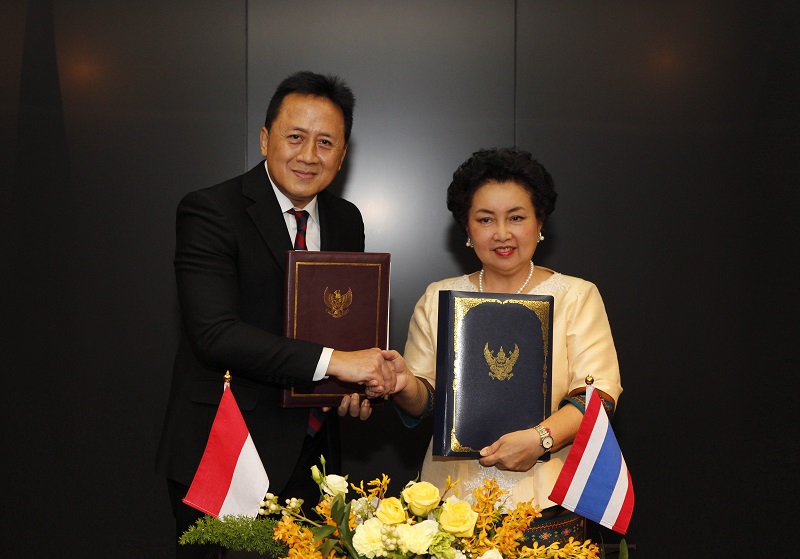
Mr. Triwanto Munaf, Chairman of the Creative Economy Agency of the Republic of Indonesia, mentioned that over the past two years, the Creative Economy Agency of Indonesia has played a significant role in the creative activities of CEA, such as the Chiang Mai Design Week and Bangkok Design Week, by showcasing the works of new designers in the form of craft pieces that blend various ideas and techniques from new creators, or pieces that integrate knowledge from diverse fields and groups of designers into commercially viable products that enhance social quality and reflect the uniqueness of the country. Indonesia is recognized as a country with growth in the creative industry and has successfully overcome geographical challenges as a large archipelago, becoming a global incubator for the creative industry with four unicorn-level startups.
Due to geographical constraints as an archipelago and income concentration in certain areas, the Indonesian government prioritizes developing a framework for national economic policy while accelerating structural adjustments to lay the groundwork for development in various areas conducive to the growth of the creative industry. This includes improving Indonesia's critical infrastructure (Palapa Ring), developing a 4G telecommunications network, establishing e-commerce market strategies, and founding the "Creative Economy Agency of the Republic of Indonesia" to drive concrete initiatives in promoting the creative industry.
As a result of these structural adjustments, businesses in Indonesia have achieved success and gained global recognition in a short period, such as Indonesia's first unicorn, "GO-JEK," a platform for taxi and motorcycle ridesharing. This startup was the first to venture into the challenging business of addressing severe traffic congestion, expanding its market to Singapore, Vietnam, the Philippines, and Thailand, and reaching a valuation of over 1 billion USD. Shortly after, several other companies quickly followed suit to become unicorn startups, including Traveloka, Tokopedia, and Bukalapak. Currently, Indonesia's GDP is experiencing rapid growth and has been ranked by the International Monetary Fund (IMF) as the 8th fastest-growing economy in the world, with a GDP of over 3,028 million USD within three years. It is also projected that Indonesia's economic growth will rise to 4th place in the next 30 years.
Thank you for the information from the Creative Economy Agency (Public Organization)