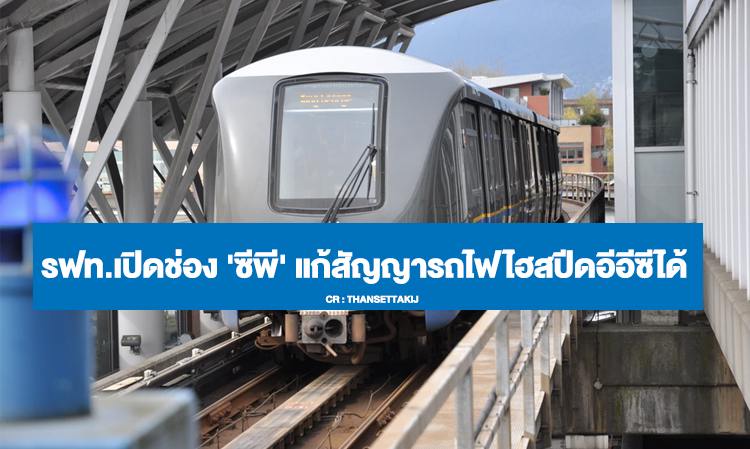
SRT Opens Door for 'CP' to Amend EEC High-Speed Rail Contract
On May 15, 2019, Mr. Worawut Mala, the acting governor of the State Railway of Thailand (SRT), revealed that the SRT and the private sector partner in the joint investment project for the high-speed rail connecting three airports in the EEC, with a budget of 220 billion baht, including Charoen Pokphand Holding Co., Ltd. and its partners, have agreed that the contract for this project can be amended after signing and starting construction, as well as after the commencement of services, throughout the 50-year concession period.
The reason for allowing contract amendments is to ensure fairness for the private sector and to mitigate risks for the government in the future in case of unforeseen events. The conditions for amending the contract specify that the private sector can propose changes if abnormal events occur that directly impact the project, such as national inflation rates, economic crises, and war situations. However, this does not include conditions related to lower-than-expected revenue or passenger numbers, such as if the number of passengers is less than anticipated or if revenue falls short of projections. Such factors are not considered valid reasons for contract amendments. Nevertheless, the SRT will only extend the concession period in cases where the handover process of SRT land is delayed beyond the agreed timeline.
Mr. Worawut further stated that once there is a clear guideline for amending the contract, it must be submitted through the appropriate channels to the project oversight committee before being presented to relevant agencies, such as the Ministry of Transport, and then to higher-level policy makers. Therefore, the private sector cannot amend the contract arbitrarily, as there must be a process for reviewing the appropriateness from multiple parties. It is essential to ensure fairness for the private sector, which bears the risks, just as the SRT may face challenges if the project encounters significant obstacles.
Mr. Worawut also mentioned that during the meeting of the State Enterprise Policy Committee (SEPC), chaired by Prime Minister General Prayuth Chan-o-cha on May 15, the SRT is preparing to report on the progress of its rehabilitation plan for the committee's acknowledgment. Additionally, it will propose the hiring of 1,904 personnel this year in line with the plan to support the dual-track railway project. Furthermore, the SRT is preparing to request a budget of 3.4 billion baht for registering a subsidiary for train operations, which will be used as working capital for managing the Red Line suburban electric railway before seeking approval from the Cabinet.
The goal is to establish the aforementioned subsidiary and a property subsidiary by June this year. However, it is expected that the Red Line electric railway project will take 13-14 years to break even or become profitable due to the gradual increase in passenger numbers. To reach profitability, there must be at least 80,000-90,000 passengers per day.
Thank you for the information from www.thaipost.net