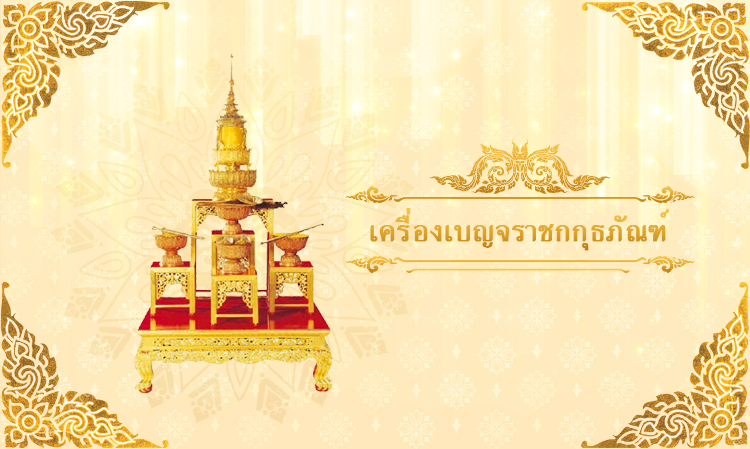
The Five Royal Regalia
<\/p>
 <\/strong>
<\/div>
 <\/strong><\/div>
<\/div>
The Five Royal Regalia
<\/strong><\/div>
<\/strong><\/div>
<\/div>
These are symbols of kingship, presented by the Brahmin officiant during the coronation ceremony.<\/strong><\/div>
They signify that the king has ascended the throne correctly and completely.
<\/strong><\/div>
<\/strong><\/div>
<\/div>
The Great Crown of Victory
<\/strong><\/div>
<\/strong><\/div>
<\/div>

 <\/strong><\/div>
<\/strong><\/div>
<\/div>
This is a golden crown adorned with precious stones, standing 66 centimeters tall and weighing 730 grams.<\/strong><\/div>
It was created as part of the royal regalia during the reign of King Rama I. At that time, the crown's top was decorated with small diamonds until the reign of King Rama IV, who graciously ordered trusted individuals to select and purchase larger diamonds from India.
These were used to replace the previous decorations on the crown, with the largest diamond named “Maha Vichai Mani,” measuring approximately 1.6 centimeters in diameter and 1.4 centimeters in height.<\/strong><\/div>
These were used to replace the previous decorations on the crown, with the largest diamond named “Maha Vichai Mani,” measuring approximately 1.6 centimeters in diameter and 1.4 centimeters in height.<\/strong><\/div>
-------------------------------------------------------------------------<\/strong><\/div>
The Sword of Victory
<\/strong><\/div>
<\/strong><\/div>
<\/div>

 <\/strong><\/div>
<\/strong><\/div>
<\/div>
This ancient sword is believed to be the royal weapon of the Khmer kingdom during the reign of King Pathum Suriyawong. It was found in the lake of Siem Reap, and no one knows how long it had been there. A fisherman caught it in his net, and it was in excellent condition, free from rust or decay. Phra Chao Apai Phubet (Ban), who was the acting governor of Battambang and Siem Reap, presented it to King Buddha Yodfa Chulaloke in 1827. The king graciously ordered the crafting of a gold-plated handle with intricate designs and a gold sheath adorned with precious stones, which was completed and presented as part of the royal regalia during the coronation ceremony in 1828.
The sword itself is 64.5 cm long, with a beautifully designed gold-plated section near the handle. The handle measures 25.4 cm, and when sheathed, it is 101 cm long and weighs 1900 grams.<\/em><\/strong><\/div>
The sword itself is 64.5 cm long, with a beautifully designed gold-plated section near the handle. The handle measures 25.4 cm, and when sheathed, it is 101 cm long and weighs 1900 grams.<\/em><\/strong><\/div>
-------------------------------------------------------------------------<\/strong><\/div>
<\/div>
The Royal Staff
<\/strong><\/div>
<\/strong><\/div>
<\/div>

 <\/strong><\/div>
<\/strong><\/div>
<\/div>
This is a golden staff with a trident tip, made from the wood of the Chai Phra tree. It is entirely covered in gold. His Royal Highness Prince Narisara Nuvatti described it as resembling a monk's staff used for conducting the Mahabangsukul ceremony.
This staff was created as part of the royal regalia during the reign of King Rama I.<\/strong><\/div>
This staff was created as part of the royal regalia during the reign of King Rama I.<\/strong><\/div>
--------------------------------------------------------------------<\/strong><\/div>
The Royal Fan
<\/strong><\/div>
<\/strong><\/div>
<\/div>

 <\/strong><\/div>
<\/strong><\/div>
<\/div>
The original fan was created during the reign of King Rama I and is made from palm leaves, known as the “Pachani Phak Makham,” with gold leaf covering and gold trimmings. The handle is also made of gold.
Later, during the reign of King Rama IV, it was decided that according to the Pali scriptures called “Valavichani,” it should not be a palm leaf fan but rather a fan made from the hair of a Brahmin. Therefore, he graciously ordered the creation of a Brahmin hair fan as part of the royal regalia.
Subsequently, white elephant tail hair was used instead, referred to as the white elephant tail fan, but the original palm leaf fan could not be discarded. Thus, both were used together and referred to collectively as “Valavichani.”<\/strong><\/div>
Later, during the reign of King Rama IV, it was decided that according to the Pali scriptures called “Valavichani,” it should not be a palm leaf fan but rather a fan made from the hair of a Brahmin. Therefore, he graciously ordered the creation of a Brahmin hair fan as part of the royal regalia.
Subsequently, white elephant tail hair was used instead, referred to as the white elephant tail fan, but the original palm leaf fan could not be discarded. Thus, both were used together and referred to collectively as “Valavichani.”<\/strong><\/div>
-----------------------------------------------------------------------------<\/strong><\/div>
The Royal Slippers
<\/strong><\/div>
<\/strong><\/div>
<\/div>

 <\/strong><\/div>
<\/strong><\/div>
<\/div>
These are pointed slippers made of gold, adorned with precious stones, weighing 650 grams. They have been part of the royal regalia since the reign of King Rama I.
During the coronation ceremony, the Maha Ratchakru Wama Hamuni is the one who presents them to the king.<\/strong><\/div>
During the coronation ceremony, the Maha Ratchakru Wama Hamuni is the one who presents them to the king.<\/strong><\/div>
-----------------------------------------------------------------------------<\/strong><\/div>
<\/div>