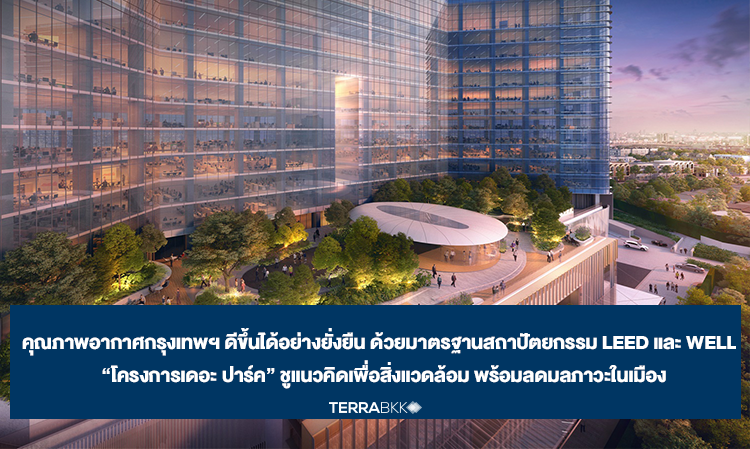
Sustainable Improvement of Bangkok's Air Quality with LEED and WELL Architectural Standards: The PARQ Project Promotes Environmental Awareness and Reduces Urban Pollution
- LEED <\/em><\/strong>and <\/em><\/strong>WELL <\/em><\/strong>standards have become a trend that various buildings prioritize to combat urban pollution and create clean air indoors, focusing on energy efficiency and sustainable environmental impact.<\/em><\/strong><\/li>
- The PARQ <\/em><\/strong>real estate project is committed to environmental care, aiming to reduce pollution and promote sustainable well-being while helping to position Bangkok as a new business hub in ASEAN.<\/em><\/strong><\/li>
In light of the PM2.5 dust pollution crisis affecting Bangkok and several provinces in Thailand, there is a growing awareness among Thai people about the importance of clean air. Therefore, long-term solutions to sustainably improve air quality have become a top priority for both public and private sectors.
According to a recent survey by Nielsen Thailand in collaboration with The PARQ, developed by TCC Assets (Thailand) Co., Ltd. and managed by Frasers Property Holdings (Thailand), the latest trends among office workers in Bangkok reveal that poor indoor air quality is a primary concern for employees. The key factors that city dwellers believe affect their work efficiency and quality of life include good indoor air quality (64%), access to natural light and views (45%), and the presence of green spaces (40%).
The survey also found that over 90% of office workers in Bangkok spend most of their lives indoors. Therefore, buildings must provide an environment that promotes good health and enhances work efficiency. Leading real estate developers in Thailand are increasingly focusing on creating sustainable architecture and green buildings that meet international standards such as LEED and WELL, aiming to elevate the quality of life alongside clean indoor air.
"Our stance as a real estate developer is to care and enhance the lives of people who spend time in buildings comprehensively, with design that prioritizes the health of building users as a core principle, sustainable architectural design, and efficient use of energy and resources, while adhering to various practices to ensure better well-being for users. Sustainability must encompass both environmental and human resources; if both are well-managed, the quality of life standards will sustainably improve," said Ms. Su Lin Sun, CEO of The PARQ project.
LEED and <\/strong>WELL <\/strong>standards prioritize people and the environment sustainably.<\/strong>
The LEED (Leadership in Energy and Environmental Design) standard is a globally recognized green building standard aimed at reducing environmental and human impacts sustainably, from the beginning to the end of the construction process. This includes using innovative building materials that emphasize environmental conservation and energy efficiency, reducing emissions, and managing resources wisely, aligning with the current social context where many companies are seeking high-quality office spaces to boost productivity and enhance the quality of life of their personnel.
The WELL standard has revolutionized the architecture industry by providing a higher quality of life for building users through a complete rethinking of modern building design, from material selection to ventilation and lighting systems, emphasizing the integration of best practices in construction and design with medical and scientific research to promote the well-being of people. Data from the Global Wellness Institute (GWI) revealed that as of 2017, globally, properties registered with WELL exceeded 224 million square feet, reflecting the ongoing health trend at an international level.
The WELL standard is certified by the International Well Building Institute (IWBI), while the LEED standard is certified by the U.S. Green Building Council. Both standards have multiple levels, and data from GBIG shows that only 20 projects in Thailand have achieved the highest LEED Platinum certification. Although this number is still small, it is expected to increase, as in 2018, the registration of buildings certified with LEED in Thailand surged by 70%.
Progress of Green Architecture in Bangkok
Real estate projects certified with both LEED and WELL in Thailand not only push for new standards in living and working but also stand out with comprehensive smart services, such as providing clean and safe drinking water, natural light, and suitable environments, low-reflective lighting to reduce eye strain, enhancing work efficiency, along with various health services, diverse food courts, spas, gyms, art exhibitions, and green spaces for relaxation.
The PARQ project aims to be the first real estate project in Thailand fully equipped with both LEED and WELL standards. The project is strategically located next to the Queen Sirikit National Convention Center and connects to the MRT Queen Sirikit National Convention Center station and Benjakitti Park, making it a potential area on the Innovation Corridor along Rama IV Road. The PARQ will set a new standard for office buildings and enhance the quality of life for working individuals seeking a balance between work and personal life, perfectly aligning with the project's concept of "Life Well Balanced."
Inside The PARQ, a high-efficiency air filtration system will be installed to control microorganisms and fungi, ensuring stable indoor air quality. At all six entry points, there will be an air pressure system to prevent contamination from outside air, along with sensors to monitor and control air pressure for consistent air circulation. The impact of being an energy-efficient building extends broadly, improving urban air quality, reducing heat emissions, and mitigating potential impacts from various construction phases. From the tenant's perspective, in addition to improved air quality, there are numerous benefits from energy-efficient buildings, comprehensive smart services, and amenities such as electric vehicle charging stations, clean drinking water, and green spaces, all of which help reduce operational costs for businesses while attracting new talent and retaining valuable personnel longer.
"The PARQ project will set a new standard for quality of life for workers by being a building equipped with the latest technology, caring for the well-being of people in the building, and responsibly addressing environmental sustainability. Aiming to be the first office in Thailand to achieve both LEED and WELL certifications is crucial in becoming the most complete office and lifestyle space," concluded Ms. Su Lin Sun, CEO of The PARQ project.
The sustainable architectural design of The PARQ, built according to the standards of both LEED and WELL, has the potential to attract leading companies to help position Bangkok as a new business hub in the ASEAN region.
Thank you for the information from www.theparq.com