"Somkid" Teams Up with "Finance Minister" to Boast About 4 Years of Government Achievements
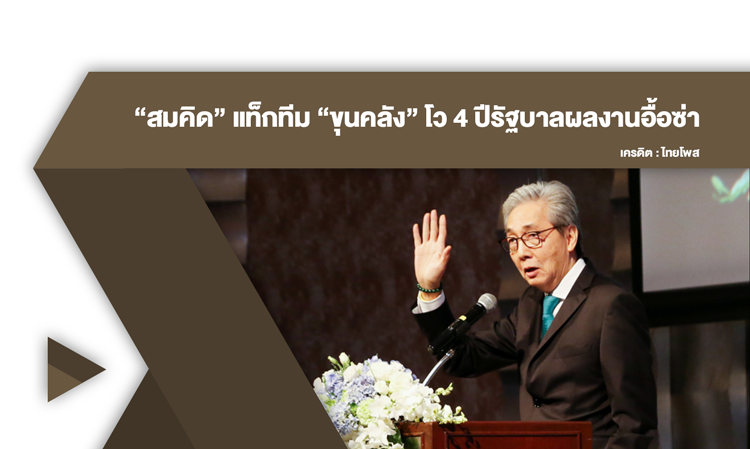
On March 19, 2019, Deputy Prime Minister Somkid Jatusripitak revealed after chairing a meeting to follow up on the progress of state enterprises in driving the national strategy that he discussed with Finance Minister Apisak Tantivorawong about the need to talk about the government's past achievements. He emphasized that the work of state enterprises, which are the real implementers, has produced numerous measures over the past four years.
He stated that for the Thai economy to move forward, it must rely on both the monetary policy of the Bank of Thailand (BOT) and the fiscal policy implemented by the Ministry of Finance through state enterprises. Many measures have been put in place because these organizations are agile and can work quickly, with a new generation of executives who represent the country's future. However, there has been a perception that state enterprises have not delivered results.
"The achievements of state enterprises over the past four years include significant economic reforms. The Bank for Agriculture and Agricultural Cooperatives (BAAC) has supported farmers to engage in larger-scale agriculture. The Government Savings Bank has focused on lending to low-income individuals and SMEs, providing them with opportunities for employment. The Small and Medium Enterprise Development Bank of Thailand (SME Bank) has facilitated small SMEs in accessing funding, and the Government Housing Bank has implemented the 'Million Houses' initiative, which has garnered interest from many low-income earners—something no previous government had considered," Somkid stated.
Meanwhile, the State Railway of Thailand (SRT) and the Mass Rapid Transit Authority of Thailand (MRTA) have previously been viewed as organizations without a future, as the past government did not prioritize them and allocated budgets to the Department of Highways for road construction, since most politicians are construction contractors. The current government has placed importance on rail transportation. Before this government, the MRTA was operating four rail lines, but now there are eight lines in operation.
Regarding the Board of Investment (BOI), in the past four years, it has played a crucial role in steering economic reforms towards more innovative and research-driven investments. In four years, 5,518 operators have applied for investment promotion, amounting to 2.28 trillion baht, which is 65% of investments in targeted industries compared to only 52% under previous governments.
"Entering the fourth year, there are claims that this government has done nothing, while in reality, it has accomplished a lot. I urge the Ministry of Finance to share the achievements of state enterprises with political parties so they won't waste time thinking of campaign measures, as this government has already implemented those measures. There is no need to devise new policies; just continue the existing measures that this government has initiated. I have also advised state enterprise executives not to be attached to individuals; even if I and the Finance Minister are not around, they should continue implementing measures to avoid missing opportunities for the country. It's not about blaming the government for damaging the economy over these four years; this government needs to restore the economy that previous governments have harmed," Somkid said.
Finance Minister Apisak stated that he discussed with Somkid that they have heard many campaign promises from various political parties, which have accused this government of doing nothing. This is not true, as this government has done a lot of work, and the issues that political parties are campaigning on have already been addressed by this government. All specialized financial institutions have implemented numerous measures to help improve the living conditions of low-income individuals.
The government's measures will focus on three important areas: 1. Projects must enhance competitive capabilities, 2. Reduce inequality, and 3. Maintain fiscal discipline. The implementation of various measures by the Fiscal Policy Office (FPO), the State Enterprise Policy Office (SEPO), and the Public Debt Management Office (PDMO) must ensure that the measures yield economic returns, reduce inequality, and do not create a fiscal burden beyond legal limits. These are not projects designed merely to distribute money without economic impact, as some have claimed.
Thank you for the information from www.thaipost.net