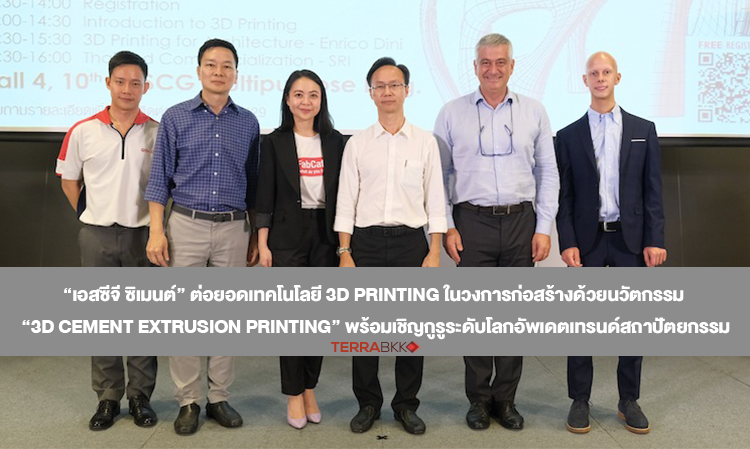
SCG Cement Expands 3D Printing Technology in Construction with '3D Cement Extrusion Printing' Innovation, Inviting Global Experts to Update Architectural Trends
Currently, contractors, engineers, real estate developers, and new-generation architects are seeking diverse, unique, beautiful, and durable pieces. This demand has led SCG Cement to develop the '3D Cement Extrusion Printing' innovation, marking a significant advancement in the construction industry. This technology allows for the creation of structures using 3D printed cement, which can be used for structural components, walls, decorative materials for buildings, and furniture pieces.
Mr. Siamrat Sutthanukul Chief Marketing Officer - Cement and Construction Solution Business SCG Cement and Construction Products Business revealed that SCG Cement Co., Ltd. has collaborated with Mr. Chalermwut Sa-nguanjat, Head of Mortar Technology Research Group at the Research and Innovation Center in the Cement and Construction Products Business of SCG, to develop the 3D Cement Extrusion Printing innovation. This technology utilizes a special mortar formula (Mortar Ink) developed by the Mortar Technology research group, allowing for precise 3D printing using computer-controlled technology. This process ensures high-quality production while addressing the shortage of skilled labor, resulting in quality pieces produced in just a few hours. Additionally, it can be creatively expanded into various construction projects, ranging from small to large-scale, including livable houses.
Furthermore, SCG Cement has exchanged ideas with Enrico Dini, a renowned Italian engineer and expert in 3D printing technology, to enhance the capabilities of printers and mortar into a solution called '3D Cement Extrusion Printing Solution.' This solution aims to expand the market in both design and construction sectors. The 3D Cement Extrusion Printing Solution will provide consulting, design, and installation services for architectural and construction projects. SCG Cement is not only a manufacturer of special cement for 3D printing but also the first in Thailand to offer a comprehensive 3D Cement Extrusion Printing solution.
To celebrate the launch of the 3D Cement Extrusion Printing innovation, SCG Cement organized a seminar to update on architectural trends both internationally and in Thailand, which are increasingly leaning towards 3D printing. The seminar showcased innovations under the topic '3D Cement PRINTING for ARCHITECTURE, PAST, Present, Future towards sustainability,' featuring esteemed guests such as Mr. Enrico Dini, a globally recognized expert in 3D printing technology, Ms. Kanya Kowitvisith, a faculty member from the Faculty of Architecture and Planning at Thammasat University and co-founder of Fab Cafe, and Dr. Laphayot Prasitsopon, a researcher from the Mortar Technology group at the Research and Innovation Center in the Cement and Construction Products Business of SCG, who shared their knowledge, experiences, and expertise on 3D printing technology. The three speakers provided insights from various interesting perspectives.
Construction Moves Towards 3D Printing Technology
Ms. Kanya Kowitvisith stated that 3D printing technology began over a decade ago, utilizing additive materials for 3D shape formation. According to data from 3D HUBs, the largest community of 3D printer users globally, there have been no fewer than seven types of 3D printing technologies in the past three years, categorized by code base materials such as polymer, inkjet, powder, glass, metal, and laminated materials.
The advent of 3D printing started from the early era, evolving from traditional 3D printing materials. The most popular 3D printing materials include mortar, cement, and plastics. Key figures in this development include Enrico Dini, an expert in 3D printing from D.Shape. Subsequently, other materials such as glass and metal were introduced. In the second era, 3D printers began to be used to create small houses, and in the third era, real estate companies started using these tools commercially, such as Winton Group in China and various custom-made production companies in Europe.
Currently, Thailand has the largest 3D printing machines capable of producing actual pieces. Educational institutions, such as the Faculty of Architecture at Thammasat University, have studios teaching students to apply this technology practically. Internationally, 3D printing has been developed to find new construction methods, aiding humans in construction, exemplified by MS 3D, a leading group using 3D printers for large steel bridge construction in Spain.
The role of 4D printing technology is expected to emerge in the next 3-4 years, spearheaded by Self-Assembly Labs, which focuses on creating self-assembling materials triggered by stimuli, such as certain liquids that can develop into circuit boards. The application of 4D printing principles in education, such as Japanese origami folding techniques, is also being explored, with current examples including the development of thin solar panels and electrically conductive inks (The Octobot) for circuit board writing.
Global Experts Interested in Creating Temples with 3D Printing Technology
Mr. Enrico Dini stated that 3D printing technology was first produced around 2004, followed by continuous development. This technology has been adopted for household use, where designers create free-form architectural pieces. Subsequently, larger 3D printers were developed, and by 2008, a 3D printer was used to produce pieces up to 8 meters tall. This technology has since been applied to various commercial projects worldwide. Notably, in 2010, the first house was built using 3D printing technology, leading to numerous architectural and sculptural developments. Between 2015 and 2016, this technology was increasingly applied in various construction and architectural projects, such as sidewalks and bridges.
D.Shape is one of the world's leading 3D printer service providers, developing large-scale 3D printed architectural pieces, such as facades, and initiating 3D printed architectural projects in Dubai. Additionally, D.Shape has partnered with SCG Cement to utilize mortar materials for 3D printing in various projects. Looking ahead, D.Shape sees many interesting architectural constructions in Thailand suitable for 3D printing, currently preparing plans for projects such as temples, which will be large-scale Thai architecture utilizing 3D printing.
SCG Cement Accelerates Research to Meet Customer Demand
According to Dr. Laphayot Prasitsopon, a researcher in Mortar Technology, the Digital Application Global Trend of 3D printing is divided into two trends: Extrusion forming techniques and Binder Printing techniques that use Powder-Bed for shaping and setting pieces.
SCG Cement is a developer of cement material mixtures suitable for 3D printing construction projects in various European countries. The mortar formula from SCG Cement is considered suitable and meets the needs of users in 3D printing, especially for Binder printers requiring durable free-form pieces.
Additionally, the Research and Innovation Center has developed extrusion-forming mortar formulas with properties that align with global trends, such as flexibility for free-form design, reducing PM 2.5 dust levels, and enhancing work efficiency. Currently, SCG Cement offers 3D printing technology in two business models: Co-Creation and design services, collaborating with architects, engineers, and project owners interested in developing various construction pieces. SCG Cement has already developed and implemented numerous 3D printed construction pieces, such as coral reef anchoring forms in the sea, furniture pieces in Amazon Cafe, and the crest of SCG Muangthong United Football Club.
For those seeking beautiful, unique, strong, and durable pieces, consultations can be requested from Mr. Chalermwut Sa-nguanjat, Head of Mortar Technology Research Group at the Research and Innovation Center in the Cement and Construction Products Business of SCG, via email: [email protected], or by contacting the SRI Contact Center at 0 3624 0888. Additional product information can also be found by scanning the QR code.
Thank you for the information from www.scg.com