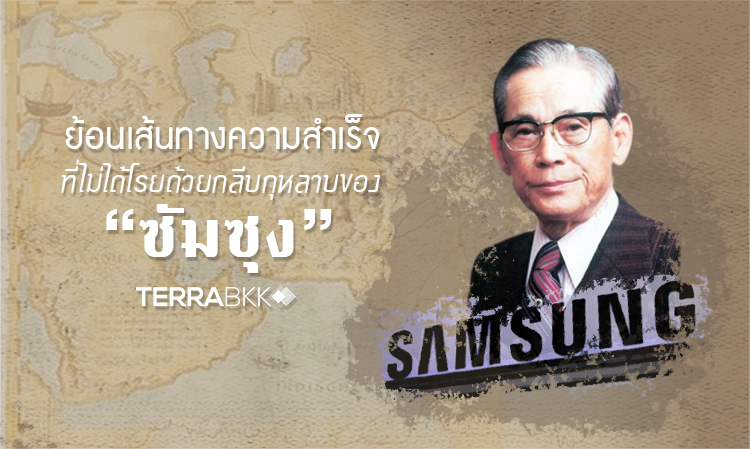
The Journey of Samsung's Success: Not a Bed of Roses
On the day when "Samsung," the South Korean electronics brand with a wide range of products, stands shoulder to shoulder with the world's leading electronics brands, many admire Samsung's success. Little do they know that if we look back to the brand's beginnings, it is almost unimaginable how it has come this far. Samsung was not a product of a family business inheritance or a result of a major disruption that transformed it into the IT giant it is today; rather, it grew from a simple grocery store.
What were the turning points and costly lessons that Samsung's leaders learned and overcame to elevate the business to become a world-class brand? The answers lie in 10 significant milestones of this brand.
1. Samsung was founded in 1938 by Lee Byung-chul in Daegu, South Korea. In the early days of the business, he focused on exporting goods such as dried fish, vegetables, and fruits to Manchuria and Beijing. Later, in 1947, the Korean War broke out, causing an economic slowdown. However, after the war ended, Samsung shifted its focus to textiles, including building the largest textile factory in South Korea.
2. In 1969, Samsung fully entered the electronics industry by starting to produce black-and-white televisions before expanding its production line to include washing machines, refrigerators, and developing color televisions alongside black-and-white models. By the 1970s, Samsung began exporting electrical appliances abroad, with Panama being the first country in 1971.
3. In 1974, Samsung Electronics acquired Hankook Semiconductor, marking another significant turning point that led Samsung to become a leading manufacturer of memory chips by the early 1990s. Even Apple, a competitor, became a customer and used Samsung's memory chips.
4. Samsung entered the telecommunications hardware industry by acquiring Hanguk Jenja Tongsin. Following this, Samsung began producing mobile phones and invested heavily in research to develop its own mobile devices.
5. In 1987, a crucial turning point for the brand occurred when Lee Byung-chul passed away, and his son, Lee Jae-yong, took over. At that time, the Samsung brand was labeled as low-quality and cheap, selling only in South Korea. After Lee Jae-yong traveled to the United States to survey the market, he found this to be true, evidenced by the low-grade placement of Samsung products on store shelves.
6. Lee Jae-yong devised a revolutionary brand overhaul by destroying substandard products. He instructed employees to gather around 150,000 phones and fax machines that did not meet Samsung's quality standards and ordered them to be burned. He also boldly announced a policy that would create a complete transformation within the organization with the famous phrase, "Change everything except for your wife and children."
7. With the visionary leadership of Samsung's chief, he not only revolutionized the organization with foresight but also became one of the few who kept pace with the digital age. Instead of focusing on developing analog color televisions like other manufacturers, Samsung chose to revolutionize the industry by inventing the world's first digital TV in 1998, and by 2008, it became the world's number one television manufacturer.
8. In 2009, Samsung launched the Samsung Galaxy i7500, its first Android smartphone, but it was criticized for lacking firmware update capabilities. Therefore, nine months later, Samsung redeemed itself by launching the Galaxy S, which received positive feedback and sold over 25 million units. In 2010, it introduced the Galaxy Tab to compete with Apple's iPad.
9. In 2012, Samsung invested over $108 billion in research and development, accounting for 6% of its total revenue. Samsung not only has its own research and development (R&D) centers with over 60,000 dedicated employees but also has R&D centers spread across 33 locations worldwide. By 2015, Samsung was the second-largest company in the U.S. for patent registrations, trailing only IBM, with a total of 5,072 patents.
10. Today, Samsung is recognized as the 14th largest company in the world, with sales valued at $225 billion, and is acknowledged as a major global electronics manufacturer that continues to innovate relentlessly.