Thai Exports Expected to Grow 7% in 2018 Despite US-China Trade War, 5% Growth Projected for 2019

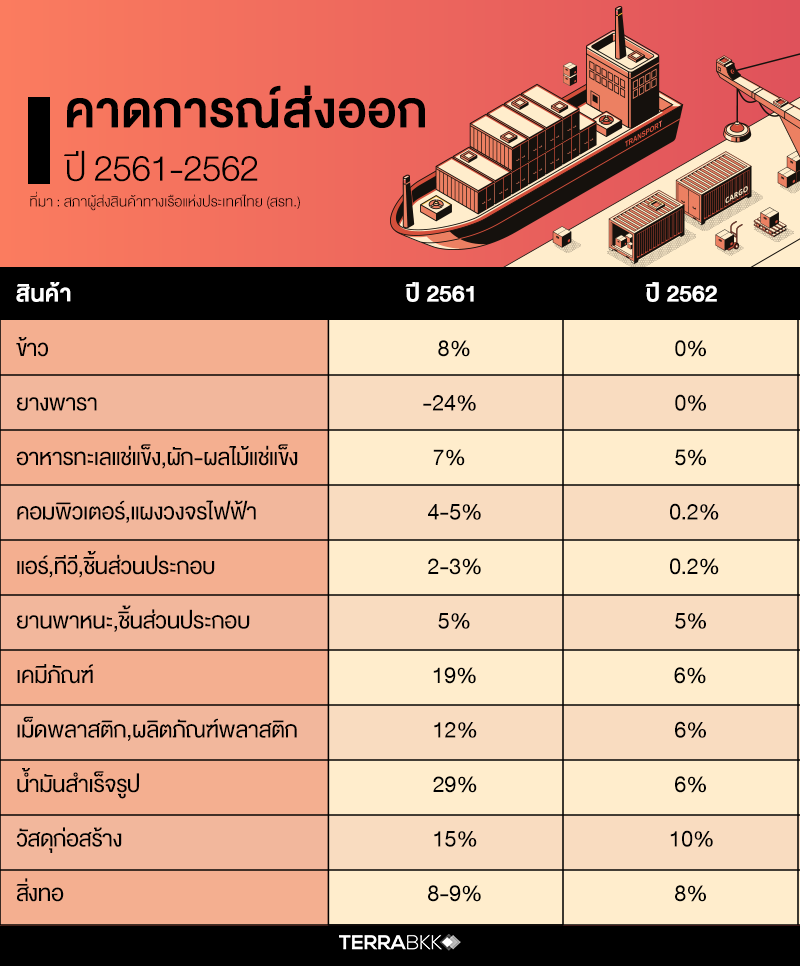
The Thai National Shippers' Council (TNSC) predicts that exports will grow by about 7% in 2018, lower than the target of 9%, due to the ongoing US-China trade war impacting the export sector, particularly in electronics and automotive industries, which saw negative export figures in November. It is expected that overall growth for the year will only be between 2-5%.
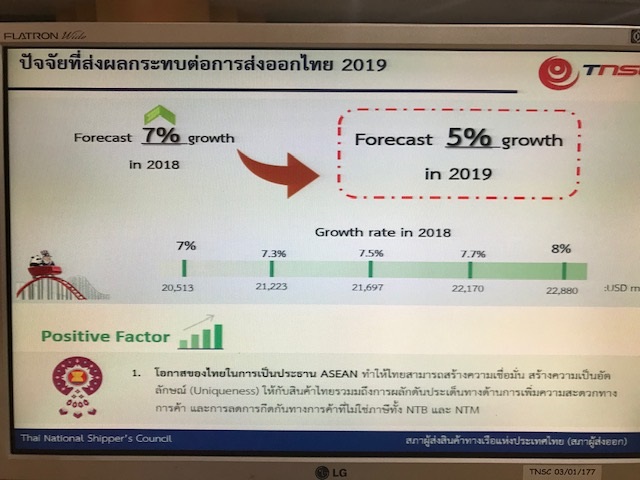
For 2019, exports are projected to grow by 5% based on the assumption that the exchange rate will be around 33.0 (± 0.5) baht per US dollar. Key positive factors include Thailand's opportunity to chair ASEAN, which can enhance confidence and create a unique identity for Thai products, as well as efforts to facilitate trade and reduce non-tariff barriers (NTB and NTM).
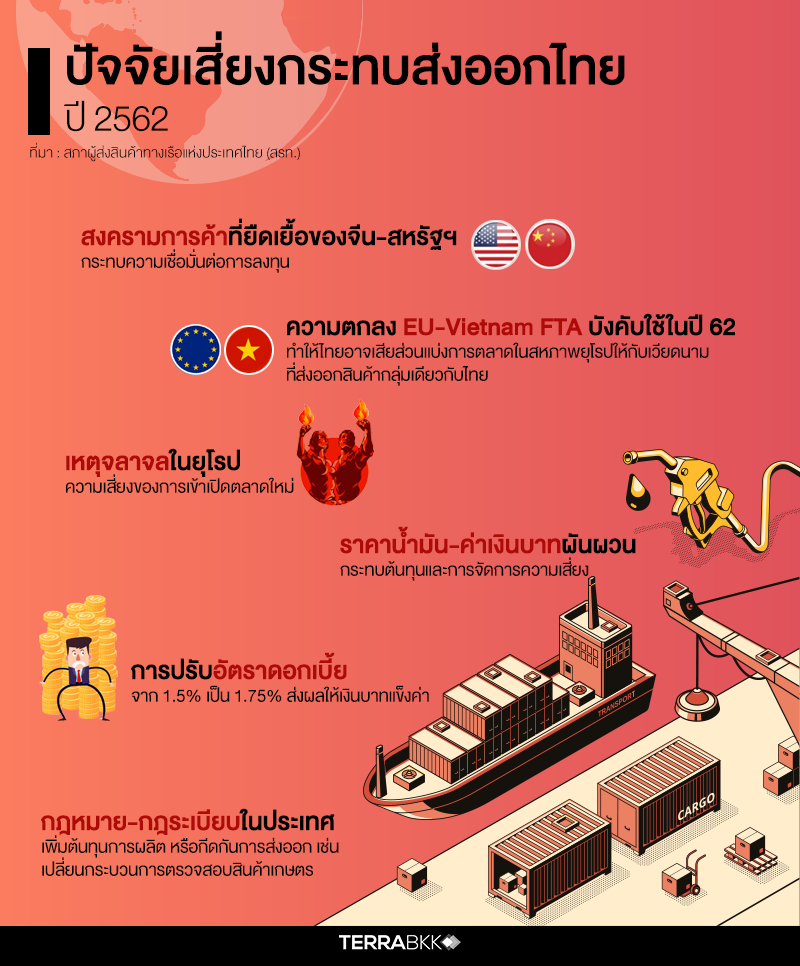
However, there are risks to be cautious of, particularly the prolonged US-China trade war, which affects investment confidence. China has announced a policy to reduce tariffs on over 700 imported and exported goods starting January 1, 2019, as an alternative for imports that would have come from the US, injecting significant liquidity into the market. This could lead to increased competition for Thai products in China, along with fluctuations in oil prices and the exchange rate impacting risk management in the energy sector.
The TNSC recommends that the government enhance international trade promotion through increased Trade Missions to expand new market bases, while also reducing international trade barriers in the form of NTB and NTM, and facilitating trade more effectively. Additionally, it urges the acceleration of international trade negotiations (FTA) to build confidence among investors and Thai exporters.
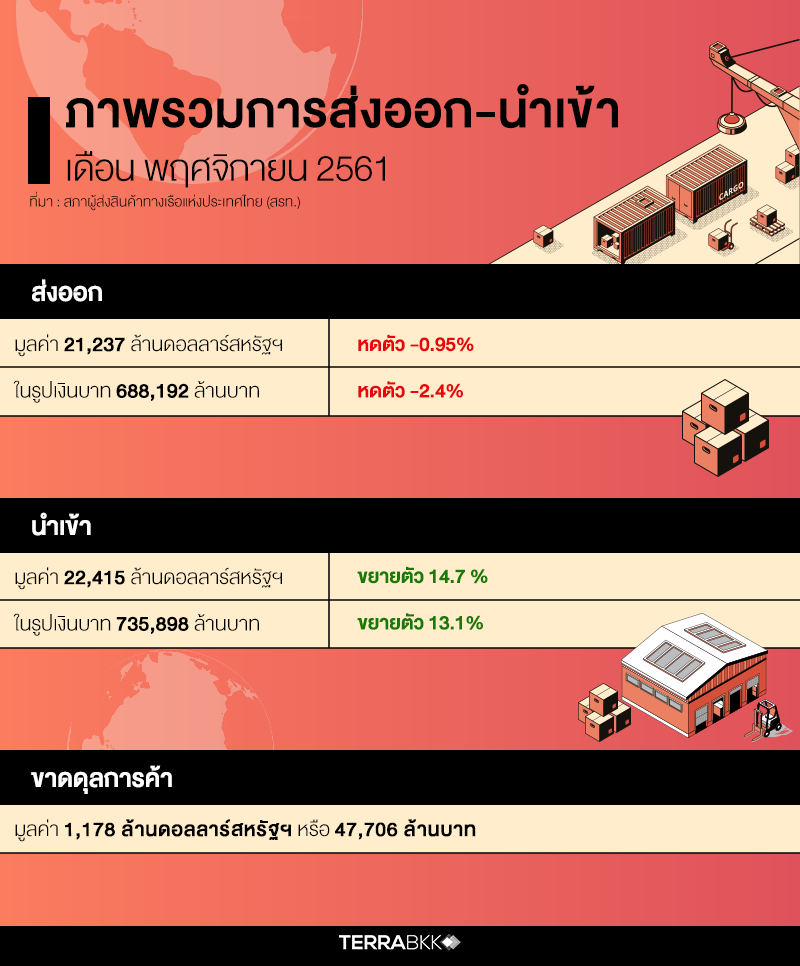
In November 2018, the overall export value was $21.237 billion, contracting by -0.95%. The export value in baht was 688.192 billion, down -2.4% compared to the same month last year (YoY).
Meanwhile, imports in November 2018 were valued at $22.415 billion, growing by 14.7%, with the import value in baht at 735.898 billion, increasing by 13.1%. This resulted in a trade deficit of $1.178 billion or 47.706 billion baht for November 2018.
From January to November 2018, Thailand's total exports amounted to $232.725 billion, growing by 7.3%, equivalent to an export value in baht of 7.447769 trillion, which is a 1.1% increase. Imports were valued at $231.344 billion, growing by 14.8% or 7.504905 trillion baht, which is an 8.3% increase, resulting in a trade surplus of $1.381 billion and a deficit of 57.137 billion baht during this period.
Exports of agricultural and agro-industrial products contracted by -8.4%, although beverages, cassava products, canned tuna, and fresh, frozen, and processed chicken continued to grow in the market. However, rubber faced continuous declines in both price and volume.
In the industrial product category, there was a contraction of -0.4%, while oil, gold, rubber products, steel, and steel products continued to grow. The categories that saw declines included automobiles and components, computers and components, semiconductor devices, transistors, diodes, and fax machines, phones, and related equipment.