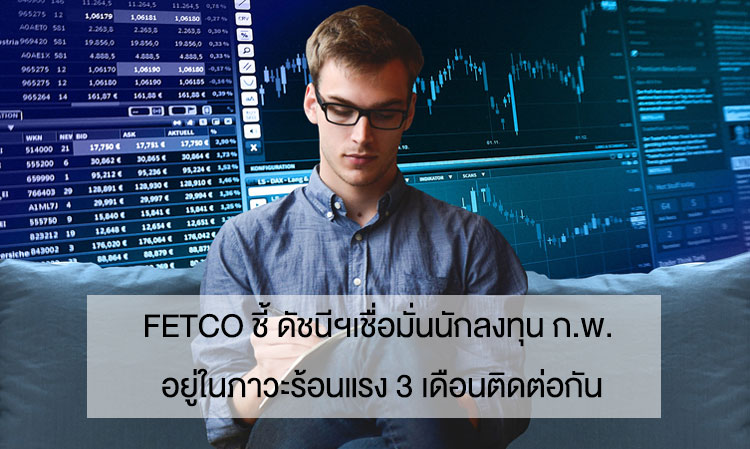
FETCO Reports Investor Confidence Index in February Shows Strong Momentum for Three Consecutive Months, Investors Monitor Capital Movement and Exchange Rate Impact
Dr. Santi Kiranant, representative of the Thai Capital Market Business Council, revealed that the FETCO Investor Confidence Index for February 2018 increased by 1.74% to 156.62, remaining in the 'bullish' category for the third consecutive month.
The supporting factors include confidence in international capital movement, as the economic conditions in the region and domestically are expected to expand compared to last year. Investors are also closely watching international capital flows, which affect exchange rates, leading to a depreciation of the dollar and a continuous appreciation of regional currencies, including the Thai baht, which has strengthened to 31 baht per dollar. This may impact the performance of export-oriented stocks, putting pressure on investor confidence.
The most interesting sectors are the banking (BANK) and electronics components (ETRON) sectors, while the least interesting sector is noted.
In January, the Thai stock market index saw significant movement, breaking historical records with a closing high of 1838.96 points on January 24, 2018. Investor confidence in international capital movement supported the capital market, driven by inflow numbers that strengthened the baht and optimism about global and domestic economic conditions, which are expected to grow compared to last year. The IMF has raised its global GDP growth forecast for 2018-2019 to 3.9%, keeping investor confidence predominantly at a strong level. However, investors view these capital movements as a potential drag on investment due to their impact on the baht and regional currencies, which may affect the performance of listed companies, alongside rising inflation trends in the US and Europe, leading to expectations of gradual interest rate hikes in the US this year, estimated at 3-4 times.
Interest Rate Expectation Index for February 2018
The index indicates that the policy interest rate is expected to remain stable at 1.50%, while the yields on 5-year and 10-year government bonds are expected to rise. This is primarily due to the gradual expansion of the Thai economy and inflation remaining below the target range.
The expected yields on 5-year and 10-year government bonds during the February Monetary Policy Committee meeting (approximately 11 weeks ahead) are at 78 and 87, respectively. The yield on the 5-year bond has decreased from the previous level (83), while the yield expectation for the 10-year bond has increased from the previous level (83). Both indices reflect an upward trend, but the market is increasingly confident that the yield on the 10-year bond will rise, with survey respondents emphasizing four main factors: 1) supply and demand in the Thai bond market, 2) fund flow, 3) expectations of US interest rate hikes, and 4) inflation and the outlook for Thailand's economic growth.