Pretend Office Companies: A Sign of the Youth Unemployment Crisis in China
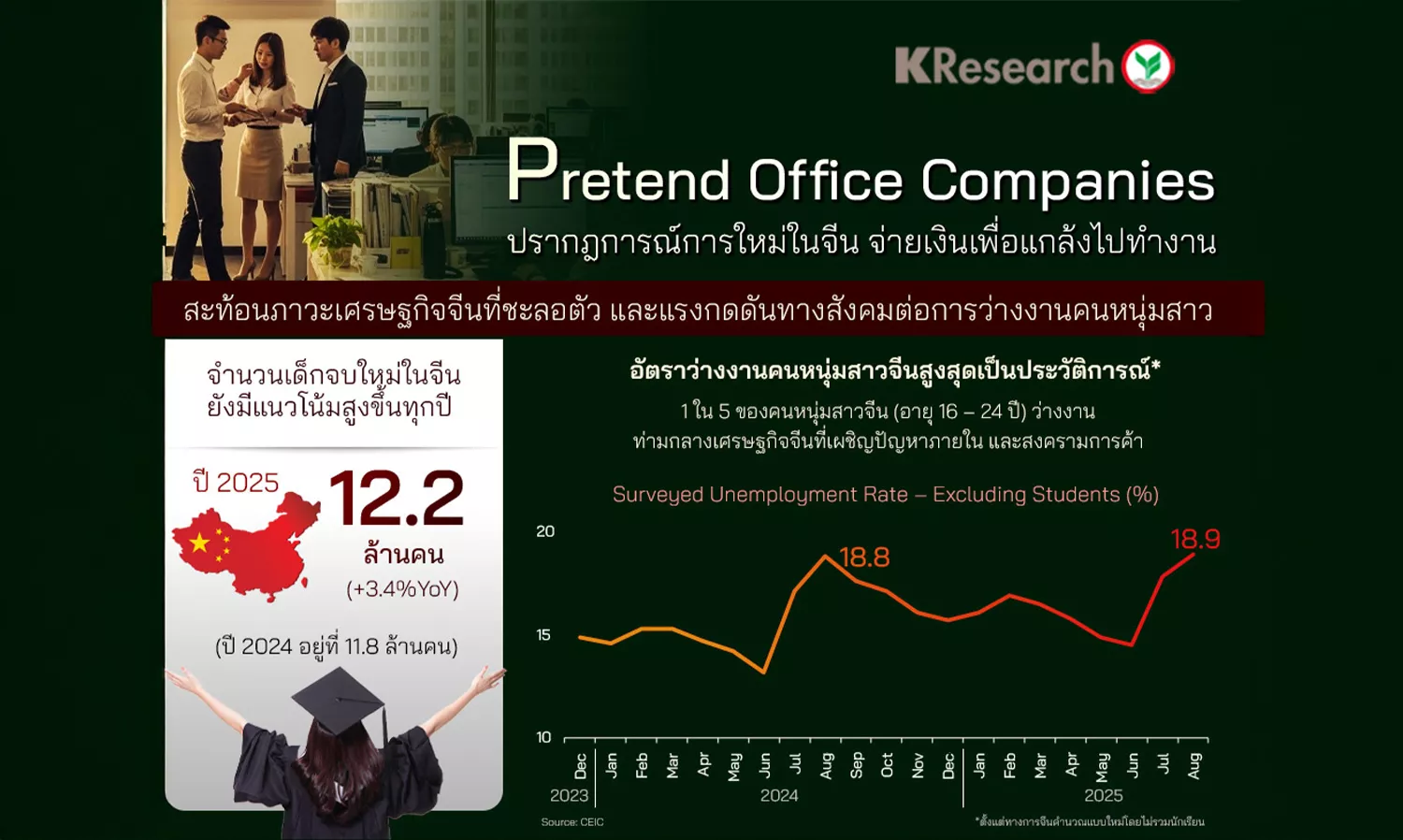
In 2025, China will face significant pressure from youth unemployment, with the number of new graduates reaching 12.2 million, an increase of 3.4% YoY from 11.8 million in 2024. The labor market is unable to absorb the growing workforce quickly enough. This imbalance reflects deeper issues beyond just economic slowdown. The unemployment rate for those aged 16–24 in August 2025 stands at 18.9%, compared to 18.8% the previous year. Although the difference is only 0.1 percentage points, the consistently high level indicates structural tensions within the Chinese economy, with 1 in 5 young people either unemployed or working part-time.
In this context, the phenomenon of Pretend Office Companies, or “paying to pretend to work,” has emerged in several cities, including Beijing, Shanghai, and Shenzhen. Users pay around 30–50 yuan (135–230 baht) to access spaces that simulate a real office environment. While it is merely a service mimicking an office, the popularity of Pretend Office Companies suggests that many young people are grappling with identity loss and social pressure. Having a “place to go” and a “daily routine” helps create a sense of being part of a valuable workforce. The structural causes stem from the slowdown of the Chinese economy, characterized by low GDP growth and stagnant private investment, which has hindered job growth in traditional industries. At the same time, Skill Mismatch—the disconnect between graduates' skills and market demands—has intensified.
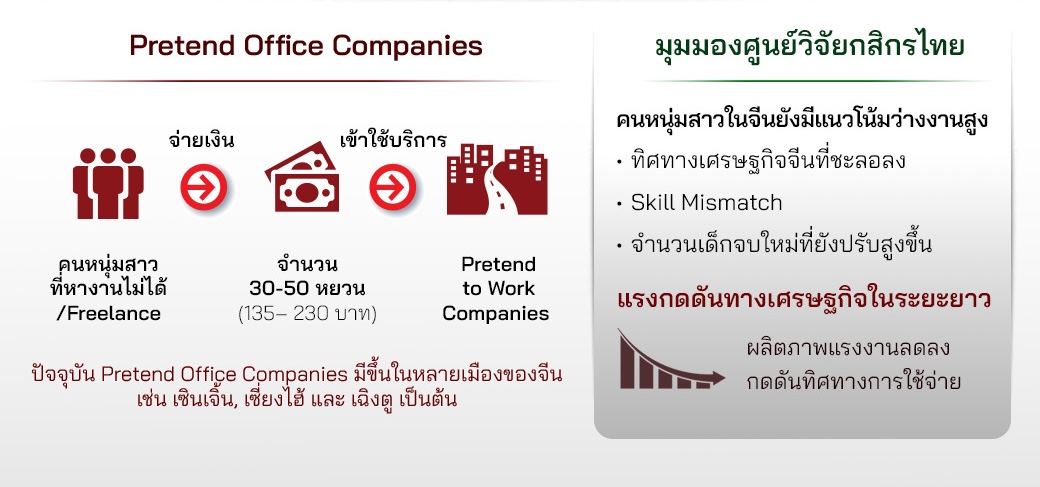
On a macro level, the rise in unemployment and part-time work will put pressure on domestic consumption rates due to declining household incomes. With over 18% of young people unable to fully enter the labor market, this will impact spending in the service sector and consumer goods, which China is trying to promote as a driving force for its economy. Another consequence is the potential stagnation of Labour Productivity, as educated workers miss out on opportunities to gain real-world experience in the labor market. If this phenomenon continues, China's competitiveness in the medium to long term will decline. Thus, Pretend Office Companies are not just a social phenomenon but a psychological indicator that young people in China are facing “invisible pressures.” Paying to pretend to work may serve as a temporary coping mechanism, but it does not address the structural issues within the economy and labor market.
From the perspective of Thailand and the East Asian region, monitoring this phenomenon is crucial, as China is a major export market. If young people, who are a significant consumer base, cannot generate income and purchasing power, the repercussions will extend to production and trade chains in the region, including Thailand. Kasikorn Research Center views the issue of youth unemployment in China as a long-term pressure affecting spending, investment, and social stability. Pretend Office Companies serve as a mere “warning sign” that China must accelerate reforms in the labor market, education, and economic structure to absorb the increasing number of new graduates each year. Otherwise, the figure of 12.2 million in 2025 may just be the beginning of a deeper and longer crisis.