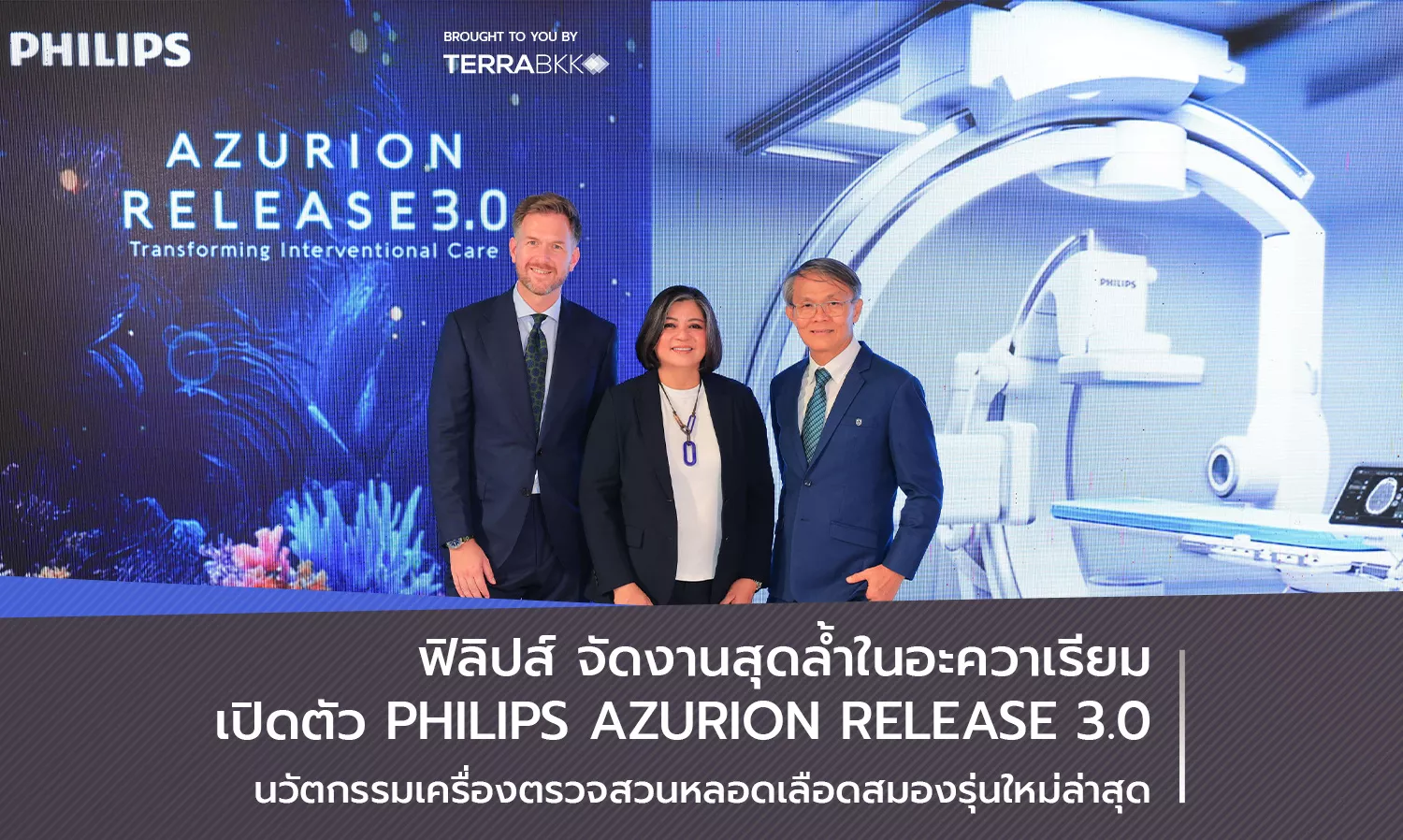
Philips Hosts Innovative Event at Aquarium to Launch Philips Azurion Release 3.0, the Latest Innovation in Neurovascular Imaging
Philips Thailand, a global leader in healthcare technology, organized an event to unveil the latest innovation in neurovascular imaging, the Philips Azurion Release 3.0, featuring SmartCT technology for medical professionals and specialists in stroke and neurology in Thailand. The event emphasized the concept of deep, powerful technology akin to the ocean, designed to revolutionize the diagnosis of complex cerebrovascular and neurological diseases, reinforcing its leadership in the Image-guided Therapy portfolio at SEA LIFE Bangkok Ocean World, located in Siam Paragon.
According to the World Stroke Organization (WSO), 1 in 4 individuals aged 25 and older may experience a stroke at some point in their lives. It is estimated that global costs associated with strokes, both direct and indirect, could reach $891 billion annually. In Thailand, stroke is the second leading cause of death and a major cause of long-term disability, with over 250,000 reported cases of disability each year. Data from the Ministry of Public Health in 2024 shows a cumulative total of 358,062 stroke patients, with up to 39,086 fatalities, primarily due to an aging population, high cholesterol, and diabetes. The key to reducing the impact of strokes on lives, society, and healthcare costs lies in the principle of 'Know Fast, Survive,' as early detection and treatment significantly improve survival rates and treatment outcomes.
Enhancing Minimally Invasive Procedures for Stroke Treatment
Minimally invasive procedures are crucial in treating strokes, where every minute counts for patient care and quality of life. The latest Philips Azurion Release 3.0 imaging system comes equipped with solutions that facilitate the planning of complex stroke treatments, such as repairing brain aneurysms and congenital vascular abnormalities. It also allows for bypassing certain X-ray imaging steps in emergency rooms by directly transferring patients to the neurovascular imaging system, significantly reducing the time to assist patients and increasing their chances of recovery, especially in cases of large vessel occlusion (LVO).
Dr. Concon Molina, Head of Image Guided Therapy Systems at Philips Asia-Pacific (APAC) and Marketing Leader for the Growth Region at Philips, stated, “With the continuous rise in stroke patients in Thailand, we recognize the urgent need for medical technology that can support specialists in providing rapid and effective care. The new Philips Azurion imaging system has been designed in close collaboration with global experts to address the needs for speed, accuracy, and confidence in procedures. We believe this new innovation will enhance stroke treatment effectiveness and reduce the long-term impacts of strokes.”
The Philips Azurion Release 3.0 is designed to ensure smooth and efficient procedural workflows, especially when utilizing both 2D and 3D imaging. When combined with the latest Neuro Suite software from Philips, it becomes a comprehensive solution for stroke patient care, integrating images from ClarityIQ technology, which provides high-quality images with reduced radiation exposure, along with specialized tools for neurological and brain disorders, enhancing the efficiency, flexibility, and control of physicians in the operating room.
Additionally, the new features of Philips Azurion Release 3.0 include improved rotation direction and speed of the C-arm, allowing for better imaging angles, a robotic arm stop system for quick transitions between 2D and 3D imaging, a control panel accessible at the surgical bed to maintain sterile conditions, automatic beam rotation for precise imaging from all angles, and a new head support device specifically for stroke patients. Furthermore, the Philips Azurion Release 3.0 also offers the SmartCT Soft Tissue Helical option, enabling stroke diagnosis with images comparable to CT scans performed in the operating room.
Driving Innovation Through Clinical Collaboration
This launch event invited stroke specialists from Thailand and internationally to discuss the future of stroke care in Thailand. Professor Kuniyasu Niizuma from Tohoku University in Japan shared experiences from using the latest Philips Azurion Release 3.0, while Thai experts included Assistant Professor Dr. Jaturon Tantivatanachai, Head of the Radiology Department at Chulalongkorn Hospital, Thai Red Cross Society, Assistant Professor Dr. Itthichai Sakranchai, a neurosurgeon and interventional radiologist at Taksin Hospital, Dr. Win Teerapatjaroen, a neurosurgeon and interventional radiologist at Chulabhorn Hospital, and Dr. Phumitham Limwatananon, a neurosurgeon and interventional radiologist at Srinakharin Hospital, who discussed the importance of developing stroke treatment guidelines in Thailand.
Mr. Wiroj Wittyawejorn, President and Managing Director of Philips (Thailand) Co., Ltd., stated, “Stroke remains one of the leading causes of death and disability in Thailand, with the golden hour for stroke treatment being within the first 60 minutes after symptoms begin, or within 4.5 hours for certain patients. Rapid treatment can lead to better outcomes and reduce the risk of lifelong disability. Furthermore, collaboration among all sectors, including Philips as a leader in medical technology, experts, and stakeholders from both public and private sectors, will enhance the quality of stroke patient care. The launch of the Philips Azurion Release 3.0 today not only reinforces Philips' leadership in medical technology but also strengthens our market-leading Image-guided Therapy portfolio. We hope that with these new innovations and technologies, we can support healthcare professionals and elevate the Thai healthcare system to provide timely care for patients and prepare for an increasing patient load in the future.”
For medical professionals and healthcare facilities interested in more details, please visit https://www.philips.co.th/healthcare/image-guided-therapy.