Impact Assessment of the Thailand-Cambodia Conflict
Key Highlights:
- Krungthai COMPASS assesses that the Thailand-Cambodia conflict will impact through three main channels: border trade, tourism, and investment, with an estimated damage value of at least 17 billion baht per month as follows:
1) Border Trade: It is expected that the closure of five key Thai-Cambodian border checkpoints will result in a loss of approximately 14,011 million baht per month in border trade value, divided into export and import values of about 11,410 million and 2,601 million baht per month, respectively. The Aranyaprathet checkpoint in Sa Kaeo province is expected to be the most affected. The export products anticipated to be impacted include beverages, motorcycle components, and internal combustion engines, while the import products include vegetables and vegetable seasonings, particularly cassava.
2) Tourism: The damage to tourism from the decrease in Cambodian tourists entering Thailand and from Thai and foreign tourists unable to visit the four provinces where clashes are occurring is estimated to be at least 2,970 million baht per month.
3) Investment: If the situation escalates in severity and expands, it may affect Thai operators doing business in Cambodia, of which there are currently over 100, with a total investment value exceeding 50 billion baht. Businesses that may be significantly impacted include beverage and retail sectors.
- In the short term, import-export operators may consider changing routes and modes of transportation. In the longer term, they may look for alternative markets to mitigate risks from the Cambodian market.
On June 23, 2025, the unrest along the Thai-Cambodian border intensified following incidents of landmine explosions in the border areas of Chong Bok and An Ma, Nam Yuen district, Ubon Ratchathani province. Additionally, the clashes have expanded to various border and public areas, resulting in significant loss of life and property. Thailand has implemented measures to close all 18 Thai-Cambodian border checkpoints, including permanent checkpoints, trade facilitation points, and tourism facilitation points, effective from June 23, 2025. Tourist sites such as Ta Muen Thom and Ta Kwai temples have also been closed since July 24, 2025.
This article aims to assess the impact of the Thailand-Cambodia conflict on border trade, tourism, and the investment of Thai companies in Cambodia that will be affected by disrupted transportation of goods, in preparation for increased risks.
Impact of the Thailand-Cambodia Conflict
Krungthai COMPASS evaluates the impact of the Thailand-Cambodia conflict through three main channels, with an estimated damage value of at least 17 billion baht per month. The details are as follows:
- Impact on Border Trade
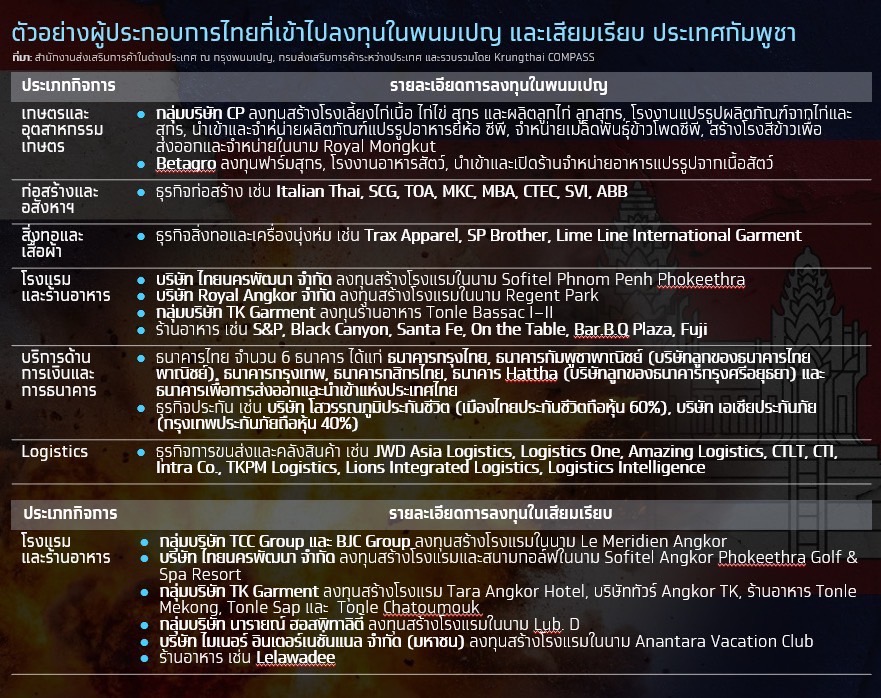
Border trade is expected to be the most affected by the closure of Thai-Cambodian border checkpoints, as it accounts for a significant 48% of the total trade value between Thailand and Cambodia. In the first five months of 2025, the value of Thai-Cambodian border trade was 80,723 million baht, an increase of 11.2% YoY, with border exports valued at 63,078 million baht (up 9% YoY) and border imports at 17,645 million baht (up 20% YoY). However, the escalating conflict along the Thai-Cambodian border will pressure border trade values for the remainder of 2025.
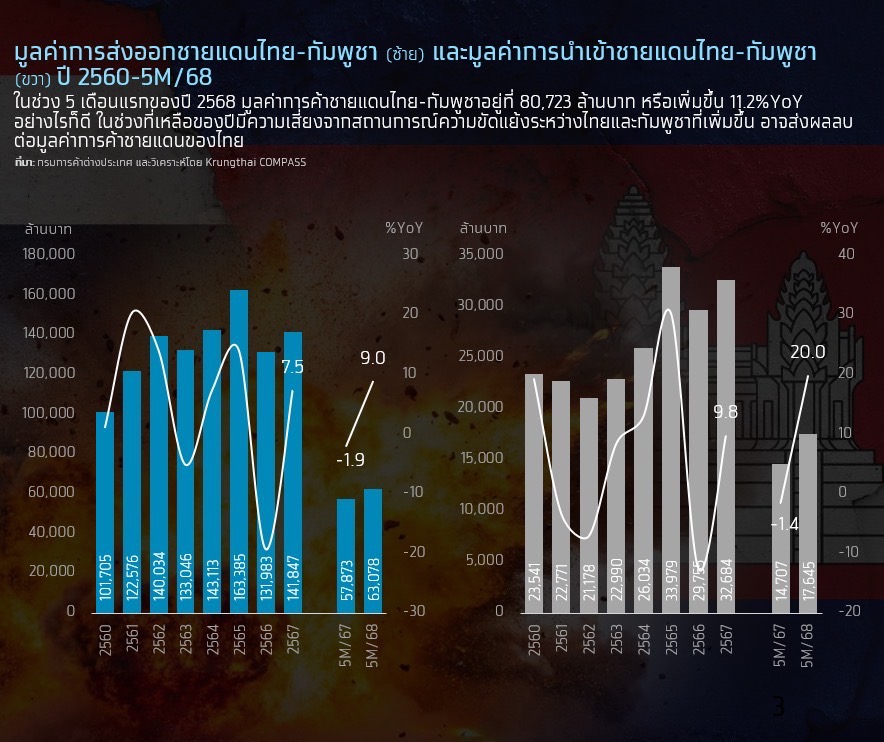
Krungthai COMPASS estimates that the closure of all Thai-Cambodian border checkpoints will result in a loss of approximately 14,011 million baht per month in border trade value, with border exports losing about 11,410 million baht per month and border imports losing around 2,601 million baht per month.
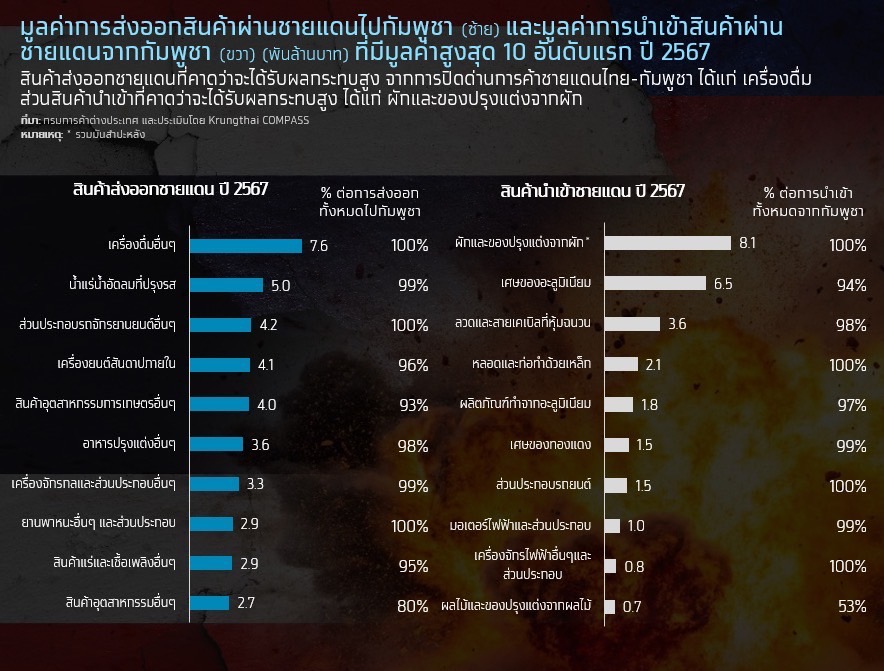
The border trade checkpoints that are likely to be most affected include the Aranyaprathet checkpoint in Sa Kaeo province, which is expected to incur losses of about 8,663 million baht per month, as it is a crucial border checkpoint for the export and import of goods and a convenient route for tourists. In 2024, the value of Thai-Cambodian border trade through the Aranyaprathet checkpoint was 110,718 million baht, accounting for a significant 63.4% of the total Thai-Cambodian border trade value. Other border trade checkpoints likely to be significantly affected include the Khlong Yai checkpoint in Trat province and the Chanthaburi checkpoint in Chanthaburi province, with estimated losses of about 2,457 and 2,159 million baht per month, respectively.
Export products expected to be impacted by the closure of Thai-Cambodian border checkpoints include various beverages, mineral water, flavored soft drinks, motorcycle components, internal combustion engines, and other agricultural industrial products, as these products were exported through the border to Cambodia in 2024 for over 4 billion baht, with border exports accounting for 93%-100% of the value of each item exported to Cambodia.
Import products expected to be impacted by the closure of Thai-Cambodian border checkpoints include vegetables and vegetable seasonings, aluminum scraps, and insulated wire and cables, as these products were imported through the border from Cambodia in 2024 for over 3 billion baht, particularly cassava, which Thailand imports from Cambodia at around 1-2 million tons per year. If checkpoints are closed for several months, it may lead to a shortage of cassava raw materials at certain times, necessitating imports from other sources such as Laos and Vietnam, which could impact related industries in Thailand, such as processed food and animal feed.
- Impact on Tourism
The damage from the unrest is expected to negatively impact the tourism sector by around 2,970 million baht per month, divided as follows:
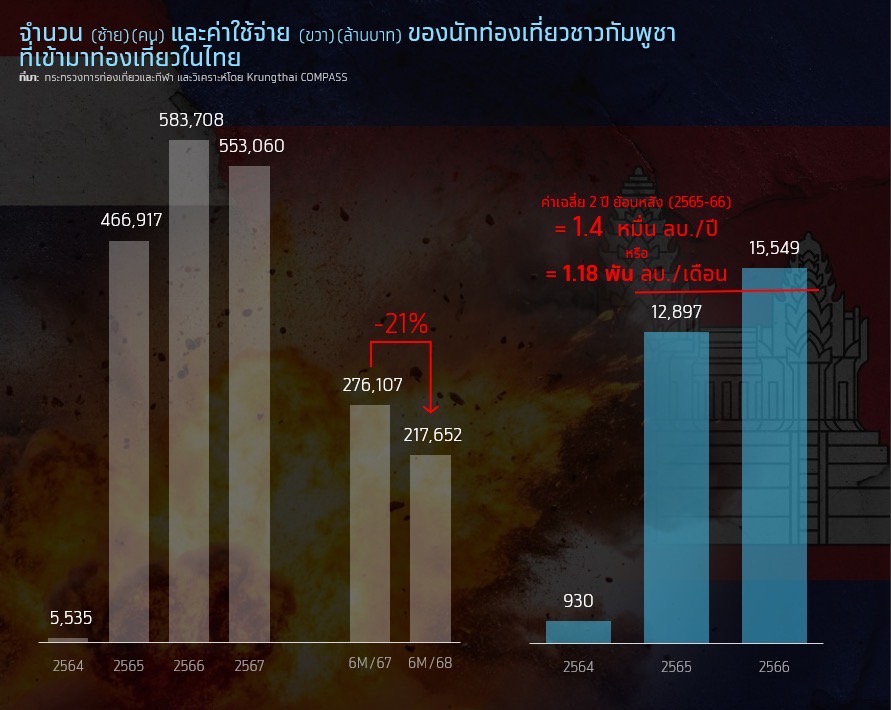
2.1) The impact from the decrease in the number of Cambodian tourists entering Thailand is estimated to result in a loss of about 1,185 million baht per month. Cambodian tourists account for only 2% of all foreign tourists entering Thailand. In the first six months of 2025, the number of Cambodian tourists entering Thailand was 217,652, a decrease of approximately -21% YoY. It is anticipated that the clashes between Thailand and Cambodia will further reduce the number of Cambodian tourists for the remainder of 2025. Based on the latest statistics on Cambodian tourist spending from 2022-2023, the average loss from the lack of income from Cambodian tourists is estimated to be around 1,185 million baht per month.
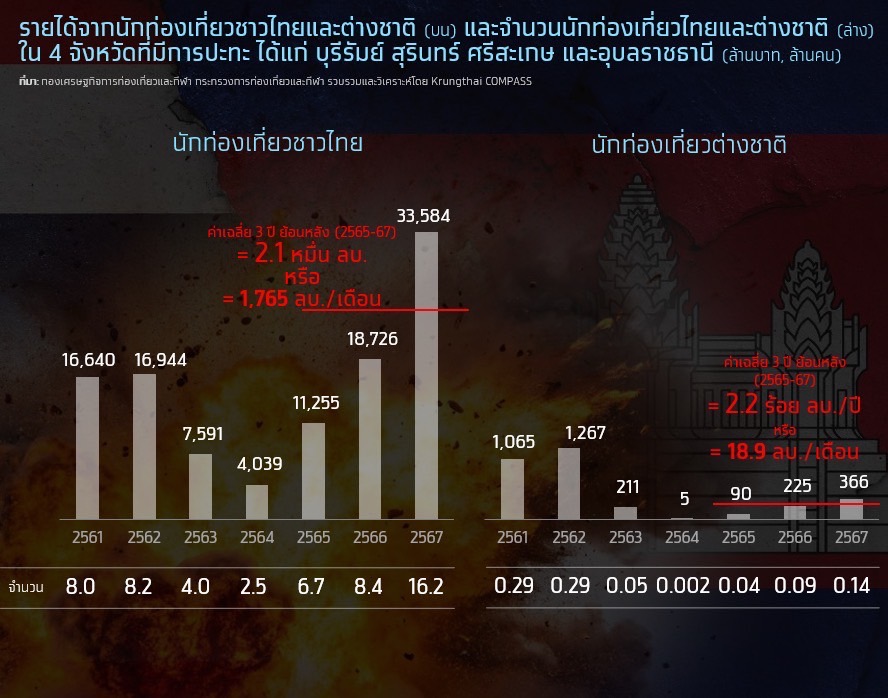
2.2) The tourism damage in the four provinces where clashes are occurring is estimated to be at least around 1,785 million baht per month, divided into 1) loss of income from Thai tourists of 1,766 million baht per month and 2) loss of income from foreign tourists of 19 million baht per month. The above estimates are based on the average historical data of Thai and foreign tourists in 2022-2024. Among these four provinces, Buriram and Ubon Ratchathani are the two provinces with the highest number of Thai and foreign tourists.
Currently, important tourist sites such as Ta Muen Thom and Ta Kwai temples, which are significant border tourist attractions in Surin province, have been ordered closed, and the ongoing clashes are expected to negatively affect upcoming tourism festivals at the end of July 2025, such as the fruit and local goods festival, football competitions, music events, and robot exhibitions in Sisaket province.
- Impact on Investment
Currently, the impact on Thai operators investing in Cambodia outside the conflict zones is not significant, as the clashes are still limited to certain points along the border and have not directly affected operations in urban areas of Cambodia.
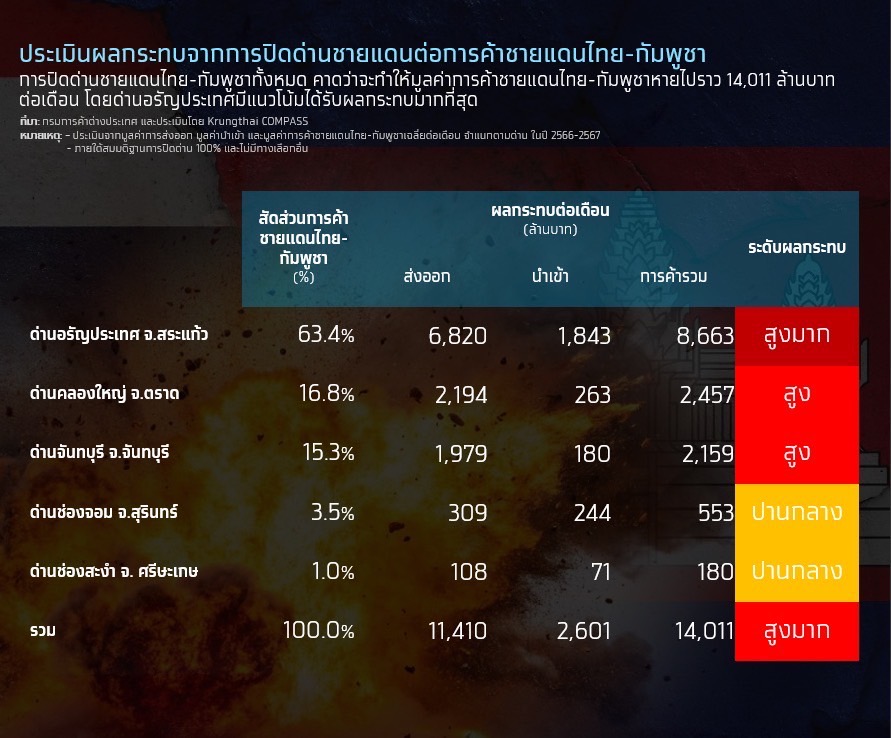
However, if the situation escalates in severity and expands, it may affect Thai operators doing business in Cambodia, of which there are currently over 100, with a total investment value exceeding 50 billion baht. Businesses that may be significantly impacted include beverage and retail sectors. Some Thai operators in Cambodia have prepared emergency management measures in case the situation worsens, and they have also prepared for the evacuation of Thai employees back to Thailand.
1 Referenced from Business Council warns Thai-Cambodian government that prolonged disputes will severely impact trade and raise concerns for Thai investments of 50 billion baht.
2 Referenced from Thai businesses revise plans in Cambodia, cancel events, increase stock, and prepare emergency plans, Bangkok Business News.
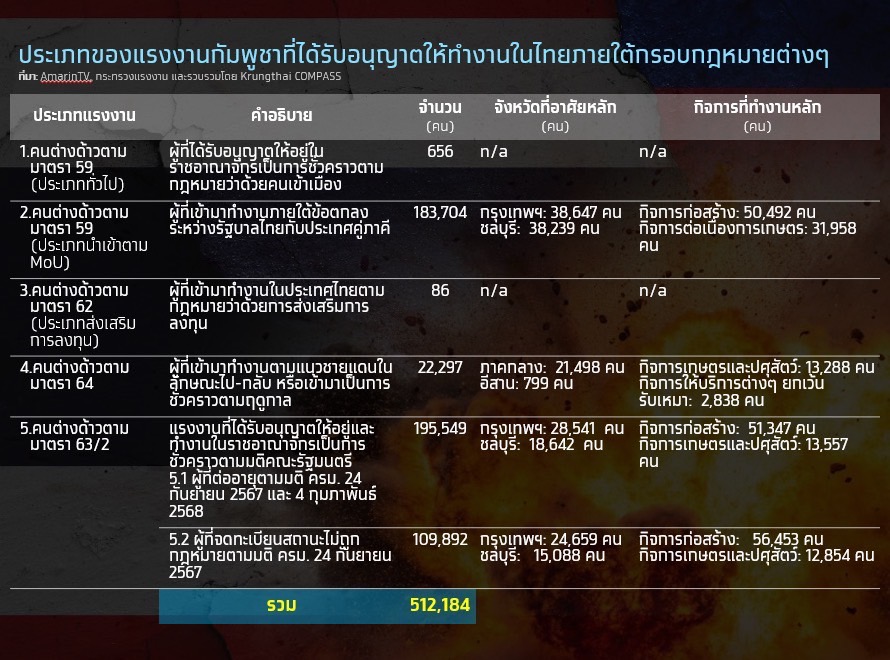
Additionally, Thailand has over 1 million Cambodian workers (approximately 510,000 legal workers). If Cambodian workers are repatriated, it may impact labor-intensive industries such as construction, wholesale and retail, real estate, and fisheries. As of May 2025, Thailand had a total of 4,080,613 registered foreign workers throughout the kingdom, the majority coming from three neighboring countries: Myanmar (2,987,988), Cambodia (512,184), and Laos (289,217).
The majority of Cambodian workers are in the construction sector, with at least 158,000 workers, followed by agricultural processing with at least 31,958 workers, and agriculture and livestock with at least 26,400 workers. Most of these workers reside in Bangkok and Chonburi.
Summary
Krungthai COMPASS assesses that the Thailand-Cambodia conflict will impact through three main channels: border trade, tourism, and investment, with an estimated damage value of at least 17 billion baht per month as follows:
1) Border Trade: It is expected that the closure of five key Thai-Cambodian border checkpoints will result in a loss of approximately 14,011 million baht per month in border trade value, divided into export and import values of about 11,410 and 2,601 million baht per month, respectively. The Aranyaprathet checkpoint in Sa Kaeo province is expected to be the most affected. The export products anticipated to be impacted include beverages, motorcycle components, and internal combustion engines, while the import products include vegetables and vegetable seasonings, particularly cassava.
2) Tourism: The damage to tourism from the decrease in Cambodian tourists entering Thailand and from Thai and foreign tourists unable to visit the four provinces where clashes are occurring is estimated to be at least 2,970 million baht per month.
3) Investment: If the situation escalates in severity and expands, it may affect Thai operators doing business in Cambodia, of which there are currently over 100, with a total investment value exceeding 50 billion baht. Businesses that may be significantly impacted include beverage and retail sectors.
The Thai Ministry of Commerce has assessed the impact of the closure of Thai-Cambodian border trade checkpoints as of June 2025 as follows: In the short term, within the first three months, cross-border small businesses such as border markets will be disrupted, logistics will change routes, and in the medium term (3-12 months), exporters will need to find new markets or routes. If the situation persists for more than a year, Thai industries relying on raw materials imported from Cambodia will begin to affect investor confidence in border stability.
Risk management: Operators should consider diversifying trade to other open checkpoints, as well as developing alternative transportation systems such as rail, maritime, or transport through Vietnam and Laos, along with bilateral negotiations to mitigate economic impacts.
Thank you for the information from: Krungthai COMPASS; Mr. Supree Srisa-arn; Ms. Sukonthip Chaisayan.