Index of Vacant Land Prices Before Development in Bangkok and Surrounding Areas – Q2 2025
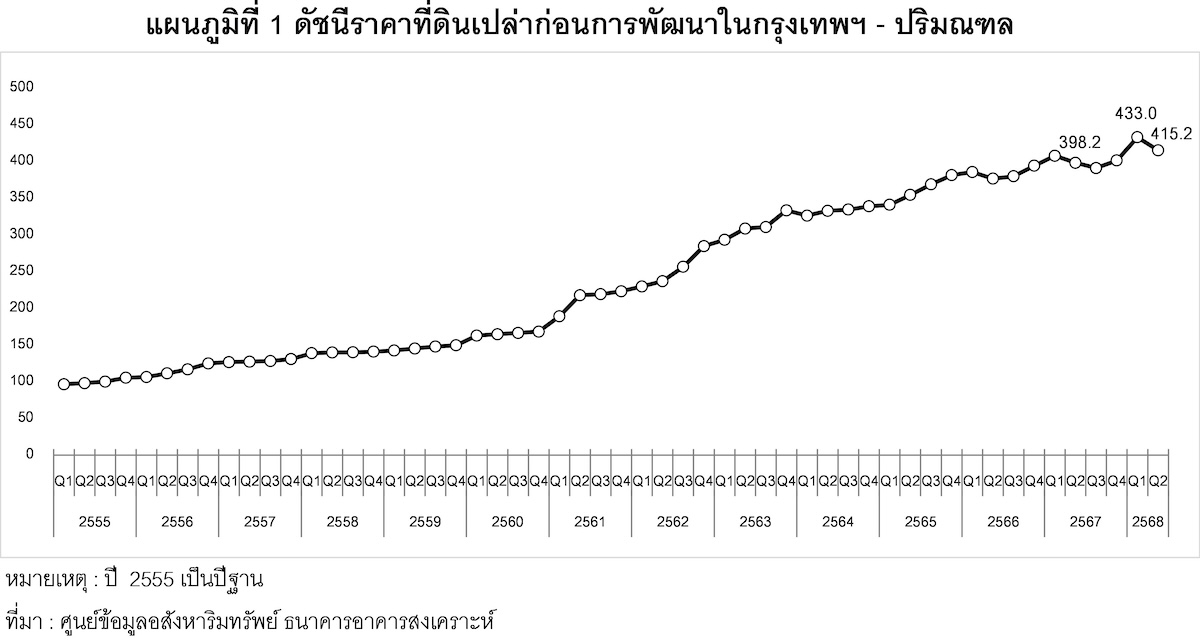
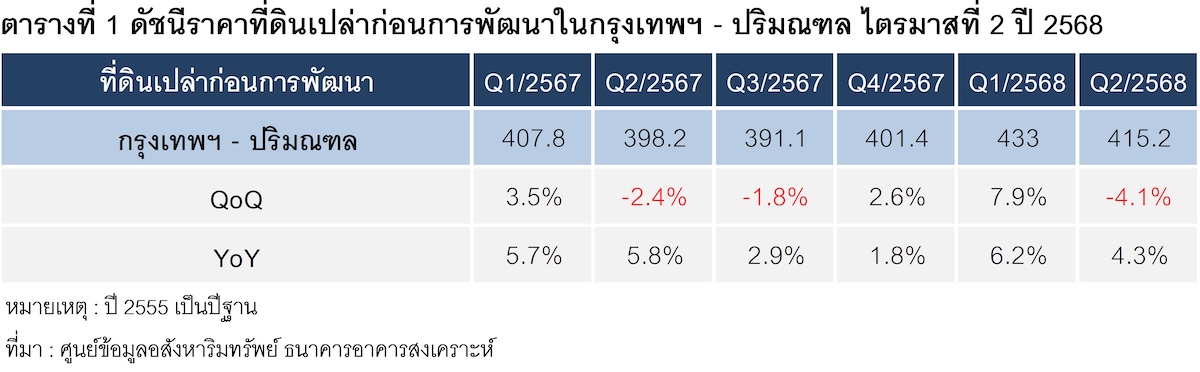
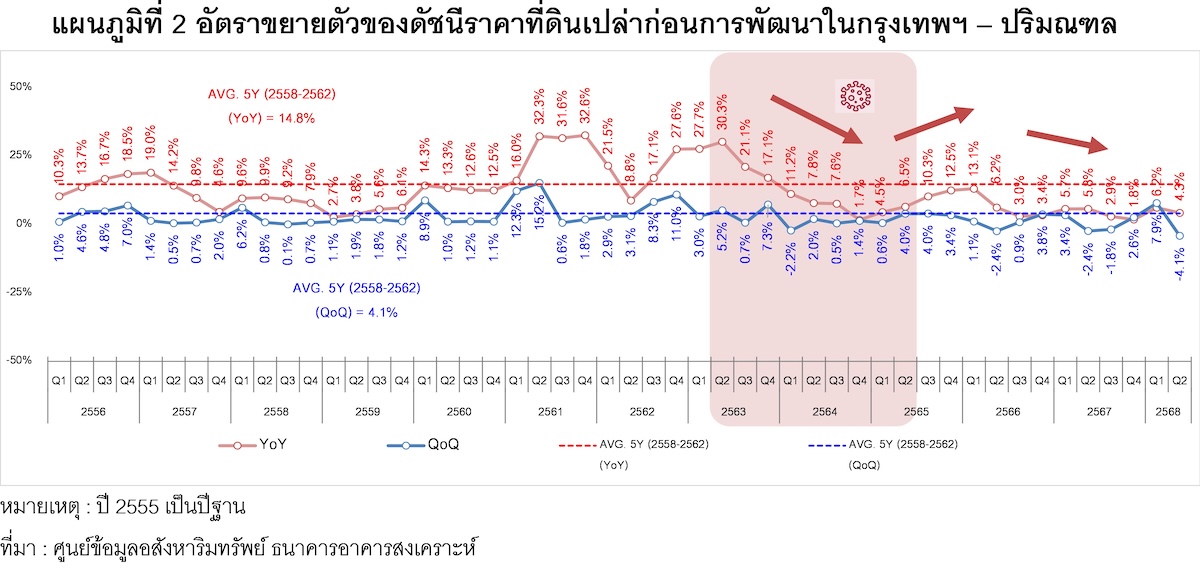
The Real Estate Information Center (REIC) of the Government Housing Bank (GHB) has conducted an analysis on "The Index of Vacant Land Prices Before Development in Bangkok and Surrounding Areas, Q2 2025". The index value is 415.2 points, representing a 4.3% increase compared to the same period last year (YoY), but a decrease of 4.1% compared to the previous quarter (QoQ). The decline compared to the previous quarter is partly due to uncertainties in U.S. economic policies, which have slowed down both the global and Thai economies. Additionally, the postponement of the announcement of the revised Bangkok master plan from 2026 to 2027 has further increased uncertainty regarding future land use, causing many operators to delay decisions on land bank accumulation. Furthermore, the burden from land and building taxes has significantly increased holding costs, leading some to gradually sell land to reduce expenses. Meanwhile, some project developers have adjusted their strategies to diversify investments into key regional cities and high-potential tourist provinces such as Phuket, Chonburi, Rayong, and Chiang Mai, resulting in a slowdown in the rate of land price increases in the Bangkok and surrounding areas compared to previous periods. However, the demand for vacant land in the peripheral areas continues to grow to support the development of residential projects for middle to high-income earners, leading to an increase in land prices, particularly in the Samut Prakan–Phra Pradaeng–Phra Samut Chedi area, which saw a price change rate of up to 39.6% YoY, similar to the land along the Green Line of the BTS, both in Samut Prakan–Bang Pu and Bearing–Samut Prakan, which also experienced a 39.6% increase (details in Table 1 and Charts 1-2).
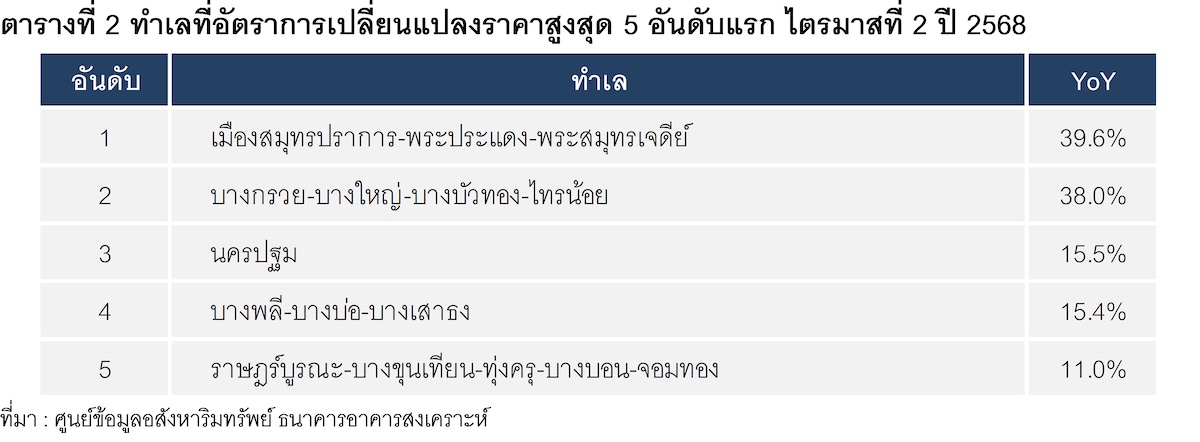
The top 5 locations with the highest rate of land price growth in Q2 2025 compared to the same period last year (YoY) are as follows (details in Table 2):
1st Place: Land in the Samut Prakan-Phra Pradaeng-Phra Samut Chedi area, with a land price change rate of 39.6%, due to continuous urban infrastructure expansion and convenient access to the city center and EEC.
2nd Place: Land in the Bang Krui-Bang Yai-Bang Bua Thong-Sai Noi area, with a land price change rate of 38.0%.
3rd Place: Land in Nakhon Pathom, with a land price change rate of 15.5%.
4th Place: Land in the Bang Phli-Bang Bo-Bang Sao Thong area, with a land price change rate of 15.4%.
5th Place: Land in the Rat Burana-Bang Khun Thian-Thung Khru-Bang Bon-Chao Phraya area, with a land price change rate of 11.0%.
These top 5 land price changes reflect a clear increase in land prices in the peripheral areas due to urban expansion, supported by the development of expressways and the construction of electric train projects. Additionally, land prices in the peripheral areas remain relatively low, making them suitable for developing residential projects that align with the purchasing power of those seeking single-family homes.
In contrast, central urban areas with limited vacant land available for development have led to high values for smaller land parcels. Recently, several mixed-use projects have been constructed along the electric train lines, causing landowners with vacant land (Land Bank) to delay investments to wait for favorable market conditions.
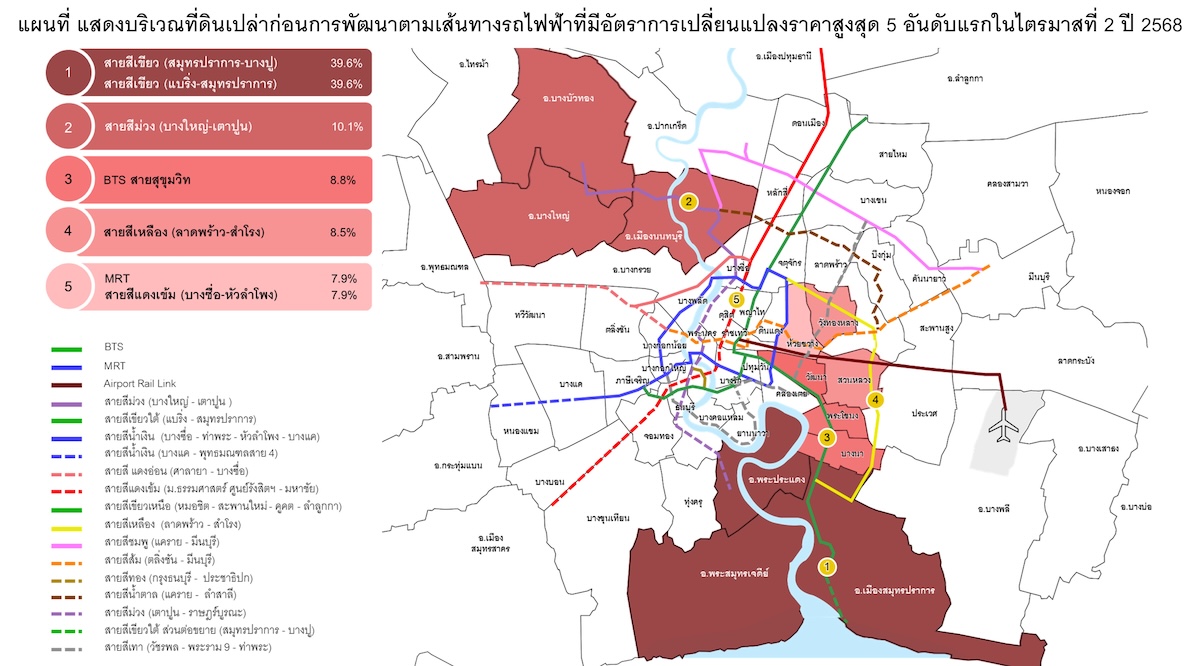
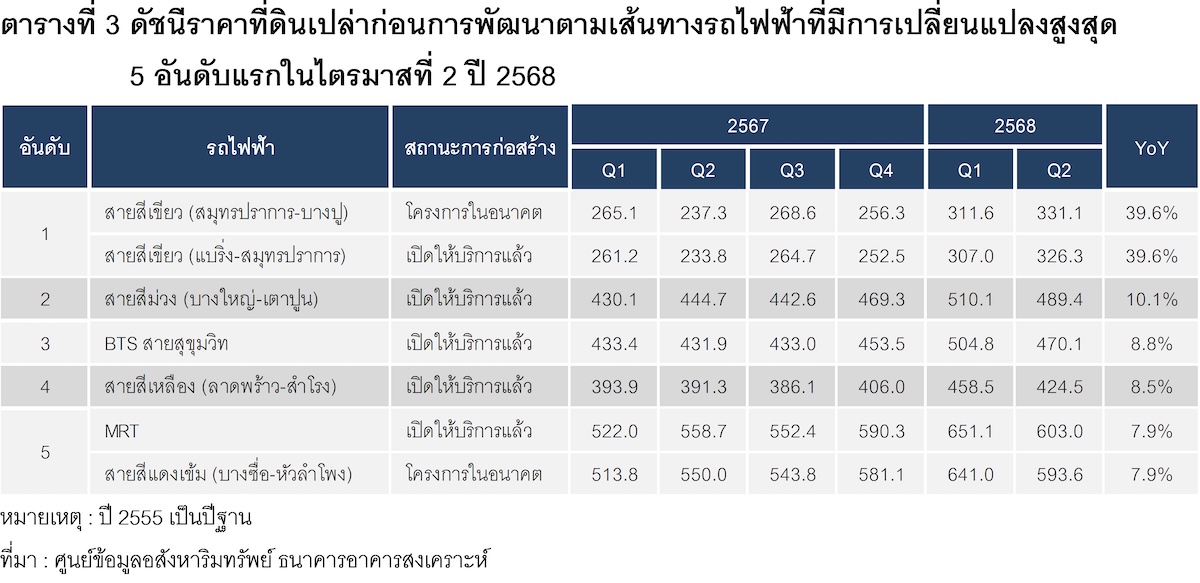
Regarding the prices of vacant land before development along electric train routes in Q2 2025, the top 5 electric train routes with the highest land price growth rates compared to the same period last year (YoY) are primarily located in areas where electric train projects are already operational or planned for future expansion. The details are as follows:
1st Place: Green Line (Samut Prakan-Bang Pu) and Green Line (Bearing-Samut Prakan), with index values of 331.1 points and 326.3 points, respectively, both showing a land price growth rate of 39.6% YoY. The areas of Phra Samut Chedi, Phra Pradaeng, and Samut Prakan city have seen significant price increases.
2nd Place: Purple Line (Bang Yai-Tao Pun), with an index value of 489.4 points and a land price growth rate of 10.1% YoY. The areas of Nonthaburi city, Bang Bua Thong, and Bang Yai have experienced considerable price increases.
3rd Place: BTS Sukhumvit Line, with an index value of 470.1 points and a land price growth rate of 8.8% YoY. The areas of Phra Khanong, Wattana, and Bang Na have seen significant price increases.
4th Place: Yellow Line (Lat Phrao-Samrong), with an index value of 424.5 points and a land price growth rate of 8.5% YoY. The areas of Wang Thonglang and Suan Luang have experienced notable price increases.
5th Place: MRT and Dark Red Line (Bang Sue-Hua Lamphong), with index values of 603.0 points and 593.6 points, respectively, both showing a land price growth rate of 7.9% YoY. The areas of Wattana and Huai Khwang have seen significant price increases (details in Table 3 and the map).
Data Collection Method
The Real Estate Information Center of the Government Housing Bank monitors changes in vacant land prices before development in the Bangkok and surrounding areas, covering 6 provinces: Bangkok, Nonthaburi, Pathum Thani, Samut Prakan, Samut Sakhon, and Nakhon Pathom, using 2012 as the base year and compiling the index quarterly.
The study utilizes data on the transfer of vacant land ownership from the Land Department, selecting only vacant land without buildings, with a minimum size of 200 square wah, and focusing on transfers where the transferor or transferee is a “juristic person,” as these typically reflect actual transaction prices. Real estate development companies must accurately record expenses or revenues to calculate taxes and expenses each year.
The index calculation uses the Chain Laspeyres analysis method, with the land prices calculated as the average price per square wah, weighted by the value of land ownership transfers in the Bangkok and surrounding areas from 2012 to 2016. Factors analyzed using multiple regression analysis include:
(1) Location of the land (2) Land use zoning plans, and (3) Routes of mass transit electric trains.