Thai Tourism in 2025 Expected to Grow by 2.2%, Slowing Down from Last Year; Trend of Thai Tourists Visiting Secondary Cities Increases
- The "Half-Price Thai Travel" program , supported by the government, will cover hotel and accommodation costs up to 3,000 baht per room per night, with a total of 500,000 vouchers available, providing positive factors during the low season.
- However, in 2025, the Thai tourism market faces significant challenges, including a slowing Thai economy, domestic political factors, natural disasters, and an increase in Thai citizens traveling abroad.
- Kasikorn Research Center predicts that in 2025, the number of Thai tourists traveling domestically will reach 205 million trips, an increase of 2.2%, slowing down from the previous year, generating revenue of approximately 1.14 trillion baht, growing by 2%, also slowing down from last year. However, the trend of Thai tourists favoring secondary cities is increasing in both number and revenue.
In the first half of 2025, domestic travel among Thai citizens is expected to grow at a slower rate, with an estimated 101 million trips, or a growth of about 2.3% (YoY), while tourism revenue from domestic travel is projected to be 574.426 billion baht, growing by 3.5% (YoY) (See Figure 1).

Due to negative factors such as earthquakes, increased travel abroad by Thai citizens, and weakened purchasing power among certain consumer groups, some provinces have seen a decrease in domestic travel, including Bangkok, Krabi, Ayutthaya, and Chanthaburi.
In the second half of 2025, domestic travel among Thai citizens is expected to continue growing, but at a slower rate of 1.4% (YoY). The market is supported by existing travel demand and the "Half-Price Thai Travel" program, where the government covers hotel and accommodation costs, along with digital coupons for spending in designated shops. However, the market environment is increasingly challenged by negative factors, including:
- A slowing Thai economy and domestic political factors affecting consumer confidence and income.
- Unpredictable weather conditions may impact travel.
- Thai citizens increasingly prefer to travel abroad, partly due to easier travel conditions from visa-free measures and marketing by travel companies making trips to certain countries more attractive compared to domestic travel, such as package tours or promotional flights to South Korea for 4 days and 2 nights at an average price of 6,000 baht, or to Vietnam at an average price of 7,000 baht.
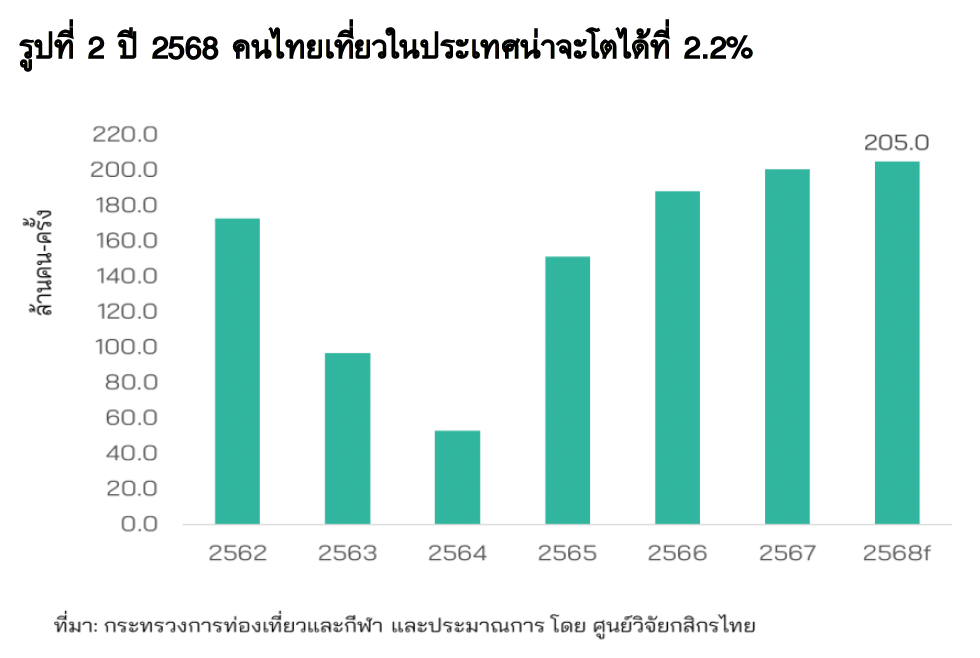
For the entire year of 2025, the Kasikorn Research Center predicts that the number of Thai citizens traveling domestically will reach 205 million trips, growing by 2.2% from the previous year (See Figure 2), but this growth will not be uniform across different areas, as secondary tourist provinces are gaining more interest from Thai tourists.
The trend of Thai tourists visiting secondary cities continues to increase, driven by various factors such as the desire to avoid crowded tourist spots, seeking new attractions, reviews of destinations on social media, and religious tourism.
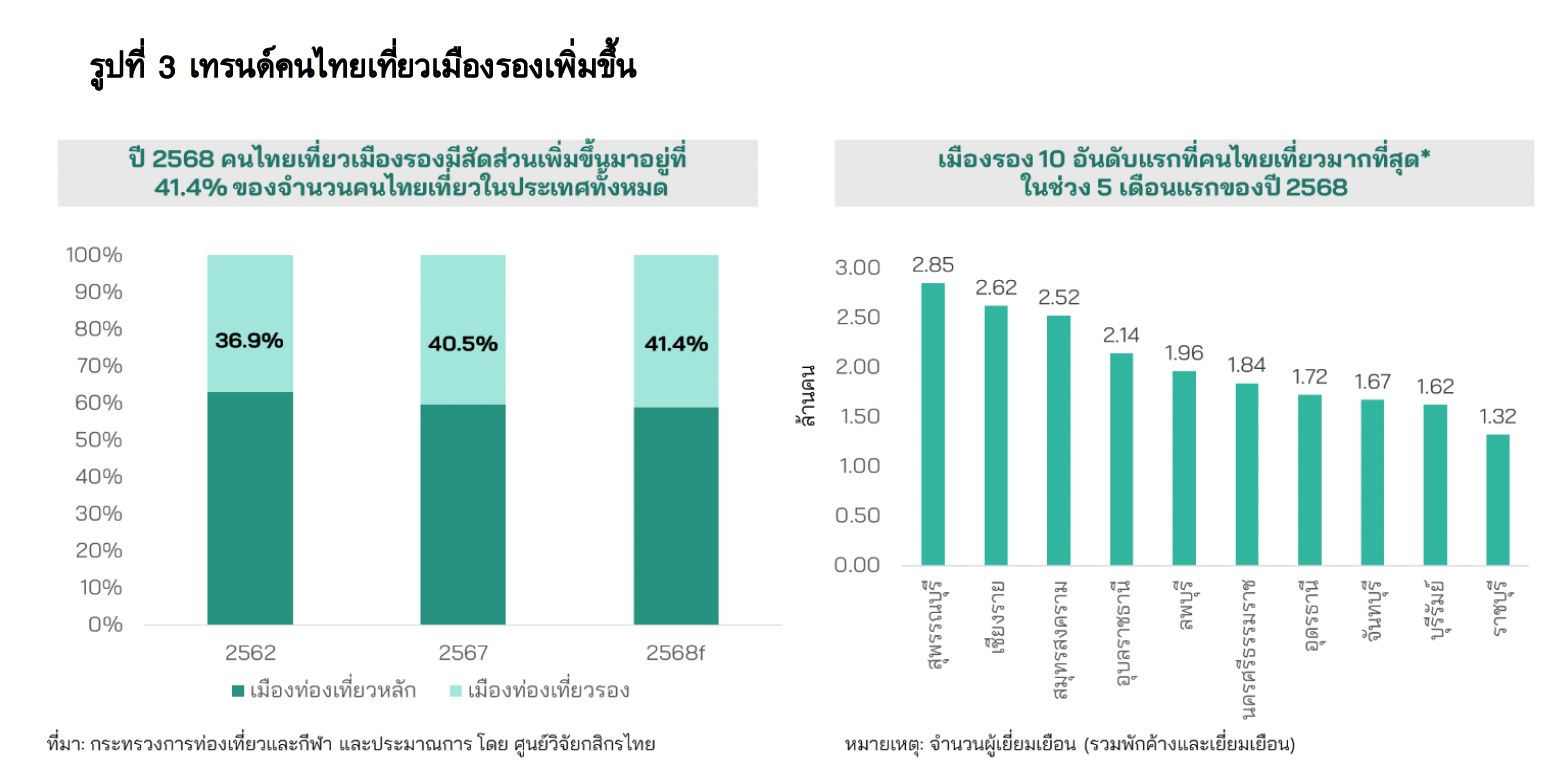
The Kasikorn Research Center expects the proportion of Thai tourists visiting secondary cities in 2025 to increase to 41.4% from 41.3% in the first five months of 2025, with a growth rate of 32.3% compared to the same period in 2022 (before COVID-19). It was found that in many secondary provinces, the number of Thai tourists exceeded 2 million, such as Suphanburi, Chiang Rai, Samut Songkhram, and Ubon Ratchathani (See Figure 3), which is higher than several major tourist provinces like Songkhla, where about 1.4 million Thai tourists traveled, while in Phang Nga, only about 650,000 tourists visited. However, the revenue proportion from secondary tourist cities remains low at around 28% compared to the 72% from major tourist cities of the total revenue from domestic tourism.
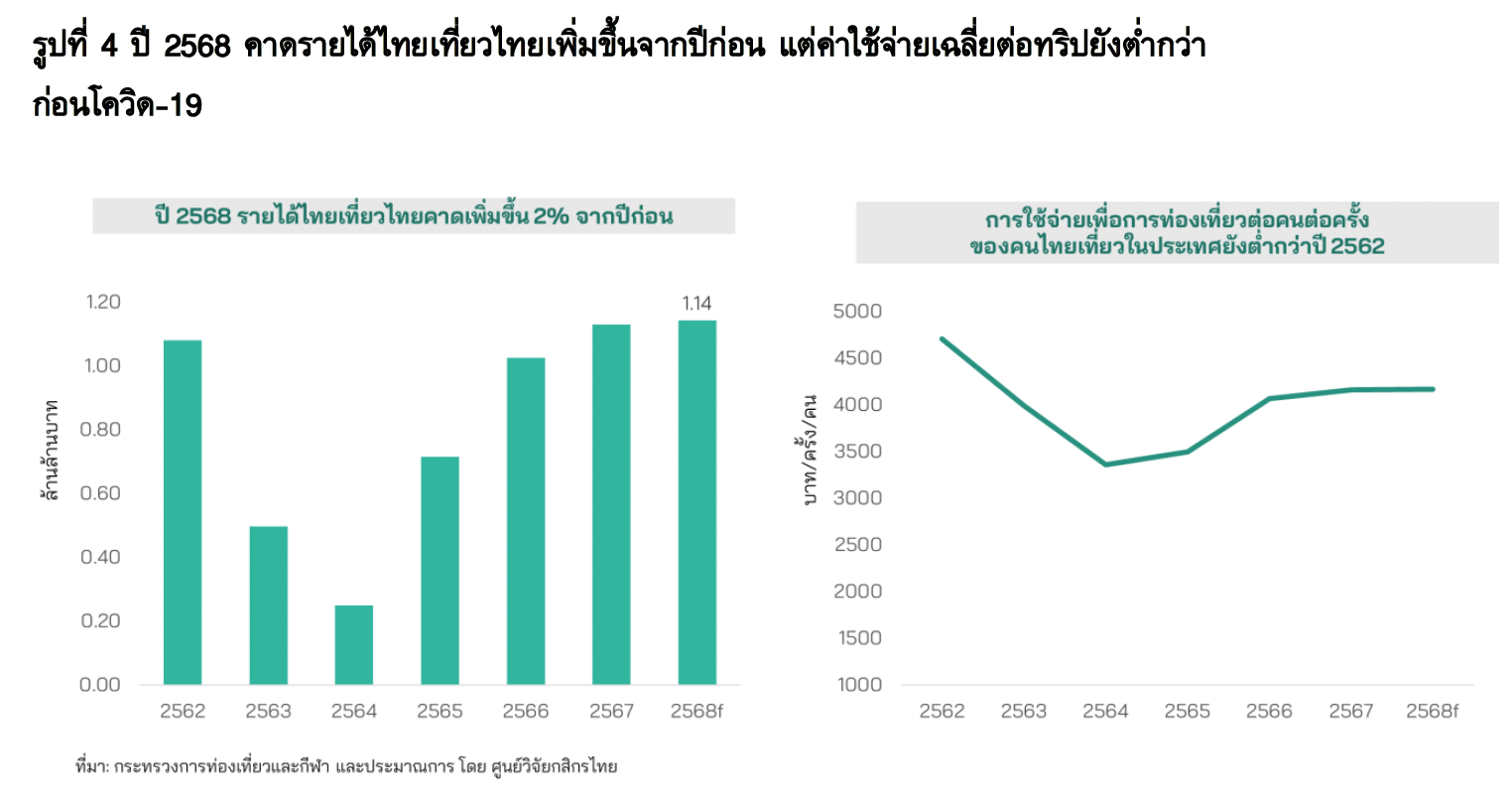
In 2025, the spending of Thai citizens traveling domestically is expected to reach 1.14 trillion baht, expanding by 2% from the previous year, with an average spending of about 4,100 baht per person per trip, still lower than in 2022 (before COVID-19) (See Figure 4).
The per capita spending per trip has not yet recovered compared to the pre-COVID-19 period, due to the slowing economy affecting travel spending, coupled with changing travel behavior among Thai tourists, with more than half (approximately 51% of all domestic tourists) preferring day trips, a trend that is increasing. Additionally, the proportion of Thai tourists visiting secondary cities is rising, but average spending in these areas is around 2,800 baht per person per trip, lower than the average of about 5,000 baht per person per trip in major tourist cities. The lower spending in secondary tourist cities is partly due to lower service prices, such as 4-star accommodation averaging about 1,850 baht per night, which is lower than the average of major tourist cities like Bangkok or Phuket, which is around 3,500 baht per night, along with cheaper food and souvenir prices.
[1] The government will cover hotel and accommodation costs up to 3,000 baht per room per night, with a total of 500,000 vouchers available, allowing a maximum of 5 vouchers per person or per night (3 vouchers for major tourist cities and 2 vouchers for secondary cities). The vouchers can be used based on the travel date, with government support of 50% for weekday travel (Monday-Friday) and 50% paid by the public for hotel bookings. For weekend and public holiday bookings, the government covers 40% and the public pays 60% of the room price, and a 500 baht coupon will be provided for each voucher, which can be used for spending in restaurants, souvenir shops, and OTOP stores in tourist areas when staying. Registration and booking will start from July 1, 2025, and usage will be from July 4 to October 31, 2025.