Housing Market Situation Q1 2025 and Outlook for 2025
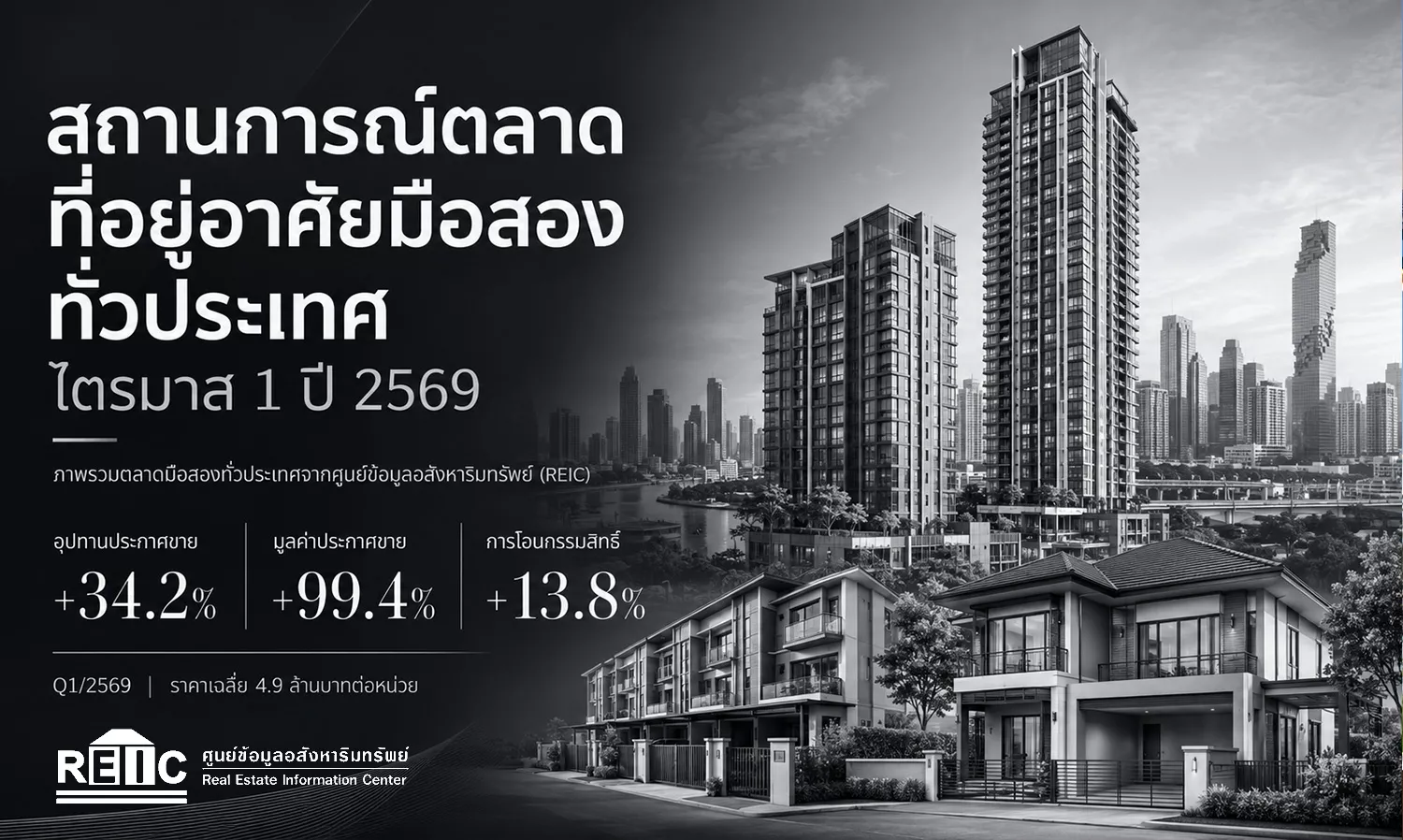
Real Estate Information Center (REIC) of the Government Housing Bank (GHB) has revealed the housing market situation for Q1 2025, indicating a slowdown. The government's measures to reduce transfer and mortgage fees to 0.01% and the temporary relaxation of LTV criteria by the Bank of Thailand (BOT) are expected to support the real estate sector's recovery starting from Q2 2025 onwards.
Mr. Kamolpop Veerapala, Managing Director of the Government Housing Bank and Acting Director of the Real Estate Information Center (REIC), stated that in 2024, the housing market experienced a slowdown due to economic conditions, resulting in a decline in the housing market in Q1 2025 compared to the same period last year. However, the government's announcement of measures to stimulate the real estate sector by reducing transfer and mortgage fees to 0.01% for properties priced below 7 million baht and the temporary relaxation of LTV criteria by the BOT reflects that the government and BOT are implementing targeted measures to stimulate the real estate sector, which is a crucial factor for the housing market starting from Q2 2025 and is expected to positively impact the overall economy in the long term.
The data from the Real Estate Information Center (REIC) indicates that in Q1 2025, the total number of property transfers nationwide was 65,276 units, a decrease of 10.5%, with a total value of 181,545 million baht, down 13.0% compared to the same period last year (YoY). This slowdown was observed across all regions. However, when examining details by province, some provinces still showed growth. The top 10 provinces with the highest property transfer values in Q1 2025 included Rayong and Surat Thani, where both the number of units and values increased. In contrast, Phuket saw an increase in units but a decrease in value, while Samut Prakan experienced a decrease in units but an increase in value. Provinces with declines in both units and values included Bangkok, Chonburi, Nonthaburi, Pathum Thani, Chiang Mai, and Nakhon Ratchasima.
Nevertheless, the nationwide slowdown in property transfers also affected the overall housing loan disbursement in Q1 2025, which similarly decreased. The total value of new personal housing loans nationwide was 109,368 million baht, down 10.0% compared to the same period last year (YoY), which had a value of 121,529 million baht. For the Government Housing Bank (GHB), in Q1 2025, its market share of new housing loans was as high as 42.8%, reflecting that GHB continues to play a significant role in supporting the country's real estate sector.
Regarding the transfer of condominium ownership by foreigners nationwide in Q1 2025, a similar slowdown was observed, with a total value of 3,919 million baht, down 0.5%. The total value of transfers was 16,392 million baht, a decrease of 9.0%. Foreigners accounted for 29.3% of the transfer value, with the top three nationalities with the highest number of transfer units being China, with 1,481 units transferred (down 7.2%) and a value of 6,117 million baht (down 19.2%). Myanmar ranked second with 439 units transferred (up 12.0%) and a value of 1,587 million baht (down 28.1%). Russia ranked third with 288 units transferred (down 2.4%) and a value of 987 million baht (up 6.9%).
Based on the average economic growth forecast for 2025 by the National Economic and Social Development Council (NESDC), the Fiscal Policy Office (FPO), and the Bank of Thailand (BOT), REIC has adjusted its outlook for the housing market in 2025, expecting it to remain stable or experience a slight slowdown compared to 2024. The number of property transfers in 2025 is projected to decrease by only 0.3%, while the value of transfers is expected to decline by 0.8%, and the total value of new personal housing loans nationwide is anticipated to decrease by 0.3%.
However, the government's measures to reduce transfer and mortgage fees for properties priced below 7 million baht, effective from April 22, 2025, to June 30, 2026, along with the BOT's temporary relaxation of LTV criteria for housing loans across all price levels from May 1, 2025, to June 30, 2026, are expected to address the slowdown in the housing market effectively and positively impact the housing market's recovery starting from Q2 2025 onwards.