
Customs Tax, Trade, and Changes: Transforming the Landscape of the Industrial Real Estate Sector by Marcus Bertenshaw, Partner - Head of Logistics and Industrial Advisory
Fstoppers, a photography equipment company from the United States, is facing a harsh reality: the cost of producing simple parts domestically exceeds $80 per piece, while the same part can be produced in China for just $7.50, making it more than ten times cheaper. Their choice is not merely about rearranging the supply chain but deciding whether they can continue to sell that product.
This example reflects the intense pressure that customs taxes place on manufacturers, which directly influences decisions about production locations, factory space requirements, and logistics networks. As these decisions evolve, they are complicated by factors such as geopolitical tensions and the need to build resilience in the supply chain. The resulting impacts are felt directly in the industrial real estate sector, particularly in terms of demand for warehouses, manufacturing plants, and global distribution centers.
This article focuses on analyzing the real impacts of customs tax policies, particularly on small and medium-sized enterprises (SMEs), their competitiveness in the manufacturing sector, supply chain restructuring, and foreign direct investment (FDI). It revisits lessons from the first US-China trade war and explores how China managed to avoid the impacts of customs taxes through various mechanisms, such as direct investment in third-country markets and restructuring supply chains.
The analysis in this article emphasizes the latest US customs taxes arising from trade tensions with China but also offers significant conclusions at a broader level, relevant to policymakers, manufacturers, and investors operating under a changing trade landscape towards a multipolar power dynamic. In doing so, this article aims to shift the conversation from emotional discourse to a strategic understanding based on evidence, which is essential for building sustainable competitiveness in the industrial sector in the long term.
1. The Perspective of SMEs – Often Overlooked Players with a Crucial Role
Small and medium-sized enterprises (SMEs) are often hailed as drivers of innovation but face structural disadvantages under trade policies. SMEs play a significant role in the US's imports from China, particularly in consumer electronics, tools, and specialized parts. However, SMEs cannot absorb customs taxes as easily as larger organizations, which may lead to increased costs and threaten business survival. Many also rely on China's manufacturing infrastructure for prototyping and low-cost tooling.
Impact on the Real Estate Sector:
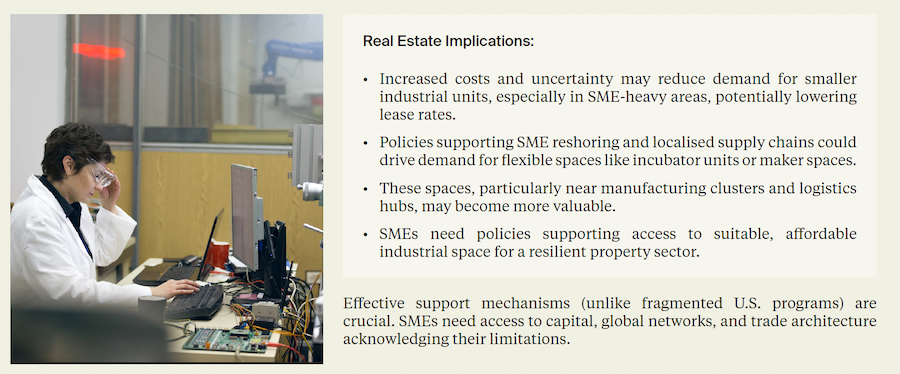
- Increased costs and uncertainty may reduce demand for small industrial space, especially in areas where SMEs are the primary users, potentially leading to lower rental rates.
- Policies supporting the reshoring of manufacturing and building local supply chains may stimulate demand for flexible spaces, such as startup areas or maker spaces.
- These spaces, particularly near manufacturing clusters or logistics hubs, may become increasingly valuable assets.
- SMEs need support from policies that facilitate access to suitable and affordable industrial space to ensure overall real estate flexibility.
Effective support mechanisms (as opposed to the fragmented US programs) are essential for SMEs to access funding, international trade networks, and a commercial ecosystem that understands their constraints.
2. Large Companies and Greater Challenges
While large manufacturers are better equipped to handle customs taxes, they still face limitations in reshoring production and restructuring their businesses. Many multinational corporations can adjust networks or relocate capital, and some are even seeking exemptions from tax policies (which SMEs cannot easily access). However, reshoring is not straightforward due to high domestic costs, a shortage of industrial land, and weak supply chains.
Additionally, geopolitical concerns and supply chain disruptions are pushing manufacturers to prioritize resilience and risk diversification in regional supply chains.
As production returns, the use of automation is increasing. A report from McKinsey Global Institute in 2017 estimated that 60% of manufacturing activities could be automated, and reshoring often relies on investments in robotics and artificial intelligence, which may not create many direct jobs [Reference: McKinsey Global Institute, “A Future That Works: Automation, Employment, and Productivity,” 2017].
Impact on the Real Estate Sector:
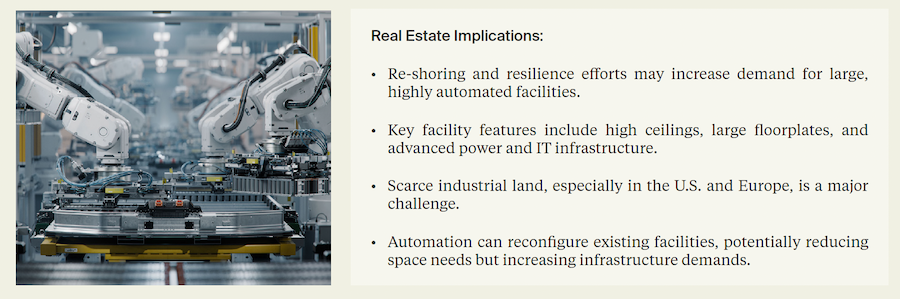
- Efforts to reshore production and enhance supply chain flexibility may stimulate demand for large, highly automated facilities.
- Key features of future factories will include high ceilings, spacious layouts, and infrastructure capable of supporting advanced electrical and IT systems.
- The shortage of industrial land, particularly in the US and Europe, poses a significant obstacle.
- Automation may help restructure existing factories for greater efficiency, even with reduced space usage, but will require more infrastructure.
3. The Automation Mirage
Even as production reshoring occurs, it is under significantly altered conditions, contrary to public expectations. Reshoring does not equate to job creation at previous levels; automation and robotics have drastically reduced the need for labor in manufacturing, making production a capital- and technology-intensive activity. McKinsey's report indicates that over 60% of manufacturing activities can be automated with existing technology, meaning that factories returning to the US will come with fewer jobs but require much higher skills.
This transformation profoundly impacts the industrial real estate sector. While automation reduces the need for space for traditional production lines, it significantly increases the demand for technology and infrastructure in factories. Modern factories must have robust infrastructure, such as high load-bearing floors, high ceilings, advanced electrical capabilities, temperature control systems, and high-speed digital connectivity to support robotics and data-driven production processes.
Moreover, this type of factory requires much higher initial investments compared to traditional industrial spaces, both in terms of new development and upgrading existing spaces, leading manufacturers and real estate developers to carefully consider long-term operational viability, scalability, and return on investment when moving forward with automation-driven reshoring plans.
4. Where Capital Goes When Certainty Doesn’t
While customs taxes aim to encourage manufacturing to return to its home country, the outcome has been a dispersion of production away from China instead. The “China-plus-one” strategy has become standard practice for multinationals seeking cost efficiency and geopolitical security. Countries like Vietnam, Thailand, Malaysia, Canada, and Mexico have benefited from this shift, driven by regional trade agreements, competitive labor costs, and proximity to key markets.
However, the recent implementation of US tax policies, including threats to impose tariffs on imports from Mexico, particularly concerning immigration issues, reflects a significant shift in policy direction [Reference: Office of the United States Trade Representative, “President Trump Announces Tariffs on All Imports from Mexico,” May 30, 2019, and Wall Street Journal, “Trump Threatens Tariffs on All Goods From Mexico to Force Action on Border,” May 30, 2019].
The latest tariffs imposed on imports from Mexico clearly aim to disrupt the trend of nearshoring, demonstrating the government's intent to ensure that production does not merely shift across the border but returns fully to the US. This approach increases uncertainty regarding Mexico as a nearshoring destination and may reduce investment flows into Mexico's industrial hubs.
At the same time, China is proactively adapting, with many Chinese manufacturers relocating production to third countries to maintain competitive costs while still effectively accessing global markets. Research from the OECD and academic articles have shown that foreign direct investment (FDI) in markets like Vietnam and Thailand is one strategy employed to maintain access to global markets and mitigate the impact of US sanctions [Reference: Organisation for Economic Co-operation and Development, “Global Value Chains: Preliminary Evidence on Drivers, Scope and Measurement,” 2012 and Journal of International Business Studies, “The impact of tariffs on the location of foreign direct investment: Evidence from the US-China trade war,” 2021].
This trend has led to a more fragmented and uncertain global manufacturing landscape, forcing companies to face challenges in deciding supply chain locations.
Impact on the Real Estate Sector:
- Increased uncertainty in Mexico due to US tax policies may lead to reduced demand for industrial space from previously strong levels and halt new investments or expansions along the US-Mexico border.
- Southeast Asian countries are likely to gain more attention as alternative nearshoring destinations, resulting in increased demand for warehouse space, distribution centers, and logistics infrastructure in the region.
- Investors and tenants in the real estate sector must closely monitor policy developments and assess risks and volatility in locations that were previously primary manufacturing hubs.
5. What About Strategic Protection?
Proponents of customs tax measures often cite reasons related to "emerging industries" or "national security," especially in strategically important sectors such as semiconductors, pharmaceuticals, critical minerals, and defense industries, which may warrant support due to geopolitical risks and supply chain vulnerabilities exposed during recent significant events. However, relying solely on customs taxes is often insufficient. Protecting industries may help buy time for adaptation but may not automatically lead to innovation or enhanced competitiveness. For instance, the US solar industry remains lagging despite customs tax measures, primarily due to insufficient investment.
Sustainable "industrial revitalization" requires more than just tax measures; it necessitates investments in technology, workforce development, and creating an ecosystem that genuinely supports industrial growth.
Impact on the Real Estate Sector:
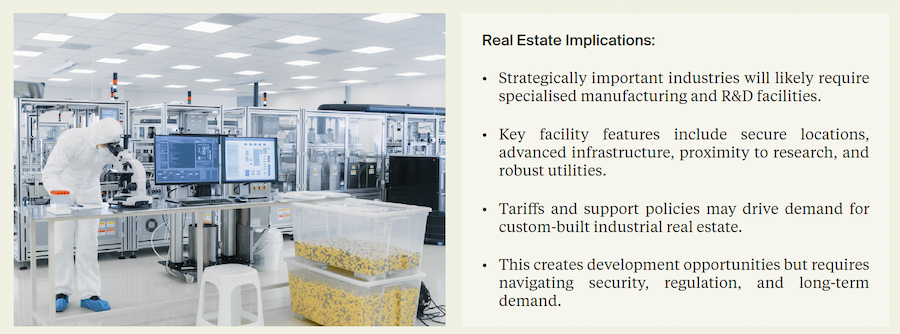
- Strategically important industries will increasingly require specialized manufacturing and research and development spaces.
- These spaces must have specific characteristics, including secure locations, advanced infrastructure, proximity to research centers, and robust utilities.
- Tax measures and supportive policies may stimulate demand for specifically designed industrial spaces, creating opportunities for real estate developers.
- However, these developments must navigate complexities related to security, regulations, and long-term demand assessments.
6. Conclusion – Choose the Foundation, Not the Fix
While customs tax measures can shift trade directions, they do not consistently benefit the industrial real estate sector. These measures increase costs, create uncertainty, and may reduce competitiveness, which is a key driver of demand for modern industrial space. Continued reliance on tax policies may distort markets, hinder investment, and increase volatility.
Sustainable revitalization of the industrial sector requires a stronger foundation, including investment, workforce skill development, and policy alignment. In real estate, this means policies that support long-term growth, stability, and innovation rather than relying on temporary fixes.
These policies should encompass building resilient logistics networks, supporting the development of sustainable and adaptable structures to accommodate ever-changing manufacturing technologies, and utilizing technology to enhance space efficiency. Additionally, collaboration between the public and private sectors is crucial to address land shortages, infrastructure development, and workforce training.
Policymakers must choose a direction: to proceed with a tax-focused approach that risks dispersing supply chains and contracting investment, or to invest in the infrastructure that underpins a strong industrial real estate market.
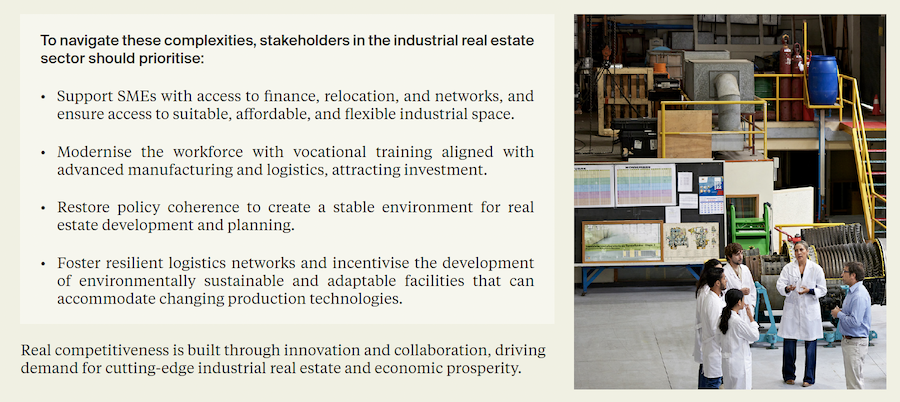
To address this complexity, stakeholders in the industrial real estate sector should prioritize:
- Supporting SMEs in accessing funding, reshoring, and business networks while providing “suitable, affordable, and flexible industrial space.”
- Developing workforce skills through vocational programs aligned with modern manufacturing and logistics to attract investment.
- Restoring policy coherence to create a stable environment for real estate development and long-term planning.
- Building flexible logistics networks and promoting the development of sustainable and adaptable buildings in line with evolving manufacturing technologies.
True competitiveness arises from innovation and collaboration, which are the real drivers of demand in the modern industrial real estate market and lead to long-term economic prosperity.