Trump Delays Import Tax Increase on Inauguration Day, Causing Dollar to Weaken
Donald Trump has officially been sworn in for a second term as President of the United States on January 20, 2025. Trump stated that he would proceed with various key policies he campaigned on, as follows:
- Energy and Environmental Policy: Signed an executive order withdrawing the U.S. from the Paris Agreement on climate change, declared a national energy emergency to increase domestic oil and gas production, and reduce energy prices, as well as canceling the Green New Deal from former President Joe Biden's administration.
- Immigration Policy: Declared a national emergency at the southern border, deported illegal immigrants, sent troops to the southern border to prevent the entry of migrants, constructed additional sections of the border wall, and canceled automatic citizenship for those born in America.
- International Aid Policy: Signed an executive order withdrawing the U.S. from the World Health Organization (WHO), stating that the U.S. had been unfairly contributing excessive funds to the WHO.
- Cost of Living Measures: Ordered federal agencies to take action to reduce the cost of living for American consumers, though details have not yet been specified.
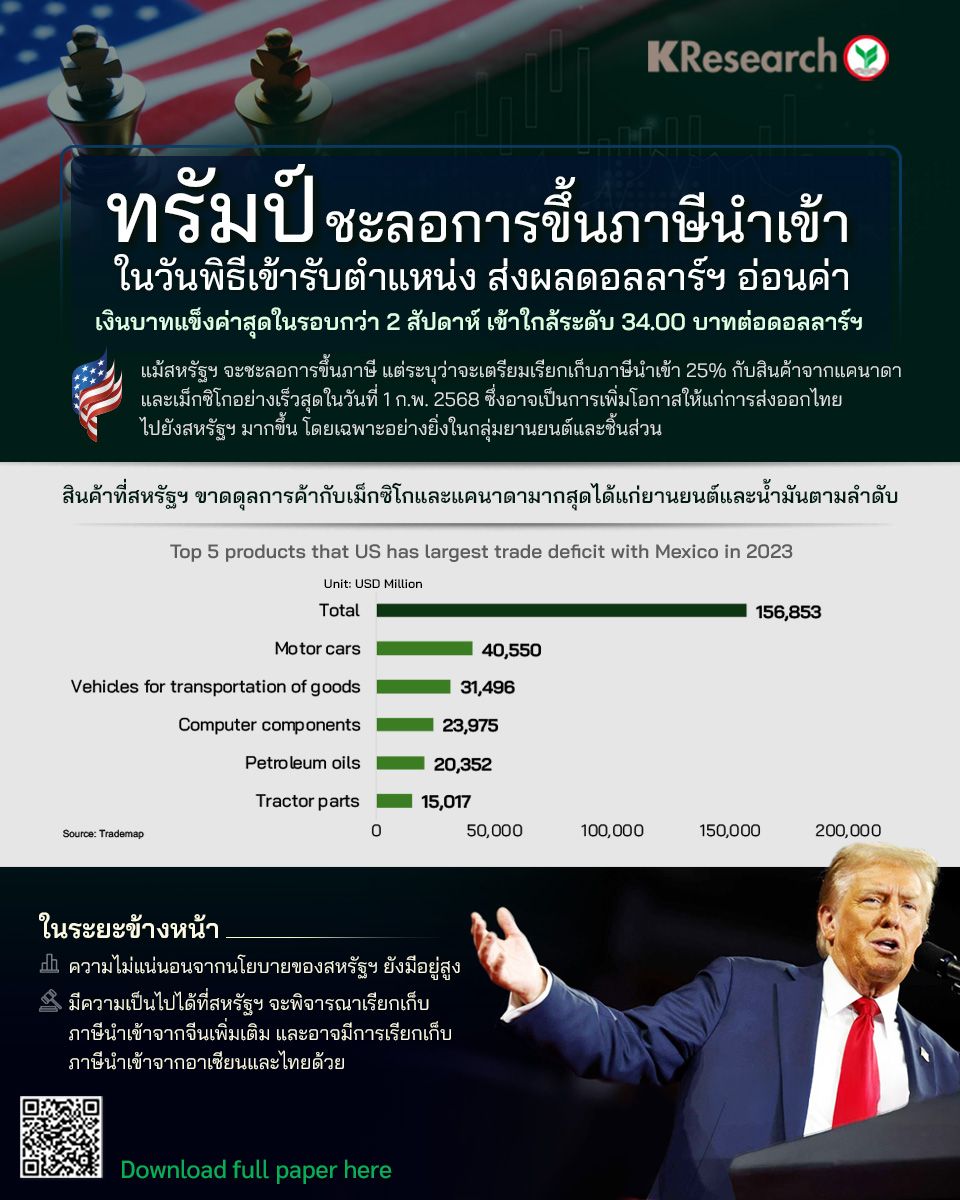
- Regarding Import Tax Increases, Trump has not immediately raised import taxes to investigate economic risks and national security concerns from the ongoing trade deficit, including unfair trade practices and currency manipulation by other countries, particularly China, Canada, and Mexico. Trump indicated that the U.S. plans to impose a 25% import tax on goods from Canada and Mexico as early as February 1, 2025, which could lead to increased trade tensions with countries that signed the U.S.-Mexico-Canada Agreement (USMCA).
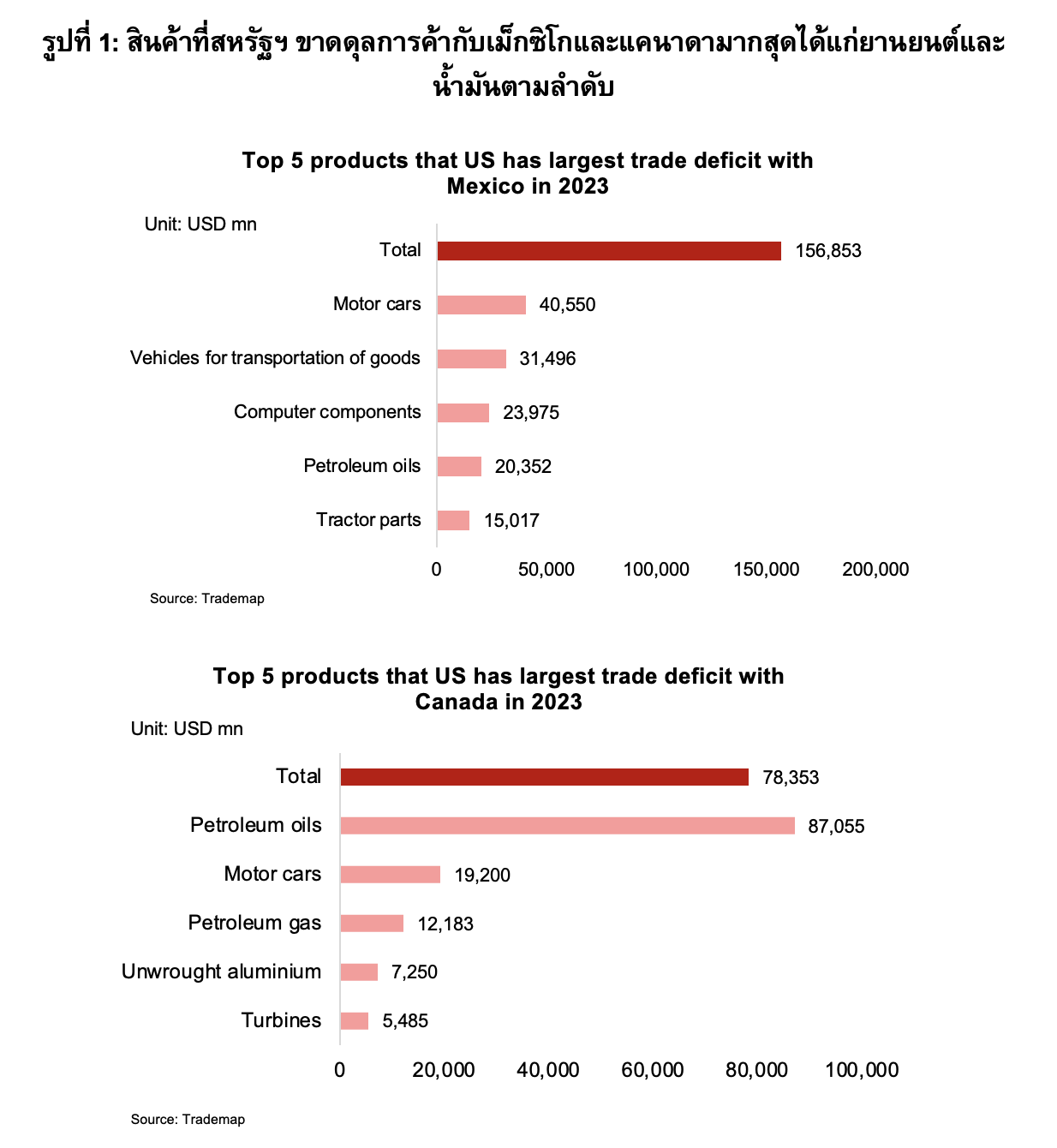
- The import tax increase on Canada and Mexico could impact the U.S. energy and automotive sectors as the U.S. heavily relies on imports and has a trade deficit in energy with Canada and in automotive with Mexico. Although the U.S. has policies to support domestic manufacturing, it may not be sufficient to meet domestic demand, as supply chain adjustments take time. Therefore, the import tax increase on Canada and Mexico could affect the supply chains of the U.S. energy and automotive industries and may increase inflationary pressures in the U.S. This situation could create more opportunities for Thai exports to the U.S., especially in the automotive and parts sectors.
- In the near future, uncertainty from U.S. policies remains high, and there is a possibility that the U.S. will consider imposing additional import taxes on China, as well as potentially on ASEAN and Thailand. The impact on the economy will depend on the timing of the import tax increases, the taxed goods, and negotiations with each of the U.S. trading partners. Kasikorn Research Center believes there is a possibility that the U.S. may impose import taxes on certain goods from Thailand in the second half of this year, particularly on goods where the U.S. has a high trade deficit with Thailand, as well as goods related to China's supply chain, which could lead to a decrease in Thai exports by about 0.5% and affect Thailand's economic growth rate by about 0.3%. The Kasikorn Research Center has already included this impact in its economic forecast for Thailand in 2025 at 2.4%.
- Following Trump's inauguration, the dollar has weakened due to the delay in the import tax increase, resulting in the Thai baht strengthening to nearly 34.00 baht per dollar, the strongest level in over two weeks, while Asian stock markets opened positively, including Japan's Nikkei index, China's CSI 300 index, and Thailand's SET index.
Discussion
Follow breaking news Investment property articles on Facebook, click here.