By 2025, foreign tourists visiting Thailand are expected to reach 37.5 million, generating approximately 1.78 trillion baht in tourism revenue (Kasikorn Research Center)
- In 2025, the number of foreign tourists visiting Thailand is expected to continue growing, but there is high uncertainty due to economic and geopolitical risks, international tourism competition, and safety perceptions. The Kasikorn Research Center forecasts that the total number of foreign tourists visiting Thailand in 2025 will be 37.5 million, an increase of 5.6% from 2024.
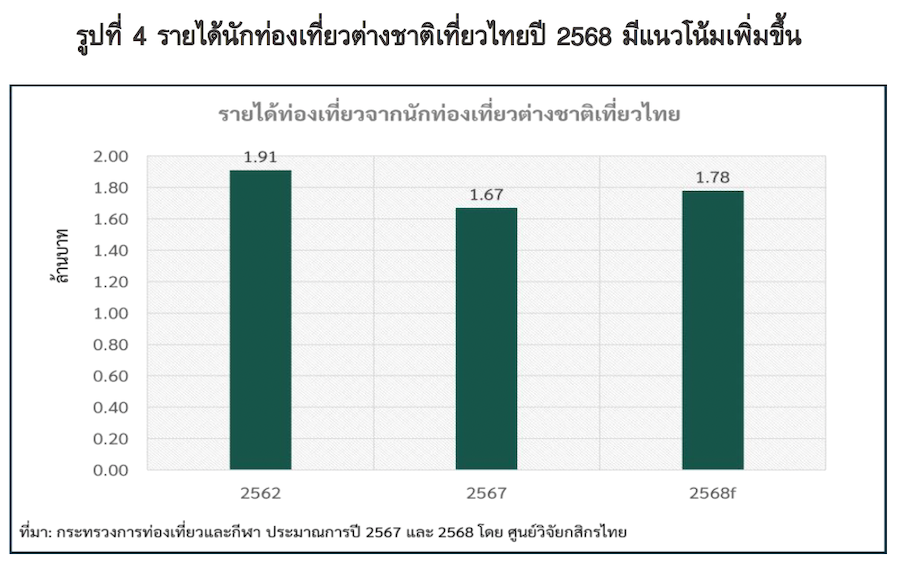
- Revenue from foreign tourists visiting Thailand is projected to be 1.78 trillion baht, growing by 6.5% from 2024, although the average spending per person per trip remains lower than in 2019 due to economic factors and changing tourist behaviors.
The Kasikorn Research Center believes that the foreign tourist market in Thailand will continue to grow in 2025 due to the free visa measures that facilitate travel, and competition in the airline industry that keeps ticket prices stable. In 2024, low-cost airlines expanded routes to Thailand, making travel cheaper, along with government and private sector marketing efforts to stimulate tourism. According to data from the Ministry of Tourism and Sports, from January 1-12, 2025, the number of foreign tourists was 1.32 million, a growth of 19.9% (YoY).
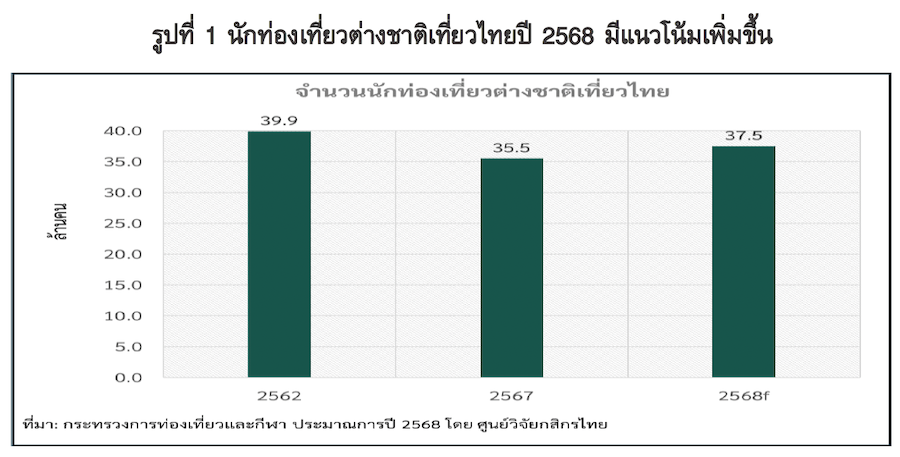
For the entire year of 2025, the Kasikorn Research Center estimates that the number of tourists may reach 37.5 million (Figure 1), but compared to the high base in the previous year, the growth rate of the foreign tourist market will slow to 5.6% from 26.3% growth in 2024. This is due to four key factors:
- Global economic uncertainty and geopolitical issues, which affect purchasing power and travel decisions of tourists. The direction of global economic growth still faces risks from U.S. economic and trade policies, the recovery of the Chinese economy, the war between Russia and Ukraine, and ongoing issues in the Middle East. These factors influence travel demand.
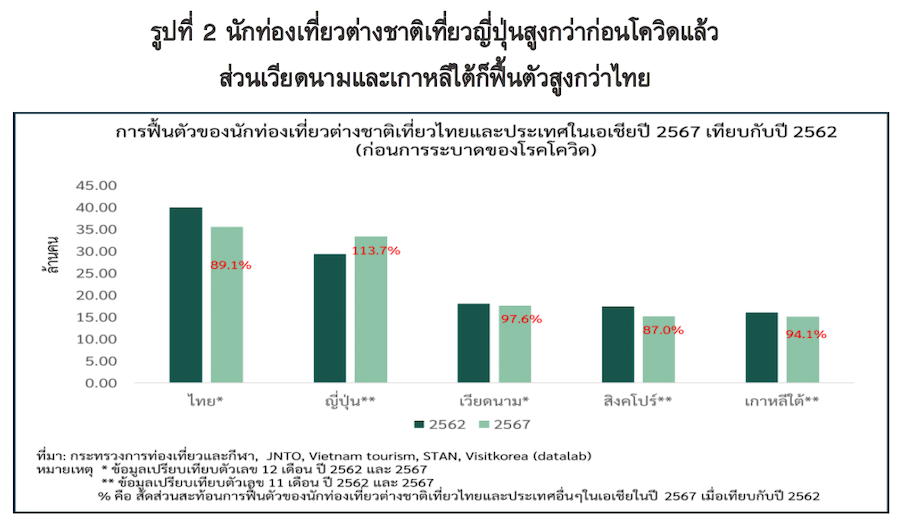
Tourist trends show interest in new destinations, while competition to attract foreign tourists among countries is increasing, as many countries promote tourism as a driver of economic growth through measures like free visas. This presents a challenge to Thailand's tourism competitiveness, reflected in the recovery of foreign tourist numbers in several Asian countries, especially Japan (Figure 2).
- The perception of safety in tourism and the quality of tourism services. An incident involving a Chinese celebrity earlier this year led to cancellations of trips to Thailand by Chinese tourists. This event impacted the number of Chinese tourists visiting Thailand in early 2025, falling short of expectations and creating risks for other markets as well. This issue also encompasses safety concerns regarding water tourism, where accidents have occurred continuously. If these issues can be resolved, it would positively impact the foreign tourist market.
- The direction of currency fluctuations, which can be both a positive and negative factor for the foreign tourist market. In 2025, although the Thai baht is expected to weaken, which is a positive factor for the foreign tourist market in Thailand, it is also necessary to consider the currency trends in each market compared to other tourist destination currencies.
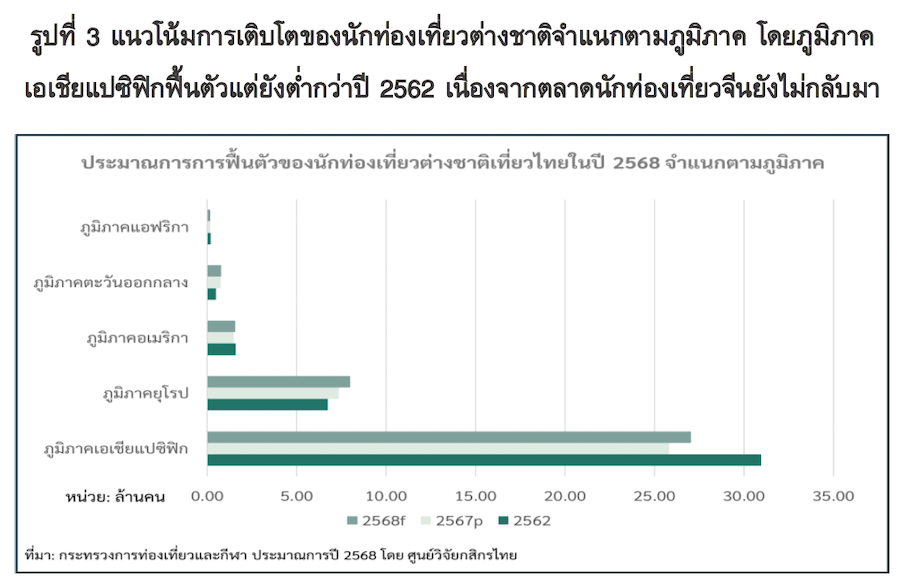
The top five foreign tourist markets remain unchanged from the previous year. Chinese tourists still hold the number one spot, followed by Malaysia, India, South Korea, and Russia. However, the driving force for growth mainly comes from tourists from Europe, partly due to European airlines expanding direct flight routes and increasing flight frequencies between Thailand and European countries (Figure 3).
Tourism revenue from foreign tourists is expected to be approximately 1.78 trillion baht in 2025, expanding by 6.5% from 2024. (Figure 4) The average spending per person per trip is expected to be around 47,400 baht, an increase of about 0.8% from 2024, but still a slight decline of 1.0% compared to 2019. When considering the distribution of foreign tourist spending across various business sectors and tourist areas, it is found that the recovery is not uniform.
- More than one-third of the average trip expenses of foreign tourists are spent on hotels and accommodations. The trend in accommodation expenses is increasing due to rising service costs (in 2024, the average room rate increased by over 30% from 2019). While spending on souvenirs, recreational activities, and attractions has increased from the previous year, it remains lower than in 2019, primarily due to changing tourist behaviors.
- Over 80% of tourism revenue from foreign tourists is concentrated in three main tourist cities: Bangkok, Phuket, and Chonburi. This aligns with the fact that over 70% of foreign tourists' travel in Thailand is concentrated in these three provinces.