EPG Emphasizes Strategy to Balance Risks and Opportunities for Business
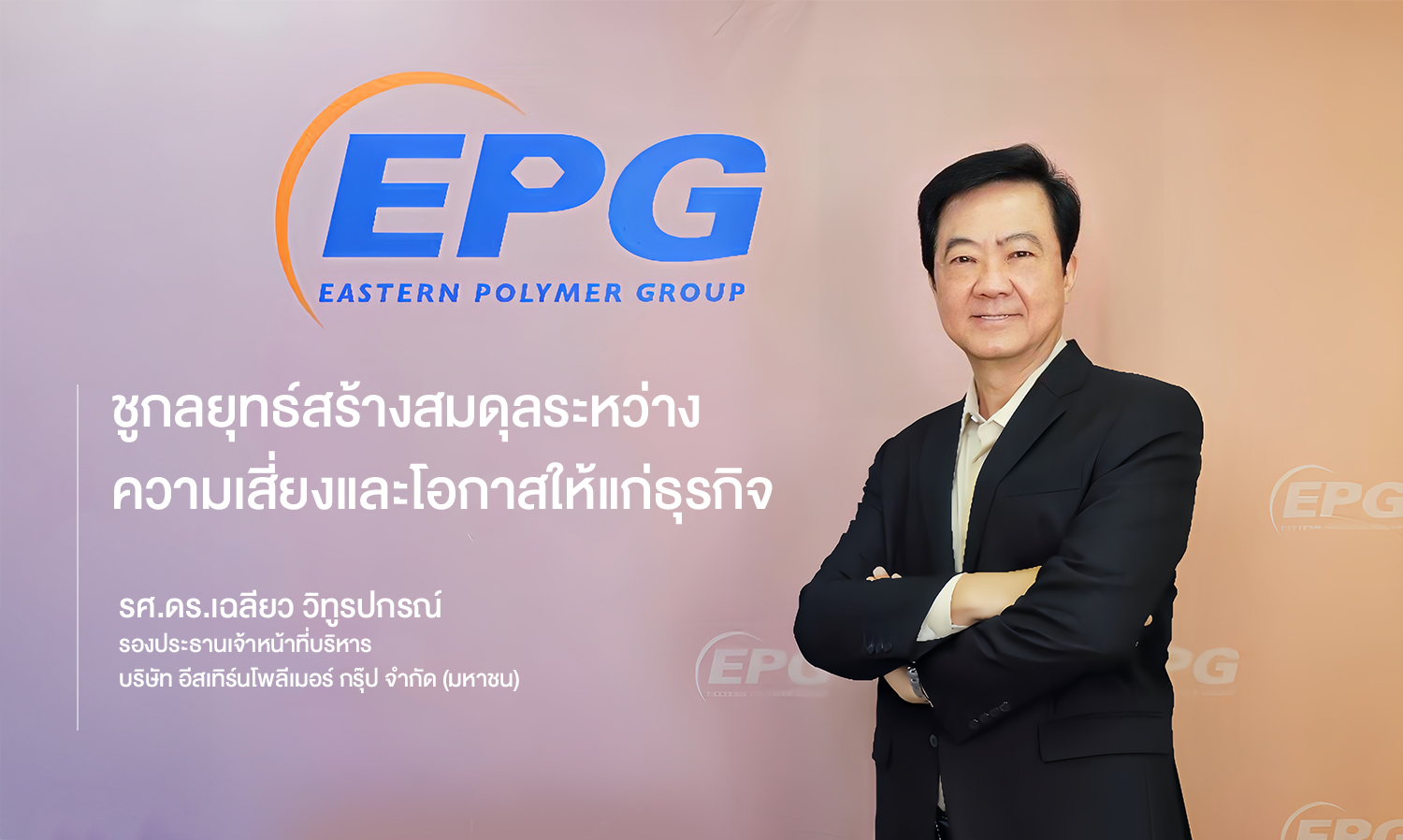
Associate Professor Dr. Chaliyo Witoorapakorn, Deputy CEO of Eastern Polymer Group Public Company Limited (EPG), a leading global manufacturer and distributor of polymer and plastic products, revealed that 2025 is a year when businesses must prepare to cope with the volatility of the global economy. This is due to ongoing geopolitical conflicts, escalating trade barriers, and a new round of trade wars. It is essential for the company to adjust its strategies and plan meticulously to create a balance between risks and seizing opportunities for the business.
Regarding international factors - the United States, when Mr. Donald Trump assumes the presidency for the second time, is expected to implement policies from his campaign. In terms of tax reform, there are proposals to extend corporate income tax reductions and lower corporate tax rates for certain business sectors to stimulate economic growth. Therefore, considering the thermal insulation business under the Aeroflex brand in the United States, Aeroflex USA Inc., a wholly-owned subsidiary of the company, should benefit from this situation. In the case of the Universal Baseline Tariff policy, which sets a basic tariff rate of 10% or more for imported goods from all countries, aimed at promoting domestic production and reducing dependence on foreign products, Aeroflex USA Inc. currently imports semi-finished raw materials from Aeroflex Co., Ltd. in Thailand for further production in the United States. Since the import tariff on semi-finished raw materials is lower than that on finished goods, the company must await further clarity on this policy. Regarding labor issues, Aeroflex USA Inc. employs skilled and legally compliant labor in the United States and utilizes high-speed automation and new technologies to replace some labor. Additionally, the economic stimulus policy in the United States promotes private investment, positively impacting the thermal insulation business as well. In terms of trade wars, the positive outcome is the relocation of production bases to Thailand. Currently, Aeroflex Co., Ltd. has begun to benefit from relocating production and establishing new manufacturing facilities, including an EV automotive factory and a Data Center.
In terms of the overall automotive industry in the country, it faces significant challenges from domestic economic issues and consumers increasingly opting for electric vehicles. Factors contributing to market contraction include rising household debt, decreased purchasing power, stringent automotive loan approval processes, and fierce competition from electric vehicle brands, particularly from Chinese automakers. However, under the government's economic stimulus measures, it is expected that household debt burdens will be alleviated, along with relaxed automotive loan approval criteria, to help automotive sales grow again in 2025. Nevertheless, the automotive parts and accessories business under the Aeroklas brand has diversified its risks by launching new products for Japanese automotive manufacturers and focusing on producing lightweight innovative products that are in demand in both combustion engine and EV automotive industries. With Aeroklas's production standards, it has recently passed inspections from Chinese automotive manufacturers, which will provide opportunities to be part of the supply chain in the future as the electric vehicle market for pickup trucks in China grows.
For the business in Australia, Aeroklas Asia Pacific Group Pty. Ltd. (AAPG) is implementing plans to reduce selling and administrative costs by ceasing operations at TJM Off-Road Products Inc. in the United States due to high operational costs, particularly transportation expenses in the U.S. However, AAPG Australia will continue to manage customers in the United States. The plastic packaging business under the EPP brand faces a highly competitive market, necessitating a balance in the customer portfolio, focusing on increasing the proportion of industrial customers. EPP has strengths in technology and production innovation, as well as various standards such as ISO, GMP, HACCP, BRC, and FSC, allowing it to expand its customer base. This year, it plans to expand into international markets and increase the diversity of packaging to meet customer demands, including paper packaging and bioplastic packaging.
Regarding the prices of petrochemical raw materials, there is a continuous downward trend. The boom era of petrochemicals has passed, with Chinese plastic pellet manufacturers and emerging Middle Eastern countries increasing production capacity significantly, leading to excess supply. It is expected that U.S. oil production will increase significantly under the new administration of Mr. Donald Trump, which will also lead to an increase in petrochemical production. Companies that use key raw materials such as HDPE, PP, PS, and PET will benefit from lower raw material prices.
Associate Professor Dr. Chaliyo further stated that for the fiscal year 2025 (April 2025 - March 2026), the company aims for sales growth of approximately 8 - 10% and a gross profit margin of 30 - 33%. For the first six months of the fiscal year 2025 (April - September 2025), the company reported sales of 7,182 million baht, an increase from 6,285 million baht in the same period last year, representing a 14% increase, with a gross profit margin of 34%, in line with targets. However, net profit was 391 million baht, down 47% from the same period last year due to foreign exchange volatility and the establishment of expected credit loss (ECL) reserves. Nevertheless, the company has systematically addressed the ECL issues. Production process problems in the joint venture in South Africa have been resolved, and negotiations with the entire supply chain are ongoing, showing gradual improvement.
The core businesses, including thermal insulation under the Aeroflex brand, automotive parts and accessories under the Aeroklas brand, and plastic packaging under the EPP brand, are operating according to the business plan. The company also receives regular profit shares from investments in joint ventures. It is expected that in the second half of this fiscal year (October 2025 - March 2026), the business will grow well according to the set targets.