In-Depth Look at Thailand Taxonomy Phase 2: Advancing Towards Green Standards in Agriculture, Manufacturing, Real Estate, and Waste Management
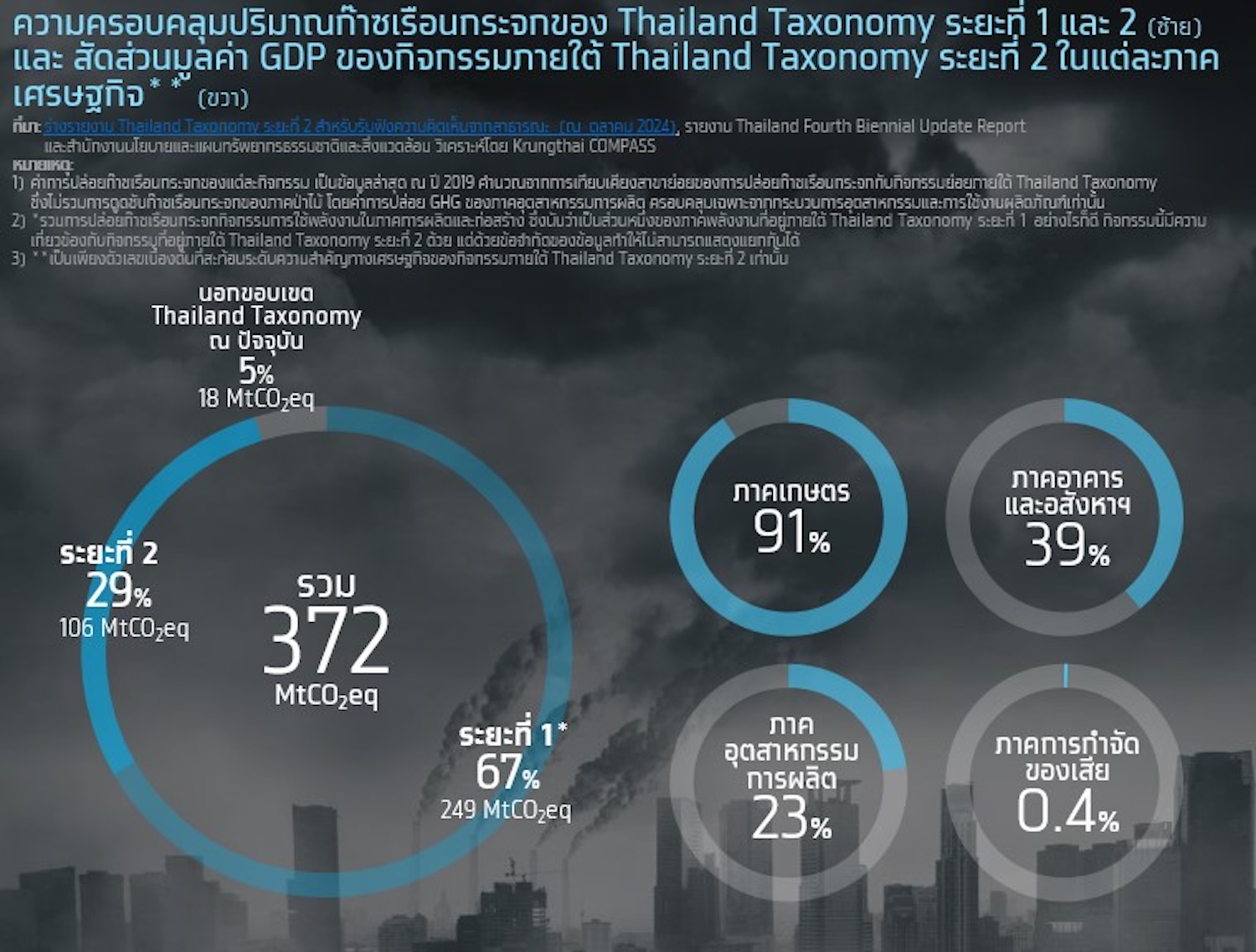
Climate change is one of the major challenges that the world must urgently address. Many countries have adopted the Taxonomy system as a tool to classify economic activities that support greenhouse gas emission reductions, establishing clear standards for sustainable economic activities to encourage investment in environmentally friendly initiatives. In Thailand, the complete version of Thailand Taxonomy Phase 1 was published in 2023, covering activities in the energy and transportation sectors, which account for approximately 67% of the country's greenhouse gas emissions.[1]
Thailand Taxonomy Phase 2 will expand to include four additional economic sectors:
1) Agriculture
2) Manufacturing Industry
3) Real Estate and Buildings
4) Waste Management
This phase is currently open for public feedback and is expected to be published in 2025, continuing to focus on addressing climate change and achieving the country's greenhouse gas reduction targets. Although Thailand Taxonomy is not a law or regulation, it is significant as both public and private sectors, including financial institutions, will use it as a mechanism to support investment in environmentally friendly activities and encourage Thailand's transition to greener business practices.
This article from Krungthai COMPASS invites readers to prepare for Thailand Taxonomy Phase 2 by outlining the categorization of activities in the economic sectors, the scope, and the criteria for environmentally friendly activities, the challenges faced by various operators, and presenting preparations for Thai entrepreneurs, the government, and the financial sector.
Understanding Thailand Taxonomy and the progress of Thailand Taxonomy Phase 2
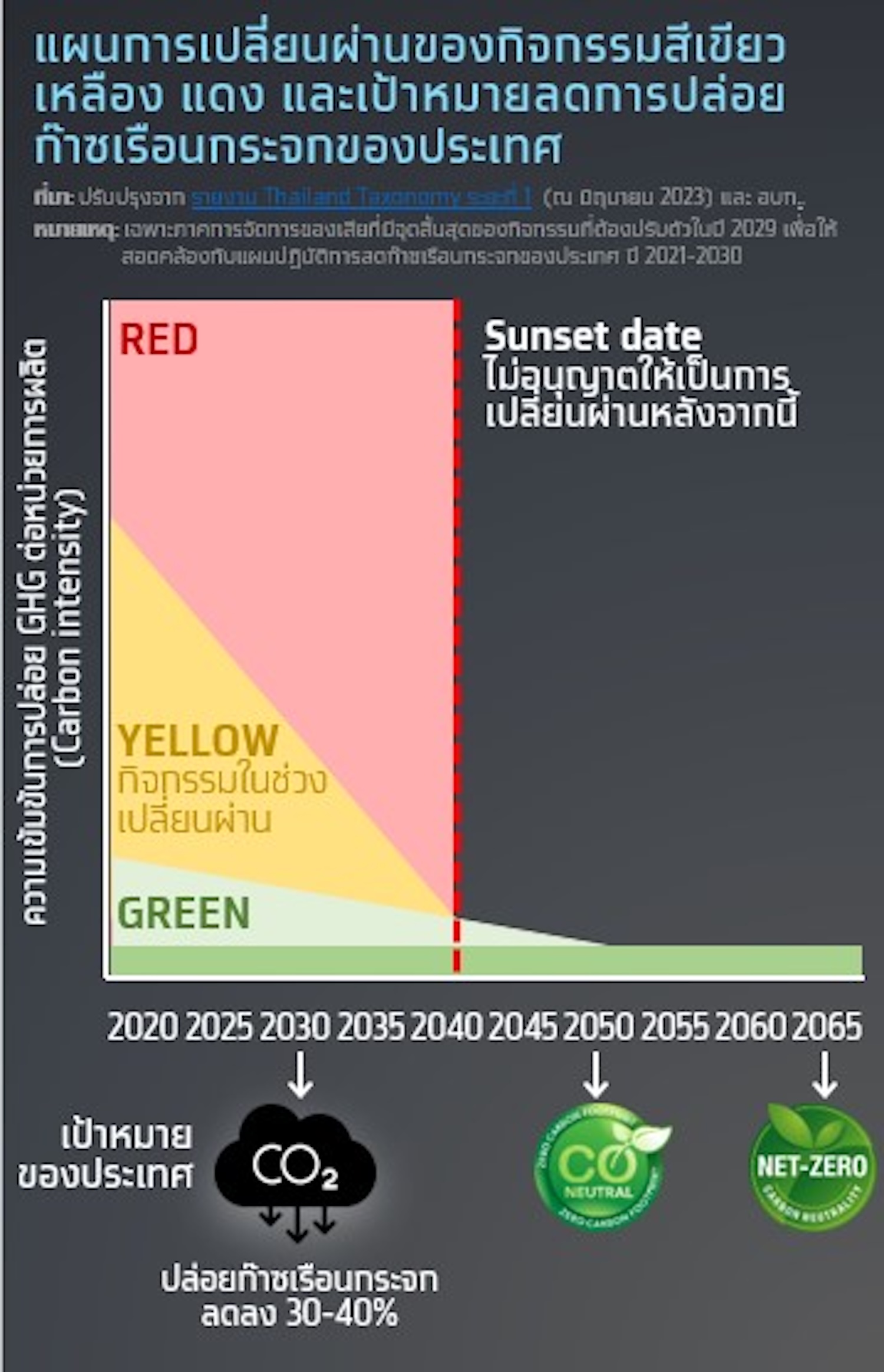
Taxonomy is a standard used to reference the classification of economic activities across various sectors for the transition to environmentally friendly operations. It categorizes economic activities based on their environmental friendliness into three levels according to a traffic light system:
- Green refers to activities that are environmentally friendly, with greenhouse gas emissions close to or equal to zero, or with a clear path towards achieving net-zero emissions.
- Amber refers to activities in transition that do not yet have net-zero emissions but can improve through defined carbon reduction pathways and must meet specific criteria within a clear timeframe. Additionally, a sunset date is set for these activities, after which all amber activities will be evaluated against the green criteria, except for waste management activities, which have a sunset date in 2029 to align with the national greenhouse gas reduction action plan for 2021-2030.
- Red refers to activities that cannot reduce greenhouse gas emissions, which must be phased out after the transition deadline in 2040 or 2029 for waste management, to achieve carbon neutrality and net-zero emissions.
Thailand Taxonomy also includes two key principles that support the categorization of economic activities with sustainability in mind: 1) Do No Significant Harm, which assesses that an environmentally focused economic activity does not negatively impact other objectives across all dimensions, such as ensuring that efforts to reduce greenhouse gas emissions do not harm the environment in other areas, including social and economic impacts; and 2) Minimum Social Safeguards, which ensures that economic activities comply with Thai regulations and internationally accepted standards, with social management systems in place to prevent negative impacts on society and human rights. These two principles are used as important criteria in environmental frameworks in many countries, such as the EU Taxonomy and UK Green Taxonomy.

Activities that comply with the criteria for green or amber activities will only be considered as such if the operators can adhere to the Do No Significant Harm and Minimum Social Safeguards principles or submit an improvement plan to align with these two principles. They must complete the plan within three years after evaluation; otherwise, the activities will not meet the green or amber criteria and will be classified as red activities.
Currently, Thailand Taxonomy Phase 2 is in the public consultation phase from October 28, 2024, to January 10, 2025, and is expected to be fully published in 2025, covering four additional economic sectors: 1) Agriculture, 2) Manufacturing Industry, 3) Real Estate and Buildings, and 4) Waste Management. When combined with the sectors covered in Thailand Taxonomy Phase 1, such as energy and transportation, it will encompass activities that contribute to greenhouse gas emissions in Thailand, totaling up to 355 MtCO2eq, or about 95% of the country's total annual greenhouse gas emissions. The significant activities under Thailand Taxonomy Phase 2 are crucial for the Thai economy, with agricultural activities accounting for over 91% of the GDP value in the agricultural sector, followed by activities in real estate and buildings and manufacturing, which account for 39% and 23%, respectively.
Under the draft of Thailand Taxonomy Phase 2 for public consultation (as of October 2024), the scope of activities and criteria for green activities in the four economic sectors have been defined:
1. Agriculture covers all activities within agricultural areas related to crop and livestock production, such as rice cultivation, perennial and non-perennial crop planting, livestock farming, waste disposal, fertilizer use, pest control, and other activities in the area, such as forest management. However, it does not include post-harvest activities such as processing, sales, packaging, and transportation. The criteria for green activities in agriculture do not specify clear quantitative measures but require a shift towards more environmentally friendly agricultural and livestock practices, ensuring that these practices do not harm the environment, comply with the Do No Significant Harm and Minimum Social Safeguards principles, and support at least one environmental objective of the Taxonomy. Given that most Thai agricultural operators are smallholders with limited adaptability, overly stringent criteria could significantly impact these small operators.
2. Manufacturing Industry encompasses various high CO2 emitting production activities, including 1) Cement production, covering everything from limestone mining to the final cement mixing stage; 2) Chemical production, covering only the production processes of basic chemicals; and 3) Steel and iron production, covering everything from raw material preparation to final steel products. Additionally, there are other manufacturing activities, such as aluminum production, battery manufacturing, and low-carbon technologies. The criteria for green activities in manufacturing relate to CO2 emissions, pollution levels, and fuel source selection, with specific details varying across different manufacturing industries.
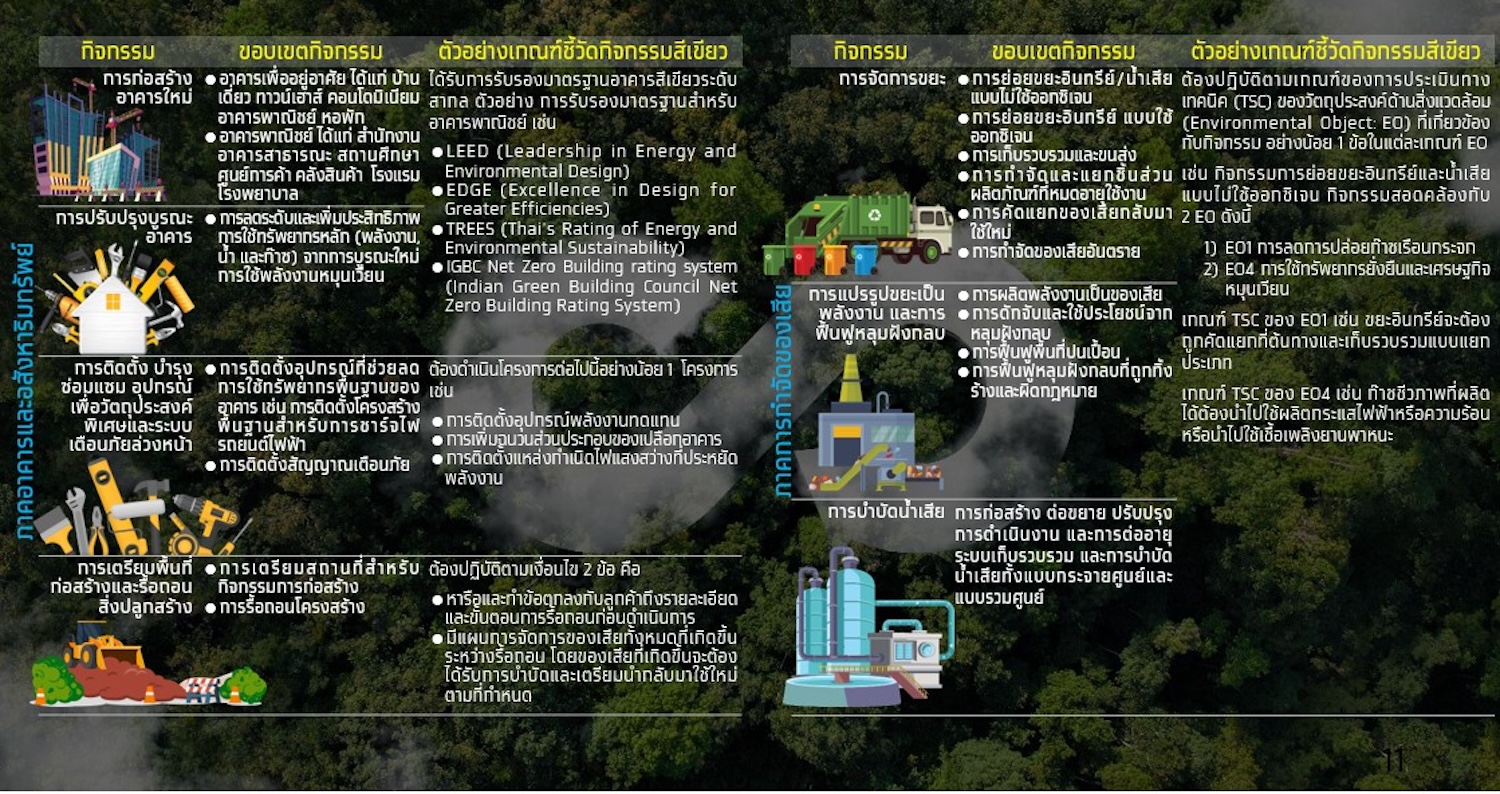
3. Real Estate and Buildings cover four main activities: 1) Construction of new buildings, both residential and commercial; 2) Renovation of existing buildings to improve resource efficiency; 3) Installation, maintenance, and repair of building equipment for special purposes, including disaster warning systems; and 4) Demolition and site preparation, excluding industrial buildings and construction material production, such as steel, concrete, and plastic, which fall under the manufacturing criteria mentioned in point 2. The green criteria for construction and renovation activities will reference international green building certification standards, such as LEED, EDGE, and TREES, and will not cover greenhouse gas emissions from construction processes. The green criteria for site preparation and demolition activities will primarily relate to planning and managing waste generated from demolition.
4. Waste Management covers 13 waste management activities across six types: 1) Municipal waste, 2) Food waste, 3) Plastic waste, 4) Hazardous waste, including electronic and electrical waste, 5) Industrial hazardous waste, covering everything from the point of release after passing through various waste sources, sorting, collection, to treatment and disposal, and 6) Wastewater, covering decentralized and centralized wastewater treatment. The green criteria for each activity in waste management must comply with the technical assessment criteria (TSC) of at least one environmental objective related to the activity.
The challenges faced by various operators in transitioning to green activity standards
While Thailand Taxonomy is designed to guide Thai operators towards environmentally friendly business standards, adapting to this framework presents several challenges and limitations for the business sector, particularly:
1. Expensive and not widely available technology limits investment in technology to improve production processes and access to appropriate technology. A study by McKinsey (2022) [2] indicates that while over 85% of the greenhouse gas reductions needed to achieve the Net Zero target by 2050 can be achieved using existing technologies, there is still a need to develop new technologies that can be widely adopted and have lower costs. The study estimates that by 2050, cement and steel production requiring greenhouse gas reduction technologies will see costs increase by 30-45% compared to 2020 under the assumption that the world can achieve the Net Zero target by 2050.[3]
2. Limited access to funding sources for operators, especially SMEs, which still cannot fully access funding in the system and may lack funding sources conducive to sustainable investment. According to the Office of Small and Medium Enterprises Promotion (OSMEP), Thai SMEs still rely heavily on informal funding sources, using only 55% of total loans from formal sources.[4]
3. Knowledge limitations, as applying green technology requires specialized knowledge, planning, and efficient resource management, which some operators, particularly SMEs, lack access to necessary information and knowledge for sustainable business management.
Krungthai COMPASS analyzes the challenges faced by operators in each main activity under the scope of Thailand Taxonomy Phase 2, considering three main factors: 1) Greenhouse gas (GHG) emissions, 2) The proportion of small operators, and 3) The investment costs for technologies or projects aimed at reducing greenhouse gas emissions, all of which reflect the level of challenges faced and the potential and limitations of the business sector in each activity. The analysis focuses on three main economic sectors: agriculture, manufacturing, and real estate and buildings, including activities such as rice cultivation, livestock, perennial and non-perennial crop planting, cement production, chemical production, steel and iron production, as well as real estate and buildings.
Rice cultivation, real estate and buildings, and cement production are the groups facing the highest challenges in aligning with Thailand Taxonomy guidelines, as these activities collectively emit over 69 MtCO2eq/year, accounting for about 19% of Thailand's total annual greenhouse gas emissions. While rice cultivation, real estate and buildings, and cement production are all high-challenge groups, each faces different challenges. For rice cultivation, although the cost of reducing greenhouse gas emissions is lower compared to other activities, almost all operators in this group are smallholders who face limitations in adaptability, including access to necessary knowledge, technology, and funding, making support from the government and relevant agencies crucial. For cement production, the challenge for operators lies in improving production processes and investing in effective clean technologies, which require high expertise and investment.
Meanwhile, the real estate and buildings sector faces challenges from both factors at a slightly lower level. From the perspective of commercial real estate, there may also be opportunity costs from lost time and opportunities for developing new projects, which is another cost to consider.
Livestock activities, perennial and non-perennial crop planting are groups facing moderate challenges, primarily due to the high proportion of small operators, accounting for 93-95% of all operators. The government and relevant agencies should support these operators in all dimensions at a secondary level. Livestock activities and perennial and non-perennial crop planting have relatively low greenhouse gas emissions, ranging from 13,000-14,000 MtCO2eq/year, accounting for about 4% of Thailand's total annual greenhouse gas emissions, and have lower costs for reducing greenhouse gas emissions compared to other activities.
Chemical production and steel and iron production are categorized as having relatively low challenges compared to other activities, but still face significant challenges due to high investment costs. These two activities do not have high greenhouse gas emissions from industrial processes and product usage, particularly in Thailand's steel production, which uses Electric Arc Furnace (EAF) processes with scrap metal as raw materials instead of iron ore and coke, resulting in lower greenhouse gas emissions. Additionally, both activities have a relatively low proportion of small operators compared to other activities, with the main challenge for operators in this group being the need to improve production processes and invest in technologies that can effectively reduce greenhouse gas emissions, similar to cement production.
Krungthai COMPASS recommends various sectors to prepare for green activities according to Thailand Taxonomy Phase 2 as follows:
1. Operators
Operators are advised to start compiling data on their resource use and greenhouse gas emissions as a first step to assess the level of greenhouse gas emissions their business produces and what improvements are needed to align with the green activity transition guidelines of Thailand Taxonomy Phase 2. For operators without experience in compiling greenhouse gas emissions data, they can refer to the monitoring and reporting guidelines for greenhouse gas emissions by sector provided by the Greenhouse Gas Management Organization (Public Organization) or contact them directly for consultation. Krungthai COMPASS also offers preliminary recommendations for operators in agriculture, manufacturing, and real estate and buildings as follows:
Agriculture
- Smallholder operators or farmers can start adapting from basic practices, such as improving soil quality, drying animal manure, which helps reduce methane emissions. Rice cultivation should shift to wet-dry alternating cultivation in irrigated lowlands, which can reduce greenhouse gas emissions by 30-70%, while also promoting stronger rice plants, reducing water and fertilizer use, thus increasing yields and lowering production costs simultaneously.
- Large operators who are already prepared may consider adopting technology in their activities, such as IoT (Internet of Things), drones, and satellite systems to collect data for monitoring soil, water, and crop conditions, leading to more precise agriculture and reduced resource use, which will increase yields and lower production costs in the long run.
Manufacturing Industry
- Accelerate the study of ways to modify production processes to reduce greenhouse gas emissions by adopting low-carbon technologies in each industry, such as cement production in Europe and the United States, which uses CCS technology to capture CO2 emitted from the clinker burning process, and hydrogen production in Germany and Japan, which has developed green hydrogen production using renewable energy instead of natural gas, resulting in no greenhouse gas emissions.
- Seek ways to transition from fossil fuel use to low-carbon alternative fuels that align with green criteria, such as hydrogen energy, green hydrogen, biomass energy, and renewable energy from wind and solar.
Real Estate and Buildings
- Design and renovate buildings according to green building standards, such as LEED or TREES, which are internationally recognized green building certifications. Additionally, study technologies from abroad to apply in designing resource-efficient building usage, such as designs that emphasize natural daylight use during the day to save energy. These actions not only reduce greenhouse gas emissions but also lower energy consumption, which saves business costs. Furthermore, from the perspective of residential and office real estate developers, energy-efficient building designs attract customers seeking sustainable housing or office spaces while helping reduce costs such as electricity and other utilities.
- Have plans for efficient demolition management, including waste management and reusing construction materials, such as using bricks and stones as fill material in other construction projects or repurposing wood from building structures into furniture.
2. Government
The government plays a crucial role in supporting and accelerating the transition to green activities through measures that help reduce barriers and create incentives for adaptation, which may consider support measures suitable for each type and size of business facing different limitations and challenges. For example, providing support to large operators in accessing efficient green technologies at lower costs and supporting vulnerable groups like SMEs in all dimensions, from knowledge creation to funding and technology support. Government credit guarantee agencies, such as the Small Industry Credit Guarantee Corporation (SICGC) or the National Credit Guarantee Corporation (NaCGA), play a significant role in facilitating access to funding for green projects, such as creating guarantee products specifically for green projects to incentivize operators and reduce risks for financial institutions. Krungthai COMPASS also provides preliminary recommendations for the government to support the agriculture, manufacturing, and real estate and buildings sectors as follows:
Agriculture
- Raise awareness and understanding among agricultural operators, most of whom are smallholders, about the risks of ignoring Thailand Taxonomy guidelines, such as losing access to future funding sources or losing competitiveness in high environmental standard markets.
- Play a crucial role in supporting the transition in terms of funding, knowledge, consulting, and supporting the grouping of small agricultural operators, such as establishing funds for financial support or loan guarantees, designating agencies responsible for assisting farmers seeking to improve their operations towards sustainability, and supporting group formations for resource and technology sharing.
Manufacturing Industry
- Elevate environmental standards in high greenhouse gas-emitting industries, such as requiring operators to gradually adopt energy-efficient technologies and set low energy use standards in production processes, starting with large operators who are prepared, and possibly providing investment support and tax incentives as motivation.
- Accelerate the development of green infrastructure systems by expanding clean energy production, whether solar, wind, biomass, or hydrogen, to meet the demand for production sectors that need to transition from fossil fuel use to alternative fuels in the future.
- Foster international cooperation with countries that have advanced low-carbon technology development to exchange knowledge and technology, which will help elevate environmental standards and accelerate the transition in Thailand's manufacturing sector.
Real Estate and Buildings
- Set energy use standards in buildings for tangible changes, such as requiring buildings to use at least 20% renewable energy of total energy consumption or establishing energy use standards per area to encourage the design of energy-efficient buildings, possibly with investment support and tax incentives as motivation.
- Designate pilot areas for green building development to serve as clear examples for the transition, which will stimulate and accelerate the transition to green activities in the construction and real estate sectors, possibly designating special economic zones or smart city development areas as pilot areas in the initial phase.
- Play a crucial role in supporting the transition in terms of funding and knowledge for small operators in the real estate and buildings sector, such as establishing funds for financial support or loan guarantees, providing tax benefits, and creating guides for designing and renovating towards green buildings for various types and sizes of buildings.
3. Financial Sector
The financial sector can play a role in supporting the transition to green activities by acting as investment advisors and offering financial products suitable for each business, such as loans for investments in renewable energy and energy-efficient machinery for the manufacturing sector or loans for construction or renovation projects focused on energy efficiency for commercial real estate. For large businesses, financial institutions can offer funding options through green bonds or transition bonds to help businesses access capital at attractive interest rates and attract investors focused on sustainable investments. Additionally, for the agriculture sector, where no clear green criteria are defined, financial institutions may consider establishing their own green activity criteria for use in developing financial products that meet the needs and help assess and verify whether the borrowing business aligns with sustainability goals, thereby reducing risks and impacts on the loan portfolio.
[1] Based on the total greenhouse gas emissions of Thailand in 2019, referenced from the Thailand Fourth Biennial Update Report.
[2] The net-zero transition: What it would cost, what it could bring (McKinsey, 2022).
[3] Net Zero 2050 Scenario set by the Network for Greening the Financial System (NGFS), a cooperative network of central banks and financial regulators worldwide aimed at supporting environmentally friendly financial operations, focusing on managing risks arising from climate change and supporting the transition to a sustainable economy.
[4] Report on the debt situation of MSMEs, Q2 2024.
[5] Expected to commence in 2025.