Real Estate No.1 “Safe Haven” for Investors Amidst Market Turbulence!
Recently, there has been a debate about which type of investment is better: cash, stocks, or real estate. Each perspective varies depending on the individual's age, experiences, and various factors that shape their views and thought processes. Each investment type has its advantages and disadvantages, yielding different returns based on readiness, knowledge, capital, preferences, duration, and desired outcomes. However, when considering the long term, real estate (especially residential properties) remains a safe investment with minimal volatility over the past decade.

Mr. Surachet Kongcheep, Managing Director of Property DNA, commented that the younger generation, particularly those under 30, may view purchasing a home in any form as a long-term burden. They see it as investing in a depreciating asset that does not generate income, with returns from real estate investments taking over ten years compared to stocks, digital assets, or other avenues that can yield quicker and higher returns with significantly lower investment amounts. Success stories are prevalent in today's online society.
While successful individuals may be few, they become role models or representatives of success that the younger generation chooses to follow. This is not inherently wrong, but it is essential to understand and seek information to follow in their footsteps, rather than simply opening an investment account and expecting to achieve similar success. Therefore, investing in any asset type has its benefits and can yield long-term or even short-term returns if one understands the asset and is willing to wait.
The investment approach of the younger generation aged 30 to 35 has clearly changed from the past. This generation tends to have less patience than previous ones, as the current world facilitates rapid changes, leading to decreased patience among newer generations. They perceive investing in real estate as less appealing, facing clear risks from oversupply in the market, requiring substantial capital due to continuously rising prices, which contrasts with their income. Investing in gold also requires a long holding period (except during times of all-time highs), necessitating significant investment to see returns.
Investing in amulets, watches, or collectibles is also popular but only among a niche audience. Although there is some interest from foreign investors in amulets, demand remains limited. Watches and collectibles may be sold in international markets, and younger individuals inheriting such assets may choose to sell or pass them on to interested investors immediately rather than holding onto them for long. This trend indicates that traditional investment forms are less appealing to the younger generation, who lack patience and do not wish to wait long for returns, preferring investments like stocks and cryptocurrencies that are quicker, easier, and yield visible returns with smaller amounts, albeit with higher risks and volatility.
Price Index of Various Types of Housing
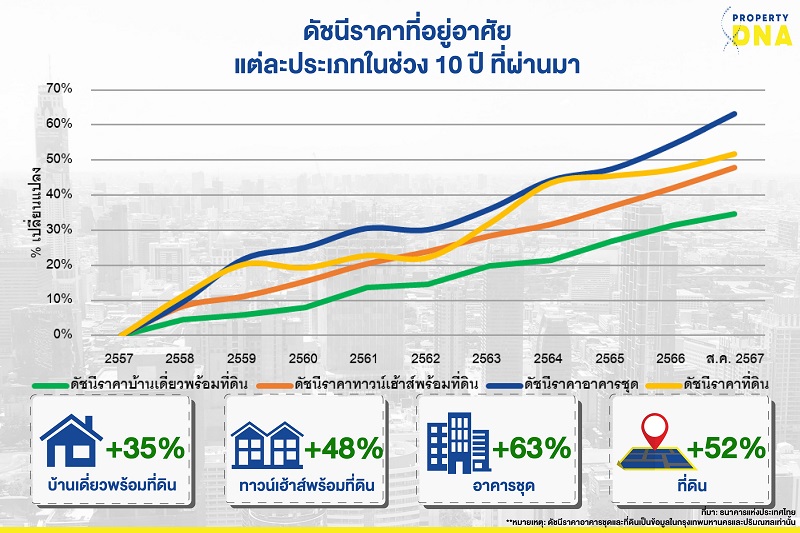
Investing in real estate is still viable, but one must consider various factors before investing. There are many types and forms of real estate investment. One form familiar to those over 35 is investing in land. Analyzing the price changes over the past decade, referencing the Bank of Thailand's real estate price index from August 2024, land prices in Bangkok and its vicinity have increased by approximately 52% since 2014. Some areas, such as those along the subway lines or regions with significant government projects, have seen even greater price increases. However, many locations have not seen price increases or have even decreased due to various factors. The key factor that promotes land investment remains that land cannot be created anew. Even though land reclamation projects exist, all such projects are developed or permitted by the government.
Investing in condominiums may yield higher returns than land, as condominium prices in Bangkok and its vicinity increased by about 63% between 2014 and 2024. Many projects in high-demand locations have seen even greater price increases, and rental yields can provide a long-term investment return, currently ranging from 4% to 7% per year or more, depending on location and project type.
“Although investing in the real estate market may seem unappealing due to negative news, it does not mean that residential projects are no longer viable investments. Compared to the returns from the Thai stock market, which, based on the Total Return Index (TRI) over ten years, stands at 34%, real estate tends to be more stable. While there are tax burdens on land and buildings, these can still be factored into the selling price.”
Nonetheless, while real estate investments may not yield as much as newer asset types or digital assets that attract the younger generation, they remain in demand. Regardless of any events that may occur, land or structures on land will still exist, unless severe incidents drastically reduce land or property values. If one chooses to invest in real estate, it is essential to have knowledge and conduct research, just as with any other asset type.
Additionally, investing in real estate can help reduce future expenses for children or future generations, as housing prices are expected to rise continuously, especially in a future world where borders may not exist, and language may no longer limit work or life. Hybrid working may become commonplace for office workers, making housing still in demand among both Thais and foreigners for permanent residence or temporary living due to migration caused by issues like war, pandemics, religion, politics, job opportunities, and food.