Development of Land Price Index for Undeveloped Land in the EEC Area
The Real Estate Information Center of the Government Housing Bank (REIC) monitors the changes in the price of undeveloped land in the Eastern Economic Corridor (EEC), which includes Chonburi, Rayong, and Chachoengsao provinces. This is to track the changes in land prices in these three provinces and to create a price index for undeveloped land, with 2015 set as the base year for the index. This year was chosen because it was when REIC received comprehensive data on land ownership transfers from the Land Department, and it was a year without special conditions that could distort the overall economic picture of the country and the EEC area. Therefore, 2015 is deemed suitable for establishing the base year for the “Land Price Index for Undeveloped Land in the EEC Area,” which will be published quarterly.
In creating the index for undeveloped land prices in the EEC area, data on land ownership transfers from the Land Department was selected, focusing only on undeveloped land without structures, with a minimum size of 200 square wah. The data used for ownership transfers included only those with either the “transferor” or “transferee” being a “juristic person,” as companies typically report actual sale prices accurately. The index calculation employs the Chain Laspeyres method, using the average price per square wah, weighted by the value of land ownership transfers in the three EEC provinces from 2015 to 2019. The factors analyzed in the multiple regression analysis include:
1. Location of the land, and 2. Land use planning.
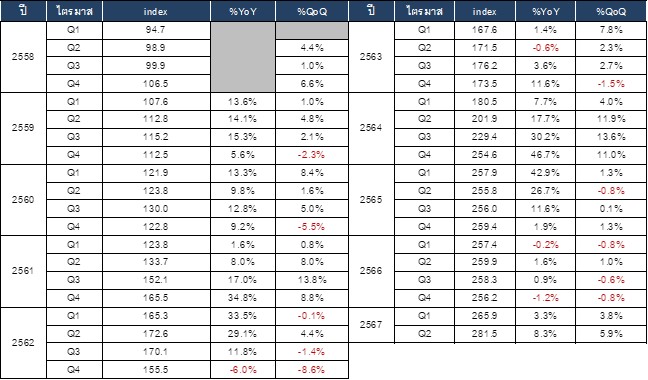
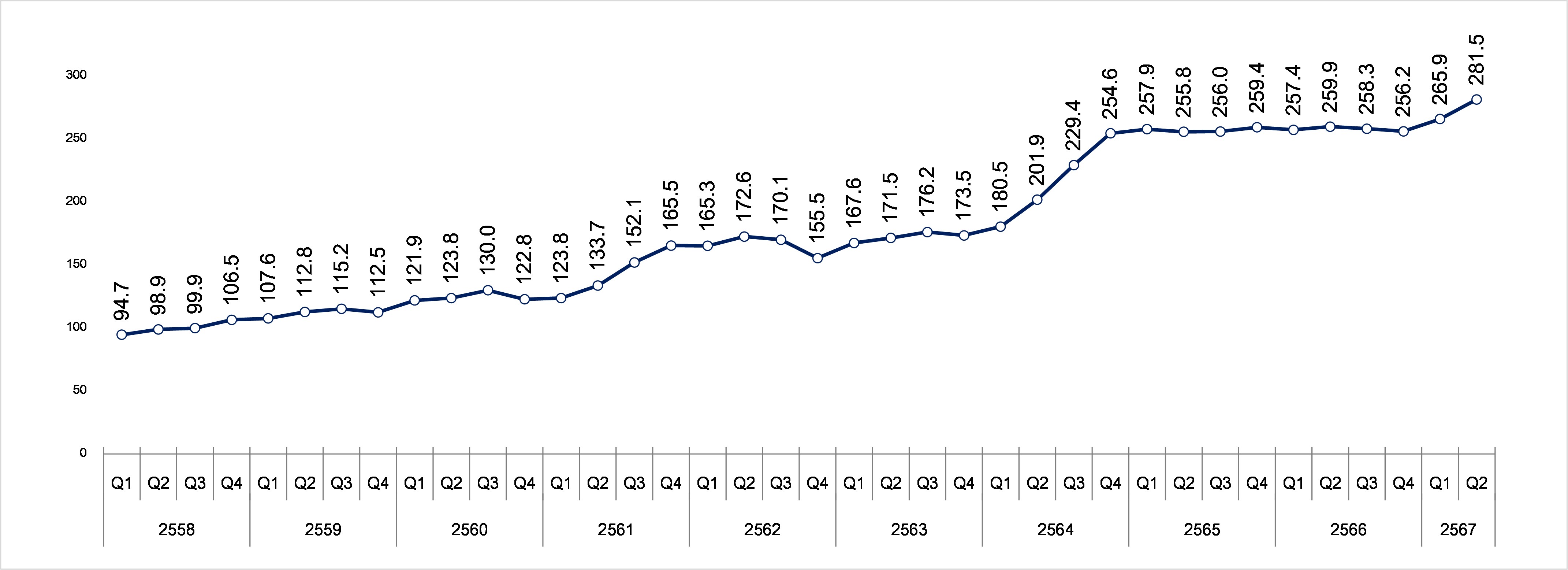
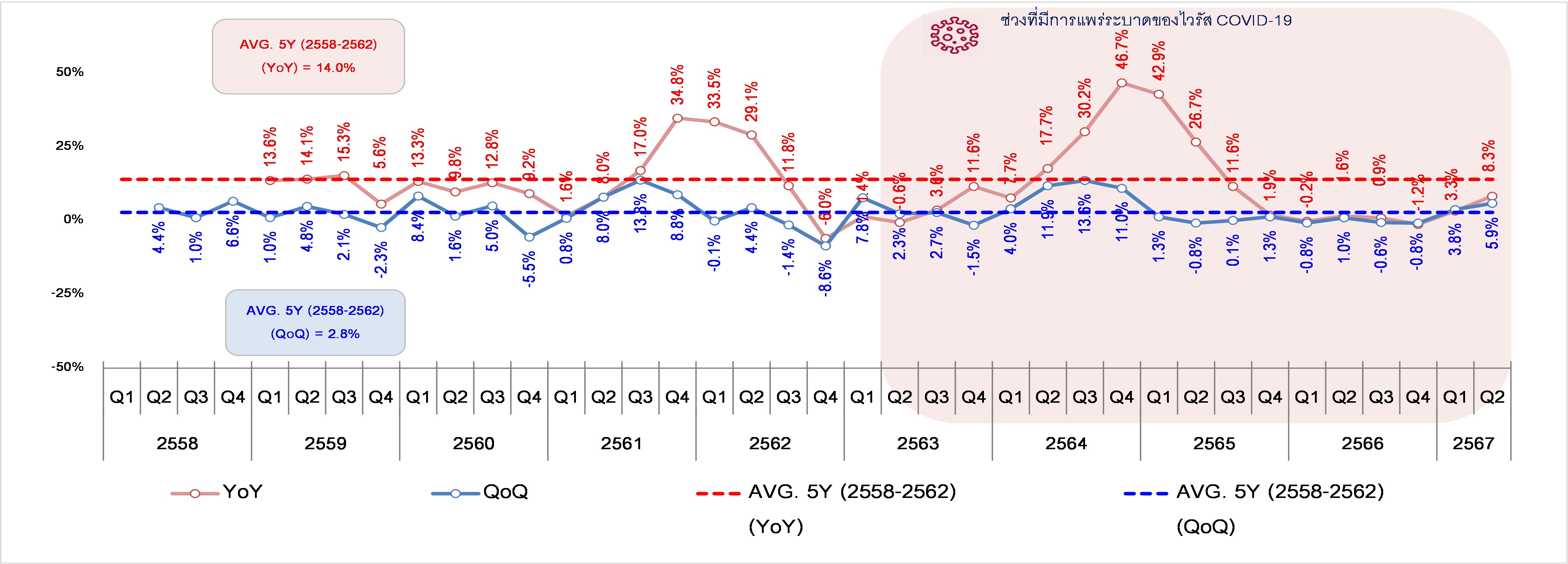
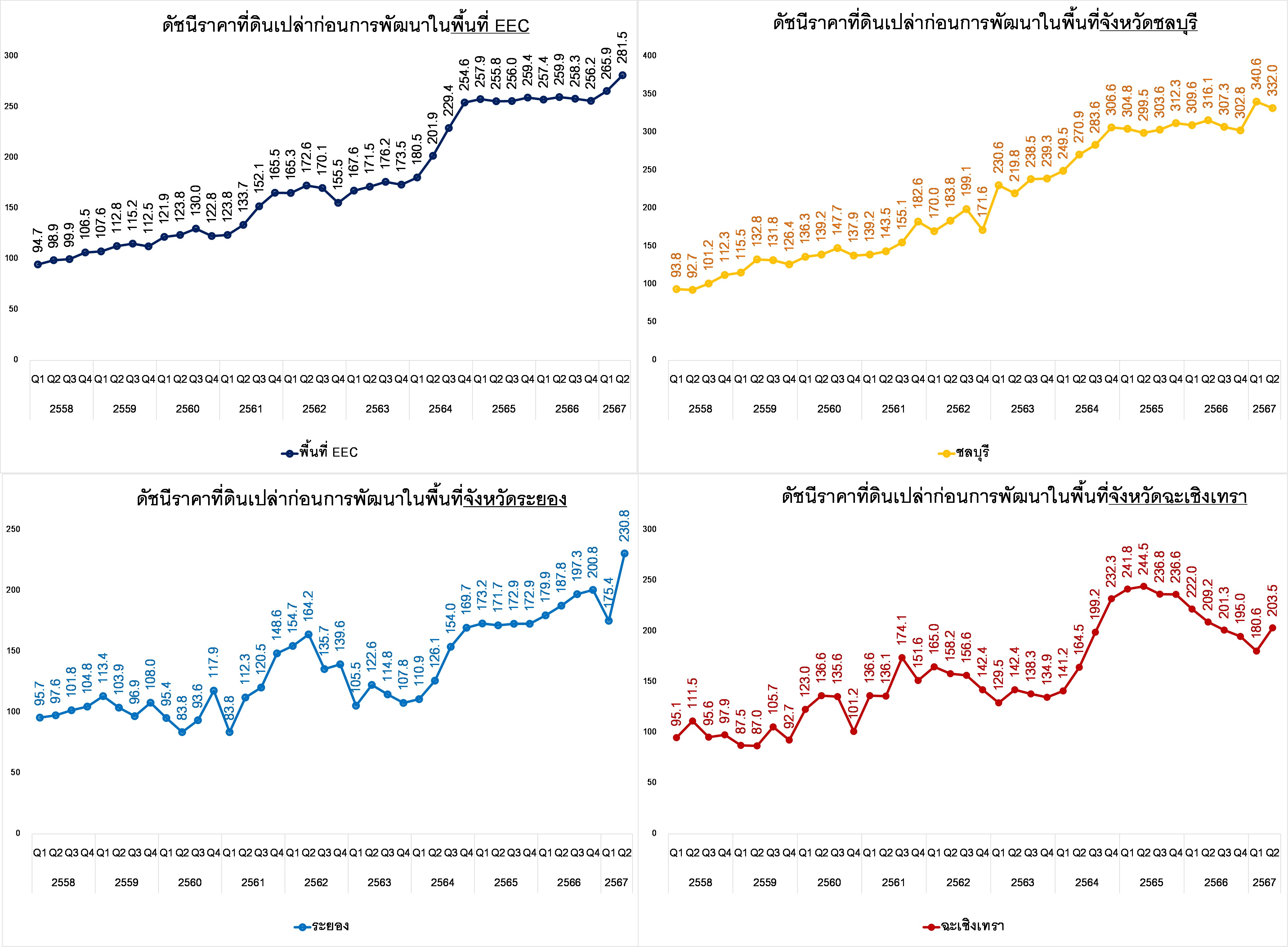
Dr. Vichai Wiratthakhan, Inspector of the Government Housing Bank and Acting Director of the Real Estate Information Center, revealed that the index for undeveloped land prices in the EEC area for the second quarter of 2024 stands at 281.5 points, an increase of 8.3% compared to the same period last year (YoY) and a 5.9% increase compared to the previous quarter (QoQ). This indicates that the growth of undeveloped land prices continues to rise, albeit at a slowing pace compared to the average increase of 14.0% per quarter during the five years prior to the COVID-19 crisis (2015-2019) when compared to the same period of the previous year (YoY) (see Table 1 and Charts 1-2).
The slowdown in the increase of undeveloped land prices may be due to developers' reduced demand for land for real estate projects, attributed to the slow recovery of the domestic economy and investment in recent times. Additionally, significant negative factors include the cancellation of LTV relaxation measures, high household debt exceeding 90% of GDP, and a stable high policy interest rate of 2.50%. Those wishing to purchase housing face increased costs but reduced purchasing power. These factors have contributed to a significant slowdown in the real estate sector recently, potentially leading to decreased demand from developers for land acquisition, as they must also bear land holding costs from land and building taxes. In 2024, the government has no measures to reduce land and building taxes, which is another reason for the overall slowdown in land demand in the EEC area. Furthermore, much of the land remains agricultural and is not suitable for residential development, while another portion is designated for industrial estate development.
Moreover, the index for undeveloped land prices in the EEC area for the second quarter of 2024 increased due to the land price index in Rayong province reaching 230.8 points, with the highest change rate of 22.9% compared to the same period last year (YoY) and a 31.6% increase compared to the previous quarter (QoQ). This may be due to investments from China purchasing land to build factories related to the electric vehicle industry, such as battery charging stations, in industrial estates in Rayong. Major electric vehicle manufacturers from China, such as BYD and Changan, have invested in the Rayong industrial estate, particularly in the Pluak Daeng area, resulting in land prices rising approximately 2.3 times compared to the base year of 2015 (100.0 points). Investors prefer to invest in Rayong province over Chonburi due to lower land prices in Rayong, which are about 30-40% cheaper.
Following this, Chonburi province has an index value of 332.0 points, with a change rate of 5.0% compared to the same period last year (YoY), but a decrease of -2.5% compared to the previous quarter (QoQ). Chachoengsao province has an index value of 203.5 points, with a decrease of -2.7% compared to the same period last year (YoY) but an increase of 12.7% compared to the previous quarter (QoQ) (see Chart 3).
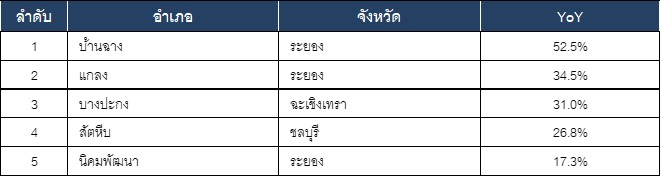
In the second quarter of 2024, the top five locations with the highest land price growth rates compared to the same period last year (YoY) are as follows (see Table 2):
1. Ban Chang district in Rayong province, with a price change rate of 52.5%. This district has diverse transportation systems, including several highways, access to the eastern railway, and U-Tapao Airport, making it suitable for residential project development. Local and Bangkok-based developers are interested in purchasing land in this area for residential projects to accommodate the workforce in industrial estates and tourism.
2. Klaeng district in Rayong province, with a price change rate of 34.5%. This district is another area of interest for developers looking to acquire land for residential project development.
3. Bang Pakong district in Chachoengsao province, with a price change rate of 31.0%. This district is attracting interest from local and Bangkok-based developers to expand residential project development due to its connectivity with Samut Prakan. Data from the housing project survey in the EEC area for the second quarter of 2024 indicates that this area is popular for residential project development.
According to the housing market survey data in the three EEC provinces, this area has the second-highest number of housing projects ready for sale in the market, increasing by 184.8%, following Chachoengsao municipality.
4. Sattahip district in Chonburi province, with a price change rate of 26.8%.
5. Nikhom Phatthana district in Rayong province, with a price change rate of 17.3%.
The changes in land prices in these top five districts reflect that these lands are located in industrial and tourism areas, which positively influence land prices due to the development of various industrial zones in these areas, creating jobs and increasing employment. This supports real estate developers' decisions to develop residential projects to accommodate the influx of residents working in the EEC area, both Thai and foreign.
It is noteworthy that all five districts benefit from changes in land use planning, allowing for greater utilization of the land, thereby increasing its value.