Philips Reveals Results of the Annual Philips Future Health Index 2024 Survey Highlighting Strong Trends in AI and Data Technology Among Healthcare Leaders in the Asia-Pacific Region, Aiming to Enhance Patient Care
- 71% of healthcare leaders in the Asia-Pacific region indicate that delays in patient care stem from a shortage of medical personnel.
- 93% report encountering at least one obstacle in connecting data from multiple sources,
yet they still recognize the importance of data connectivity for improving patient care efficiency. - AI technology is increasingly being utilized to support clinical decision-making, with 62% planning to invest more in AI within the next three years.
Royal Philips (NYSE: PHG, AEX: PHIA), a global leader in healthcare technology, has released the largest global healthcare survey for the ninth consecutive year with the Philips Future Health Index (FHI) 2024 report titled "Better care for more people." The survey gathered insights from over 3,000 healthcare leaders across 14 countries, including Australia, the Netherlands, Italy, Japan, Singapore, and Indonesia. The findings reveal that healthcare leaders are focused on enhancing operational efficiency by prioritizing workflows, data connectivity, and the use of AI technology to improve patient care, address medical personnel shortages, financial challenges, and the rising demand for healthcare services.

Dr. Mark Berbee, Vice President of the Health Systems business at Philips for the Asia-Pacific region, stated, “The issue of patients waiting too long for healthcare services and the shortage of medical personnel means that patients do not receive timely care and have difficulty accessing the healthcare system. Therefore, we see healthcare leaders striving to develop and transform to deliver better services and care to more people, particularly in overcoming obstacles to data connectivity and advancing the use of AI technology to support medical personnel and enhance patient care efficiency.”
The shortage of medical personnel and financial challenges are urgent issues affecting patient services in the Asia-Pacific region.
71% of healthcare leaders in the Asia-Pacific region are concerned about the shortage of medical personnel affecting timely patient care. Additionally, 92% of healthcare leaders point out that financial challenges impact their organizations' ability to care for patients in terms of both time and quality, and 59% report that they are improving operational efficiency while considering financial strategies.
Managing a large number of patients without compromising service quality requires prioritizing workflows. The implementation of automation systems can enhance operational efficiency and mitigate the impact of personnel shortages. The survey found that nearly half (45%) of healthcare providers in the Asia-Pacific region have already adopted automation in their workflows.
The potential of data connectivity to enhance patient care efficiency.
Healthcare leaders in the Asia-Pacific region see opportunities to elevate patient care through the potential of connecting data from various sources to consolidate patient information in one place. They believe that leveraging insights for data storage and processing can help in planning or finding suitable care approaches (36%), identifying effective treatment pathways (36%), assessing and managing patient needs (36%), predicting and reducing the risk of worsening conditions in patients (33%), and appropriately reducing wait times for diagnosis and care processes (31%).
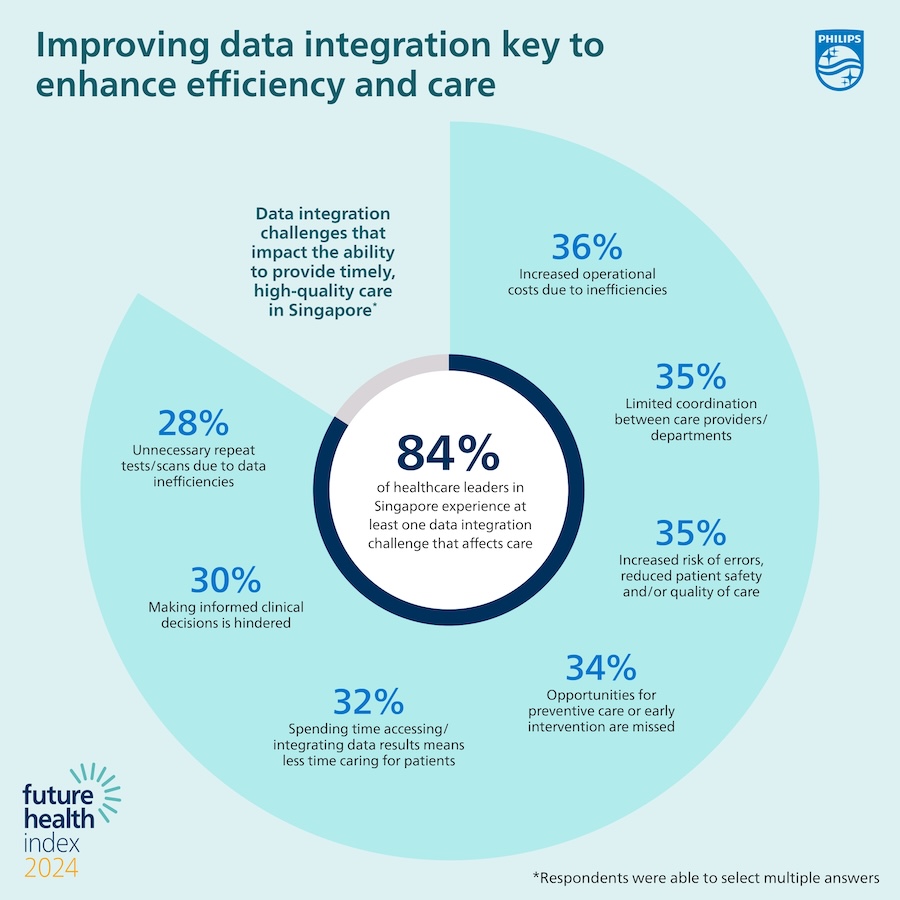
However, 93% of healthcare leaders in the Asia-Pacific region report encountering at least one obstacle in data connectivity when applied in practice, affecting patient care in terms of both time and quality. These include increased risks of erroneous care, reduced safety and/or quality of patient care (36%), limitations in coordination between providers or within departments (33%), increased operational costs due to inefficiencies (32%), time-consuming data access/integration leading to less time for patient care (31%), and missed opportunities for preventive care or timely treatment (31%).
Nevertheless, healthcare leaders in the Asia-Pacific region believe that successful data connectivity would yield the greatest potential and benefits for patient care, with 67% considering data quality to be paramount. They identify the accuracy of data (36%), improvements in data security/privacy (34%), access to patients' own health data (34%), and collaboration between platforms/public health services (31%) as areas that need development in data management.
The increasing use of AI to support clinical decision-making and growing interest in Generative AI.
In the Asia-Pacific region, healthcare leaders see successful applications of AI technology, with an increasing number utilizing AI to support clinical decision-making. The survey found that AI technology is being used to support clinical practices and plans to be implemented in various areas within the next three years, including preventive care (91%), medication management (90%), hospital patient monitoring systems (89%), treatment planning (89%), remote patient monitoring systems (87%), clinical command center systems (83%), radiology (79%), and pathology (79%).
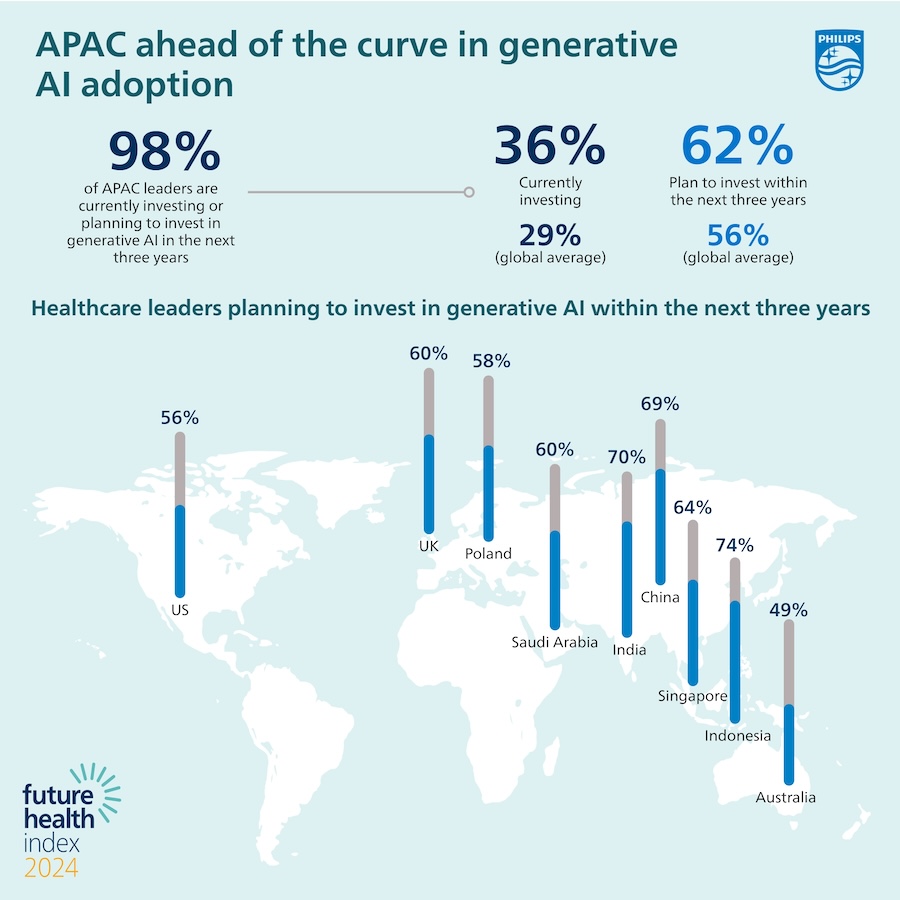
The next step in technology is the adoption of Generative AI, with healthcare leaders in the Asia-Pacific region recognizing the benefits of AI algorithms that can generate various content based on input commands, such as text, images, or data, which will be beneficial for patient care by showcasing efficiencies and new insights from patient data. 36% of healthcare leaders in the Asia-Pacific region are investing in Generative AI technology, and 62% plan to invest in this technology within the next three years. The interest in Generative AI among healthcare leaders in the Asia-Pacific region exceeds that of global healthcare leaders, with current investments at 29% and plans to invest within the next three years at 56%.
Despite the widespread awareness of AI technology, 95% of healthcare leaders in the Asia-Pacific region still express concerns about the accuracy of data in AI applications, as it may impact health outcomes. Therefore, they emphasize that AI technology must be used responsibly to prevent errors. Strategies to mitigate data error risks include transparency and understanding of AI for medical personnel (45%), instilling confidence in data and AI technology among staff (43%), ongoing training and education on AI (40%), and establishing ethical policies for data and AI usage (39%). These strategies can be achieved through collaboration across all relevant sectors.
"The future of better patient care for more people will be realized through data connectivity technology and the use of AI technology to support clinical work, improve workflows, and enhance efficiency for healthcare providers. At Philips, we leverage the benefits of AI technology and information technology, combined with collaboration with partners to innovate in the Imaging, Interventional, and Monitoring sectors to exceed these demands," Dr. Berbee added.
Additionally, Philips has been working closely with partners in the Asia-Pacific region, including healthcare providers, medical personnel, partners, and distributors, to foster long-term collaboration and new business and service approaches, emphasizing the importance of after-sales service and upgrades to drive innovation and sustainable practices. This includes promoting training and education, which will be key to long-term digital success. Furthermore, Philips offers comprehensive solutions in systems, software, medical devices, and services to address the challenges faced by healthcare providers and help unlock the full potential of digital technology.