
Thai Baht Strengthens Towards the End of 2023: Businesses Prepare for High Currency Volatility
In the first 8 months of 2023, the Thai baht fluctuated within a range of 33.88-37.17 baht per dollar. The movement of the baht has been quite volatile since the beginning of 2023, starting the year with a gradual depreciation that reached 37.17 baht per dollar by the end of April 2023 (the lowest level in six and a half months at that time). This was amid market perceptions that the strong U.S. economy would likely delay the Fed's interest rate cuts, combined with the still-weak economic situation in Thailand, prompting capital outflows from both the stock and bond markets in Thailand (see Figure 1).
The situation of the baht began to reverse and strengthen from July 2023, surpassing the 34.00 mark to reach its strongest level in 13 months at 33.88 baht per dollar in August 2023 after the Fed Chair signaled a clearer intention to prepare for interest rate cuts, as U.S. economic activity and labor market data began to show signs of weakness. Meanwhile, the weakening dollar and uncertainty in the Middle East pushed global gold prices to new record highs, further supporting the baht's appreciation.
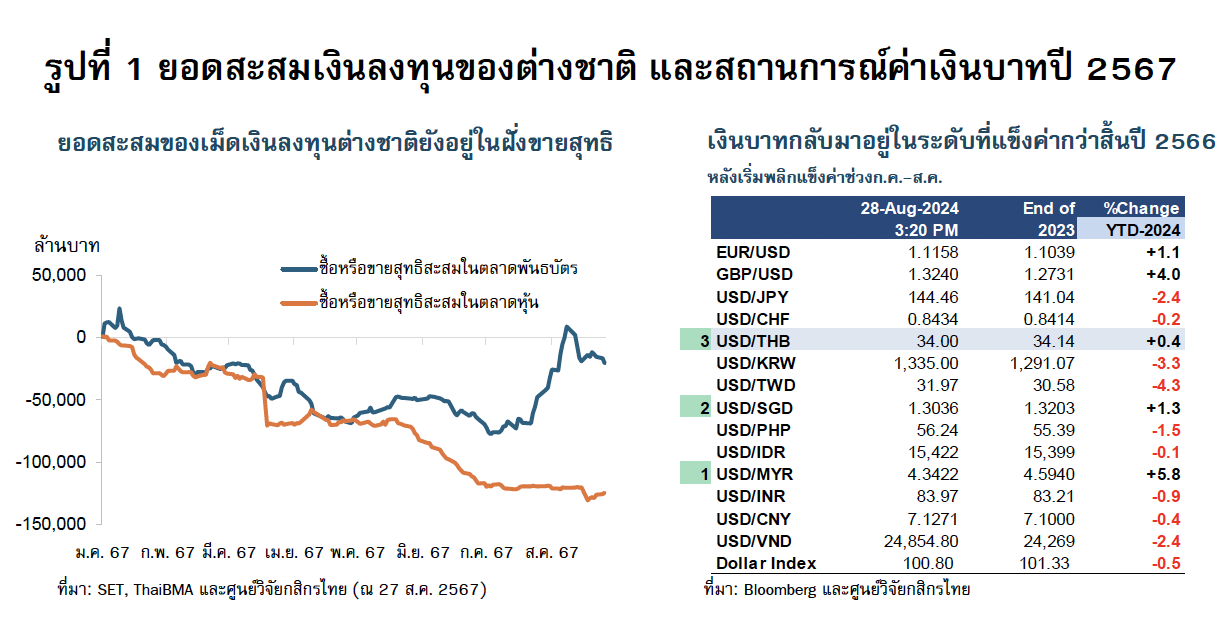
This trend was not only seen in the Thai baht but also in other currencies in the region. As of August 28, 2023, the baht was the third strongest currency (+0.4% YTD from the beginning of 2023), following the Malaysian ringgit in first place (+5.8% YTD) and the Singapore dollar in second place (+1.3% YTD).
The baht is expected to continue strengthening in the short term.
In the short term, or over the next 1-2 months, it is anticipated that if the sentiment of the weakening dollar due to the Fed's interest rate cut outlook continues, we may see the baht strengthen to around 33.60 baht per dollar. (Forecasted by the Capital Markets Business Unit of Kasikorn Bank). The market expects that the Fed will likely reduce the policy interest rate in all remaining FOMC meetings this year by about 0.75-1.00%, compared to the Bank of Thailand's (BOT) expected rate cut, which is currently anticipated to occur about once this year.
On the domestic front, while the outlook has improved with the new government team and a clearer policy vision, we still need to wait for the official conclusion of the new government's policies and clearer practical details. Therefore, the direction of the baht towards the end of 2023 still has the potential to fluctuate based on the situation and incoming economic data, with possible corrections at certain points, leading to an expectation that the baht will close 2023 at around 34.50 baht per dollar (revised from the previous forecast of 36.00 baht per dollar under the assumption that the Fed might start cutting rates slowly).
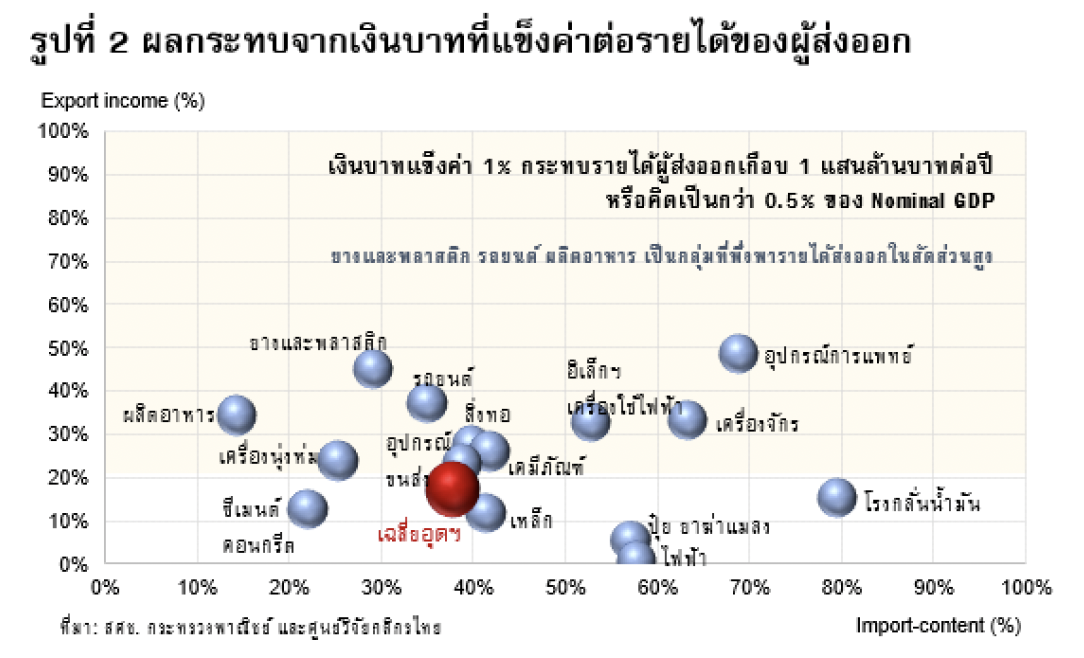
A 1% appreciation of the baht could impact exporters' revenues by nearly 100 billion baht per year.
The Kasikorn Research Center estimates that every 1% appreciation of the baht could affect exporters' revenues by nearly 100 billion baht per year, or over 0.5% of nominal GDP. Although the volatile baht situation does not significantly affect the pricing mechanism for exports, which is often in dollars, it must be acknowledged that the appreciation of the baht may have a continuous impact on businesses, especially exporters whose revenues are in foreign currencies, as it will reduce their income when converted back to baht. This impact will be more pronounced for exporters who primarily rely on domestic raw materials (low import content), as they cannot use natural hedging mechanisms to mitigate the impact. Examples of businesses that will be significantly affected include rubber and plastics, automotive, and food production.
Another concerning issue is the increased volatility of foreign currencies, which affects both exporters and importers.
In addition to the strengthening baht becoming a factor affecting exporters' revenues as Thailand enters the high season for exports in the third quarter, another worrying issue is the volatility of currencies reflecting impacts from rapidly changing economic, interest rate, and international political situations.
This currency volatility is evident in the baht against major currencies such as the dollar, yen, euro, and yuan. (See Figure 3) The exchange rate of the baht against the dollar, yen, and yuan has shown higher volatility since the beginning of 2023 compared to the average during the five years before COVID (2015-2019). If we consider the proportion of payments in various currencies against the total value of exports and imports, we see that trade in yuan has increased, necessitating businesses trading in yuan to be more alert to exchange rate risks. Meanwhile, although the dollar's role in international trade payments has decreased, it still accounts for the highest proportion at 75.3% for export payments and 80.4% for import payments as of Q2 2023. Therefore, businesses conducting transactions in dollars still need to use exchange rate risk management tools.
Finally, due to the increasing currency volatility, it has become a frequent issue in recent years due to the complexities of global economic and political problems. Thus, businesses, especially exporters and importers with revenues and expenses in foreign currencies, must prioritize using exchange rate risk management tools such as forwards, options, and futures. Additionally, they should diversify export markets and sources of imports to reduce risks, avoid price competition by aiming to enhance product and service quality above competitors, choose to use local currencies, and manage revenues and costs while reducing FX risks through other methods such as natural hedges or foreign currency deposits (FCD), etc.