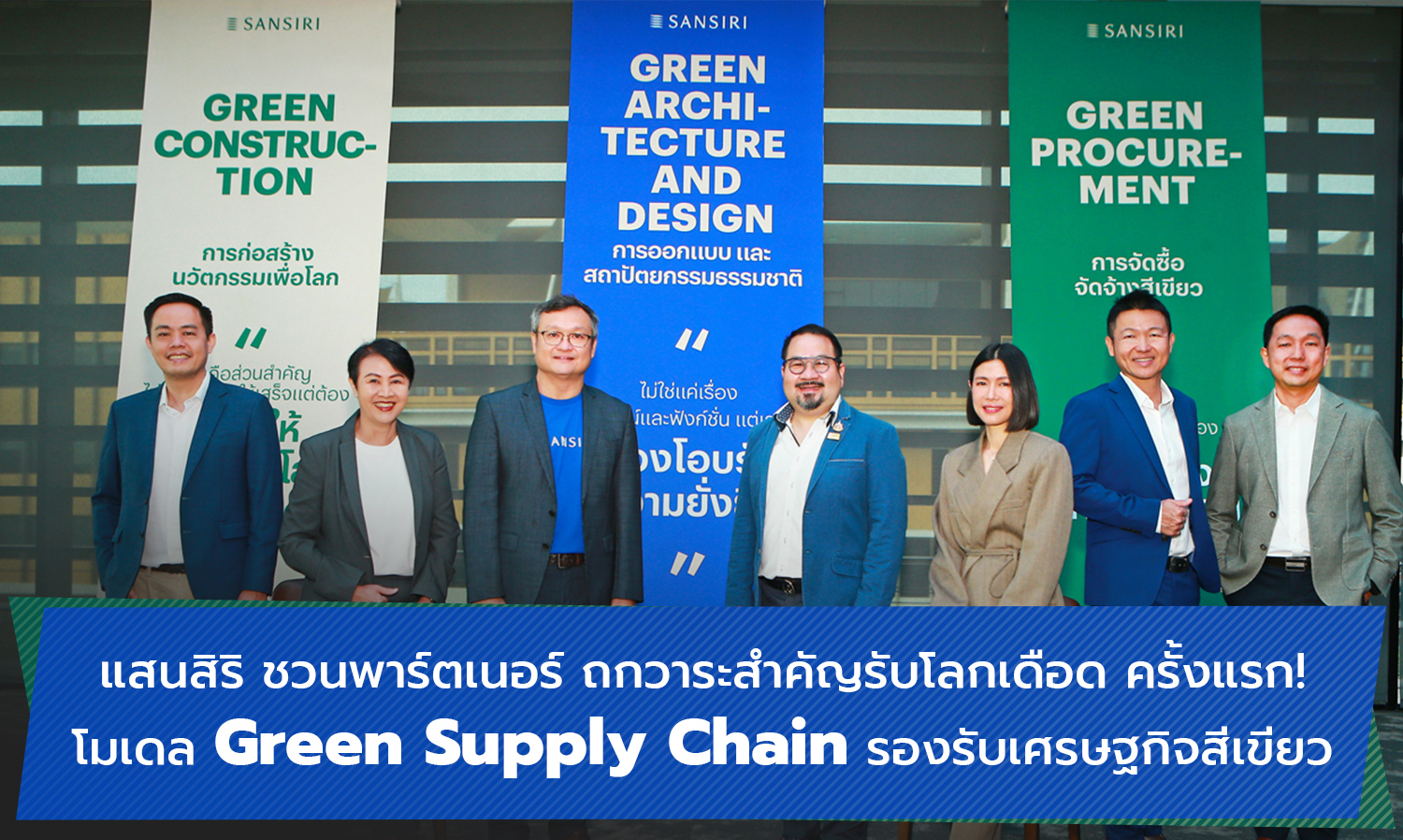
Sansiri Invites Partners to Discuss Key Agenda for a Heating World: The First Green Supply Chain Model Supporting a Green Economy
- Sansiri invites partners and allies, crucial cogs in the wheel of sustainability, to join the SANSIRI ECOLEADERSHIP FORUM to reinforce the path towards Net-Zero together.
- Revealing information on the Climate Change Act, a key to adapting for sustainable business operations in the future.
- Seeking answers to whether businesses will have a place if they do not take ESG seriously.
Sansiri Public Company Limited, the first real estate company in Thailand to aim for net-zero greenhouse gas emissions, organized the SANSIRI ECOLEADERSHIP FORUM: Change Today, Chance Tomorrow, integrating the Green Supply Chain as a vital component for sustainability, while inviting the government and SMEs in real estate to discuss critical agendas to tackle the severe impacts of climate change. The forum provided essential information to drive the Green Ecosystem towards environmentally friendly production and material selection, which plays a crucial role in sustainable supply chain operations, along with insights on the Climate Change Act, deemed a key to sustainable business practices in the future (held on July 25, 2024, at Siri Campus).
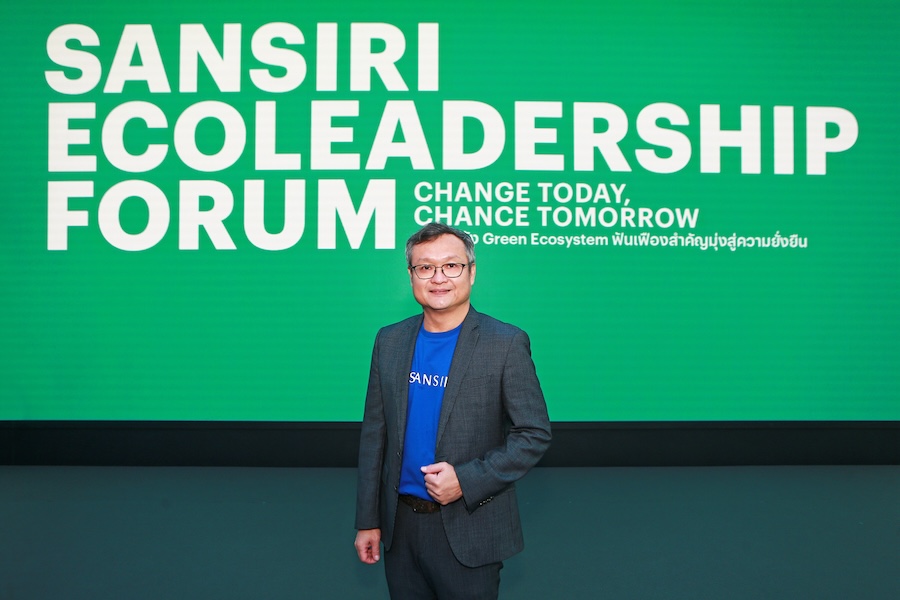
Pioneering the Green Supply Chain Model for Sustainable Growth
Mr. Uthai Uthaisangsuak, CEO of Sansiri Public Company Limited, a leading real estate developer in Thailand, stated that the heating world is not a distant issue, and the business sector plays a significant role in addressing the social and environmental challenges the world faces. This is a crucial testament for Sansiri and Green Leadership to collaboratively adjust business practices, chart a path towards a sustainable future, and grow together through the transition to ESG (Environment – Social – Governance) business practices.
2024 marks a significant milestone for Sansiri as it embarks on its 40th year in business, aiming to proudly become the number one leader in real estate, gaining trust in design, service, quality, and sustainability. This year, we plan to launch 46 new projects worth 61 billion baht, the highest value in the real estate sector.
We believe that sustainability is also related to business risks, such as scarce natural resources, which may lead to rising raw material costs, and the increasing role of alternative materials. This necessitates designing products and services that use resources efficiently and are easily biodegradable, as well as recycling materials. Businesses must prioritize developing skills and improving the quality of life for workers and participate in addressing poverty and access to basic services. If workers are unhappy, productivity may decline, leading to operational disruptions. Therefore, it is a challenge for businesses to understand and integrate sustainability practices into their organizational strategies, balancing environmental, social, and economic dimensions.
Sansiri has seriously integrated sustainability into its corporate strategy and operations while ensuring that our stakeholders grow together. The ultimate goal is to collaborate with partners and support Green Partners to grow together, driving both the industry and Thailand towards sustainable development goals.
Sansiri has planned to reduce greenhouse gas emissions at three levels: a short-term plan by 2025 to reduce carbon by 20% (achieved 15% as of 2023), a medium-term plan by 2033 targeting 50%, and a long-term goal of net-zero greenhouse gas emissions by 2050. This includes prioritizing the reduction of greenhouse gas emissions from homes and condos delivered to consumers, aligning with the organization's greenhouse gas reduction plan.
On this journey, Sansiri cannot walk alone; partners who share the same concern are crucial. Thus, we have pioneered the application of the Green Supply Chain model within the organization, involving approximately 4,000 operators across three supply chain areas: Green Architecture and Design, Green Construction, Green Procurement. All of these are vital cogs in creating value for the real estate sector, which is a major artery of the country, generating an economic value of approximately 1.05 trillion baht, accounting for 5.8% of GDP.
The Green Supply Chain model promotes and supports partners with ESG DNA and emphasizes sustainability, fostering intense collaboration. While we acknowledge that this may increase costs, we view it from a long-term perspective. Once the Economy of Scale is achieved, the operations of all parties, both us and our partners, will grow stably, creating opportunities for business development that can respond to the changing world and the evolving trends of consumers and stakeholders in an era where sustainability is increasingly prioritized.
Sansiri starts by adjusting itself first and passing on experiences and knowledge to partners to achieve tangible results. We are confident that the ongoing Green Supply Chain can drive the establishment of a strong working network in the Green Ecosystem, which not only helps reduce environmental impacts but also opens new business opportunities and enhances competitiveness in the Green Economy market. We believe that this SANSIRI ECOLEADERSHIP FORUM will be a significant step for Sansiri in its commitment to adhere to sustainability principles and create long-term value for society and the environment.
Preparing for the New Rules of the “Global Warming Act”
Dr. Pirun Saiyasithpanit, Director-General of the Department of Climate Change and Environment, revealed that climate change is a pressing issue affecting all sectors directly and indirectly. For businesses, adaptation is crucial for survival against the impacts of climate change, including transforming businesses and industries to emit lower greenhouse gases and be environmentally friendly to keep pace with sustainable consumption and trade trends.
In addition to hearing Sansiri's vision and information on the Climate Change Act, which will contribute to driving towards sustainable development goals, the event also featured a Special Talk on the topic “Change Today, Chance Tomorrow,” comprising various interesting information.
SMEs are the Cogs Connecting the Economy
Mr. Saengchai Theerakulanwong, President of the Thai SME Federation, stated that sustainability based on the Sufficiency Economy Philosophy (SEP) emphasizes the quality of human resources, developing and managing knowledge at all organizational levels, aiming to create an organizational culture that focuses on ethics to achieve strategies and organizational strategies that accommodate change, considering costs and returns reasonably, avoiding extremes, not missing opportunities, and enhancing organizational potential, creating a good organizational immunity for self-reliance and being a support for others through careful and cautious business operations, with comprehensive risk management, which aligns with ESG that must drive change through good leadership and utilize innovation leading to sustainable growth by fostering participation at all organizational levels, aiming to enhance capabilities to add value and generate added value to the business ecosystem that meets the needs of the economy and sufficiency society for sustainability.
Design Must Embrace Sustainability
Ms. Sriaampai Rattanamayu, Head of Marketing at Sansiri Public Company Limited, stated that in the 40th year, Sansiri has challenged itself under the concept of Design for Future, with one of the key design pillars being Design for Sustainability, ready to embrace sustainability and responsibility towards the environment and society. Sansiri emphasizes design that integrates an understanding of nature, creatively extending design work, using resources efficiently and practically, such as reusing construction waste through the Waste to Worth project (marble, tiles, wood), designing energy-efficient homes, and promoting clean energy by installing solar panels, reaffirming its leadership in design aimed at sustainability.
Design plays a crucial role in driving sustainability as it is the upstream process in project development, being the starting point that determines the direction and standards of all projects. Good design not only impacts project success but also plays a significant role in creating value at every stage, from planning, construction, sales, to maintenance.
The Real Estate Sector is Questioned for High Greenhouse Gas Emissions
Mr. Ongart Suwanakul, Senior Assistant Managing Director of High-rise Project Development at Sansiri Public Company Limited, stated that although the real estate industry does not directly contribute a significant portion of greenhouse gas emissions, the value chain of this business continuously consumes energy. Sansiri and its partners have always considered this and have sought ways and adjusted working mechanisms to reduce environmental impacts and mitigate future business risks.
Sansiri has a green precast factory, the first in the Thai real estate sector, certified with ISO9001 & ISO14001 for both quality management and environmental management systems, receiving a green label from the Ministry, capable of reducing waste within the factory by up to 98% (no noise and air pollution), with a production capacity of 1,500,000 square meters per year, and can produce precast concrete slabs for residential construction of 3,700 units per year.
Additionally, we incorporate technology and innovation as part of laying the foundation for sustainable construction, such as using BIM (Building Information Modelling) for construction design and planning to achieve maximum efficiency and minimize resource use, as well as developing applications to track progress and manage project resources, which we collaborate on with our partners.
Moreover, we prioritize using environmentally friendly construction materials and clear measurement results, setting goals to reduce construction site waste by 15% and specifying the use of Low Carbon 30% in TOR. Besides setting goals, measurement is also crucial, with a Dashboard developed internally to collect data and manage waste, which we currently use to analyze, measure, and manage waste on our construction sites.
Green Ecosystem is the Key Driver for Change
Mr. Prasert Trakanwatchirath, Deputy Managing Director of Project Procurement at Sansiri Public Company Limited, revealed that one of the key strategies for Sansiri's sustainable business operations is to apply the Green Supply Chain model in collaboration with partners, focusing on developing and selecting products with the least environmental impact and encouraging partners to develop environmentally friendly materials to enhance sustainable housing development.
In terms of procurement, we prioritize selecting materials that are environmentally friendly and reduce greenhouse gas emissions, such as those that have passed inspections and certifications according to established standards. Some materials must be certified by relevant agencies, such as the Greenhouse Gas Management Organization (Public Organization), which is a credible agency for verifying and certifying greenhouse gas emission reductions.
Additionally, Sansiri supports the use of materials certified by other organizations or self-certified to ensure that every project development process does not harm the environment. In 2023, we set a goal for purchasing materials with Self-Certified certification at 30%, which we exceeded with 53% of such materials purchased. We take measurement and tracking seriously and incorporate it into our organization's greenhouse gas emissions calculations. Furthermore, in terms of material production, our partners also help reduce greenhouse gas emissions when we use these products in the homes we deliver to customers.
#Sansiri #SansiriNo1Brand #SansiriBrandNumberOne#Sansiri40years #YouAreMadeForLife#SansiriSustainability #SustainabilityForum #ClimateAction