Real Estate Stimulus Measures for 2024: Transfer and Mortgage Fees Reduced to 0.01% for Homes Under 7 Million Baht, Benefiting Both Buyers and Sellers
Following the Cabinet resolution on April 9, 2024, the government has approved measures to stimulate the economy through the real estate sector by:
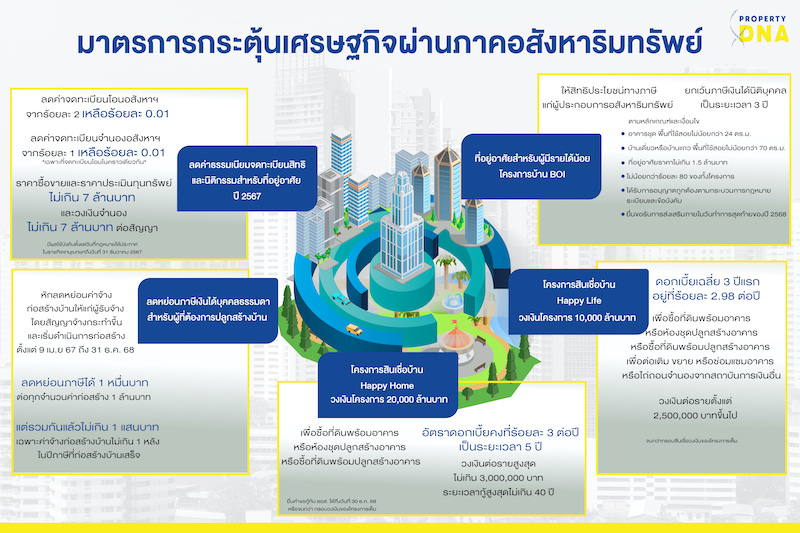
- Reducing property transfer registration fees from 2% to 0.01%
- Reducing mortgage registration fees from 1% to 0.01% for real estate transactions involving residential buildings such as single houses, duplexes, townhouses, commercial buildings, or land with such buildings, or condominiums registered as condominiums, with a purchase price and appraised value not exceeding 7 million baht and a mortgage amount not exceeding 7 million baht per contract, excluding cases of selling only parts.
This applies to individual Thai buyers and will be effective from the date the law is published in the Royal Gazette until December 31, 2024.

Mr. Surachet Kongcheep, Managing Director of Property DNA, commented on these measures, stating that while they are short-term, he supports the government's initiative. Not only do they promote housing for the public, but stimulating the economy through the real estate sector also positively impacts related businesses, including manufacturing, construction materials, and employment. Thus, the housing market is a crucial engine driving the country's economy, accounting for over 10% of the national GDP. If the real estate or housing market can thrive, it will lead to significant money circulation across all businesses related to the real estate sector.
Expanding the housing price ceiling to 7 million baht per unit is believed to cover a broader purchasing power group than the previous ceiling of 3 million baht. Although the 3 million baht housing market is the largest segment, it must be acknowledged that in recent years, many potential buyers in this price range have faced household debt issues and difficulties securing bank loans. Therefore, raising the housing price ceiling to 7 million baht per unit is expected to create broader momentum, as those with purchasing power above 3 million baht have fewer issues with loan applications, especially those looking for homes priced over 5 million baht. The approval of measures to reduce transfer and mortgage registration fees, along with the increased price ceiling, serves as a strong incentive for this group to decide to purchase housing. This measure reduces the financial burden on homebuyers, as the costs associated with transferring ownership of a house or condominium will significantly decrease. Additionally, the government's additional personal income tax relief measures for those wishing to build their own homes will further stimulate the construction sector and related materials, generating more money circulation in the economy.
Mr. Surachet also noted that besides the reduction of transfer fees from 2% to 0.01% and mortgage registration fees from 1% to 0.01%, special interest measures through state banks, namely the Government Housing Bank (GHB) and the Government Savings Bank (GSB), will facilitate easier access to loans for citizens to own homes.
The GHB has launched the Happy Home loan program with a fixed interest rate of 3% per year for 5 years, with a maximum loan amount of 3 million baht and a maximum loan term of 40 years. This program will support low to middle-income earners.
Meanwhile, the GSB has also introduced economic stimulus projects in the real estate sector for both consumers and businesses through two initiatives:
1) The GSB Home Loan for the Public, with a project budget of 10 billion baht, supporting loans for individuals to purchase their own homes, with an average interest rate of 2.95% for the first three years, a maximum loan amount of 7 million baht, and a maximum loan term of 40 years.
2) The D-HOME loan program for businesses to stimulate the economy, with a project budget of 10 billion baht, supporting loans for businesses to invest in operations, starting interest rate of 3.50% per year, with a maximum loan term of 4 years and no fees. Applications can be submitted to the GSB starting April 17, 2024.
These recent measures indicate that the government aims to primarily stimulate domestic purchasing power, with many initiatives focusing on the purchasing power of Thai citizens. Meanwhile, businesses are ready to launch campaigns or policies alongside government measures to boost purchasing power. Ultimately, if purchases involve applying for loans from financial institutions, the final decision will depend on the financial institutions' assessment of housing loan approvals, which is the last step before ownership transfer. Many businesses will benefit from these measures, not just one over another. Those likely to benefit the most are developers with housing or condominium projects priced under 7 million baht ready for ownership transfer in 2024. Major publicly listed developers with projects in this price range include Pruksa, Origin, AP, Sansiri, Supalai, Noble, and SC Asset, among others. It can be said that all of them will benefit from these measures, but the extent of the benefit will depend on the proportion of homes or condominiums ready for ownership transfer this year. Developers are also expected to introduce measures to create incentives, particularly regarding potentially lower selling prices.
“Ultimately, any measures introduced, whether by the government, financial institutions, or private sectors, can help stimulate the real estate market and related businesses to drive the country's economy. I hope all parties will cooperate and prioritize the overall picture of the country,” Mr. Surachet emphasized, adding that attention should be paid to the government's policy on land leasing for foreigners, whether there will be an extension of the land lease period for foreigners to 99 years. This topic has diverse opinions, with some in favor and others against it. Those in favor view the extension as another avenue for generating money circulation in the real estate market.