
4 Industries to Watch During the Development of Thailand Taxonomy Phase 2
The escalating climate crisis poses a significant challenge that the world must confront. The financial sector, as a provider of capital to the economy, has initiated the development of policies and tools that enable businesses and households to adapt to climate change in a timely manner. One of the key tools is the Taxonomy, a classification system used to identify activities, assets, and revenue proportions that align with important sustainability goals and meet specified criteria. This ensures that each sector has a common definition of environmentally conscious activities. Therefore, the Taxonomy is not a regulation that dictates which activities are 'good' or 'bad,' but rather a central definition that serves as a reference point for policy formulation, strategy development, and risk assessment to plan for the future adaptation of businesses.
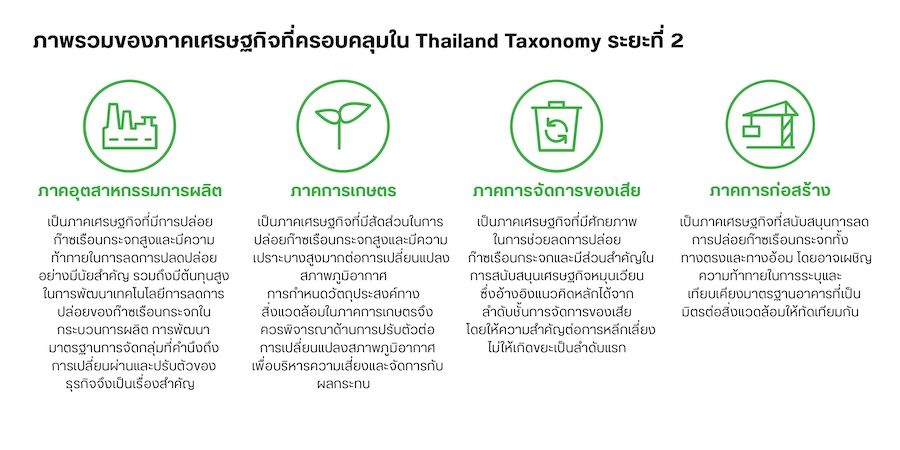
The Thailand Taxonomy Phase 1, released in June 2023, covers activities that contribute to greenhouse gas reduction to achieve climate change mitigation objectives in the energy and transportation sectors. In February 2024, the Taxonomy working group began meetings to develop Thailand Taxonomy Phase 2, which will expand the scope to include the manufacturing, agriculture, waste management, and construction and real estate sectors, while continuing to focus on climate change mitigation objectives as in Phase 1. It is expected that the scope of activities in each business sector will consider national policies and contexts, as well as remain aligned with international standards.
To help stakeholders understand the upcoming Thailand Taxonomy, this article will present forecasts on the development of Thailand Taxonomy in Phase 2 across various industries and how they are likely to evolve.
- Manufacturing Sector
The manufacturing sector has high greenhouse gas emissions and faces significant challenges in reducing emissions (hard-to-abate sector), along with high costs associated with developing greenhouse gas reduction technologies in production processes. It is anticipated that the development of the Thailand Taxonomy for the manufacturing sector will primarily consider the national context and take into account activities affected by international greenhouse gas reduction measures or policies.
When examining existing international Taxonomies, such as the EU Taxonomy, Singapore-Asia Taxonomy, and CBI Taxonomy, it is found that they cover heavy industries with high greenhouse gas emissions and challenges in reduction, as well as activities that promote greenhouse gas reduction in various forms. The conditions and indicators will depend on the specific Taxonomy and the context of the country developing it.
Therefore, it is expected that the Thailand Taxonomy Phase 2 for the manufacturing sector will emphasize the development of criteria, conditions, and indicators aimed at supporting the transition to more environmentally friendly businesses.
- Agriculture Sector
The Thai agriculture sector is highly vulnerable to climate change and is the second-highest emitter of greenhouse gases, accounting for 15.23% of Thailand's total emissions.
Current regional or national Taxonomies often cover perennial crops, annual crops, and livestock without specifying particular species. However, recently, countries with a high proportion of agriculture have begun to specify conditions and indicators for individual economic crops. Thus, the Thailand Taxonomy Phase 2 is likely to integrate both general criteria and specific criteria for key economic crops such as rice, rubber, and sugarcane.
Additionally, there may be considerations to expand the scope of livestock to include aquatic animals that are significant to the economy and climate change adaptation, to cover activities that help mitigate damage from natural disasters that may intensify in the future.
- Waste Management Sector
The waste management sector has the potential to help reduce greenhouse gas emissions and plays a crucial role in supporting a circular economy. Currently, Thailand still faces challenges with improperly disposed waste and inadequate waste disposal sites, including incinerators without air pollution control systems and outdoor burning.
For the development of the Thailand Taxonomy Phase 2, it is expected that the scope of activities will align with the National Environmental Quality Promotion and Conservation Act of 1992 and follow the direction of international Taxonomies, such as the collection and transportation of non-hazardous waste, biological waste treatment, electricity generation from unrecyclable waste, and the establishment of model centers for sorting and processing recyclable materials, as well as the establishment of wastewater treatment plants and systems for producing fresh water from seawater.
- Construction and Real Estate Sector
Comparing standards for environmentally friendly buildings presents a challenge when developing the Taxonomy, as each standard uses different indicators, leading some standards to emphasize indicators that are not directly related to addressing climate change issues. Recent Taxonomies have addressed this issue by specifying a list of reference standards. For example, the Singapore-Asia Taxonomy specifies that standards certified by the Climate Bonds Initiative can be referenced, covering new building construction, renovation of existing buildings, acquisition of real estate, and installation and maintenance of tools and equipment that enhance energy efficiency and renewable energy. Therefore, the Thailand Taxonomy Phase 2 can adopt this approach to compile a list of activities, conditions, and indicators to reduce inconsistencies between standards.
The working group will solicit public and stakeholder feedback on the draft standard document for the Thailand Taxonomy Phase 2 in the fourth quarter of 2024 and is expected to publish it in the following year.
In the meantime, businesses in the four aforementioned economic sectors should closely monitor the development of the scope and criteria through relevant associations or government agencies, both for the Thailand Taxonomy Phase 2 and other related policies or regulations, such as the draft Climate Change Act currently open for public consultation, to assess potential impacts and prepare for necessary adjustments in production processes, data collection for benefits, or reporting that may become mandatory in the future.
Note: This article was written by Dr. Bodin Wongwittayaphirom, Senior Manager, and Thanida Loseriwanit, Assistant Manager, Sustainability & Climate CoE, Deloitte Thailand.