Housing Market Situation Q2/2022
The Real Estate Information Center (REIC) of the Government Housing Bank assesses that the group of homebuyers working in the industrial and export sectors continues to recover from 2021, resulting in new purchasing power. Developers are still offering promotions, price reductions, and various giveaways, as well as targeting customers looking to invest in housing. However, there are still risks to be cautious about, particularly with the anticipated interest rate hikes in the second half of the year. Employment and income conditions for people in the tourism and service sectors are still recovering slowly. Household debt remains high at around 90% of GDP, making it difficult for low to middle-income individuals in freelance professions to access credit, similar to the previous year. The rising Non-Performing Loan (NPL) rates in financial institutions may lead to more cautious lending practices. Additionally, increasing construction costs may result in higher prices for new housing projects in the latter half of the year.
Given these factors, REIC has developed the "Overall Real Estate Market Index (Residential Sector)" using data on both demand and supply in the Bangkok metropolitan area to assess economic risks. The Overall Real Estate Market Index (Residential Sector) for Q2 2022 stands at 86.0, a slight decrease of -0.92% compared to the previous quarter's index of 86.8, but an increase of 13.3% compared to the same period last year, which had an index of 75.9.
REIC predicts that the Overall Real Estate Market Index (Residential Sector) for 2022 will be at 81.2 points, an increase of 9.1% from 2021. In a worst-case scenario, it could drop to 77.0 points, reflecting a growth of 3.4%, while in a best-case scenario, it could improve to 85.4 points, showing a growth of 14.7%.
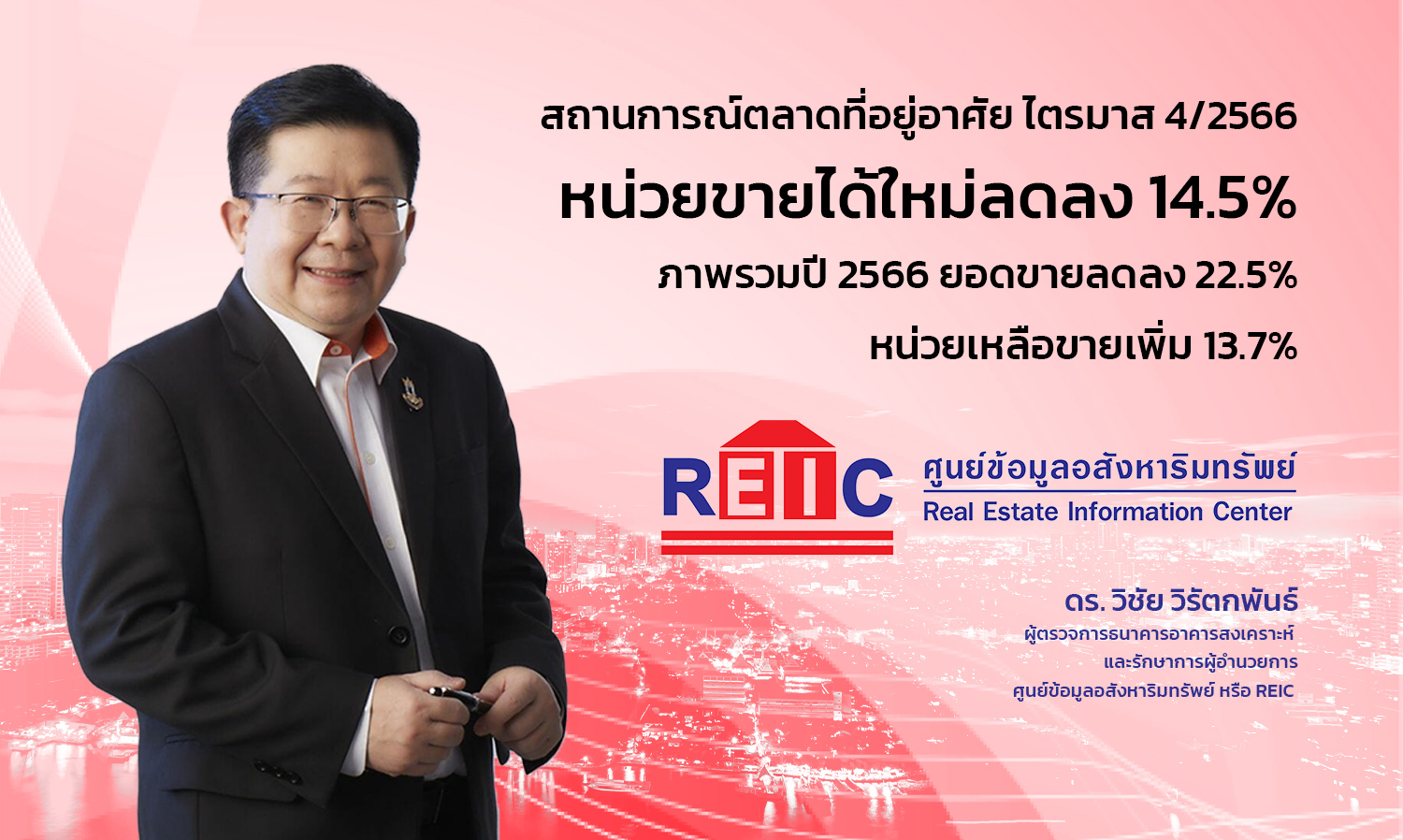
Dr. Vichai Viratakphan, Inspector of the Government Housing Bank and Acting Director of the Real Estate Information Center stated that as we enter Q2 2022, the real estate sector continues to face negative factors, particularly the ongoing rise in oil prices, which has led to a decrease in overall applications for land allocation across the country.
Land Allocation License Issuance Nationwide Q2/2022

- Housing Supply Situation Q2 2022
REIC found changes in the issuance of land allocation licenses nationwide in Q2 2022, with a total of 156 projects comprising 15,999 units. The number of projects decreased by -1.3% and the number of units decreased by -5.5% compared to the same period in 2021. This includes 7,162 single-family homes, 5,358 townhouses, 3,054 duplex homes, 240 allocated land units, and 158 commercial buildings. When considering by area, the Bangkok metropolitan area, the northeastern region, and the central region saw an increase in land allocation licenses.
In the Bangkok metropolitan area, Q2 2022 saw the issuance of land allocation licenses for 9,069 units, accounting for 56.9% of the national total, an increase of 30.9% from the same period in 2021. This includes 4,223 single-family homes, 3,737 townhouses, and 1,012 duplex homes. Meanwhile, the eastern region continues to experience a slowdown in land allocation applications, with 3,807 units, representing 23.8% of the national total, where duplex homes had the highest number of applications at 1,435 units, followed by townhouses at 1,331 units and single-family homes at 951 units.
Regarding the supply of new housing projects launched in the Bangkok metropolitan area in Q2 2022, there were 23,766 new units, including 14,932 condominium units and 8,834 housing projects. Although this is a decrease from the previous quarter, it represents a significant increase compared to the same period in 2021, which had 9,102 units, marking a 161.1% increase, with a total project value of 143,399 million baht, up 245.0%. The value of housing projects was 81,158 million baht, up 136.5%, and condominium projects were valued at 62,241 million baht, up 758.9%.
“It is noteworthy that the launch of new projects in the Bangkok metropolitan area during the first six months of 2022 saw condominium projects account for more than half of all new housing launches, with a share of 63.3%, while housing projects dropped to 36.7%, a ratio similar to the period before the COVID-19 pandemic in 2018. The value of new project launches is higher than the average before the pandemic,”
Among the top five areas with the highest number of new project launches are: 1. Thonburi District with 3,098 units, all condominium projects valued at 3,718 million baht; 2. Pak Kret District with 2,739 units, comprising 2,380 condominium units and 359 housing units, with a total project value of 9,749 million baht; 3. Bang Phli District with 1,763 units, all housing projects valued at 32,436 million baht; 4. Lat Phrao District with 1,250 units, all condominium projects valued at 4,669 million baht; and 5. Chatuchak District with 1,209 units, comprising 1,199 condominium units and 10 housing units, with a total project value of 3,515 million baht.
- Housing Supply Forecast for 2022
In 2022, the forecast for new project launches, including both housing projects and condominiums, is approximately 77,728 units, an increase of 50.8% from 2021, which had 51,531 units, or an increase ranging from 35.8% to 65.9%. The total project value is estimated at 401,360 million baht, up 83.3% compared to 2021, which had a value of 218,950 million baht, or an increase ranging from 65.0% to 101.6%. Notably, 2021 was the year with the lowest new housing launches in 11 years since 2011 and lower than 2011, which was the year of the major flooding in Bangkok with 82,595 units.
Additionally, it is expected that in 2022, there will be approximately 42,308 land allocation licenses issued, an increase of 32.5% from 2021, which had 31,927 units, or an increase ranging from 19.3% to 45.8%. The issuance of land allocation licenses in 2021 decreased from 2020 by -32.7%, as it was the year with the lowest issuance in 16 years since 2006 and lower than 2006, which was the year of the coup with 34,123 units issued.
- Housing Demand Situation Q2 2022
Regarding the housing demand situation, data on property transfers in Q2 2022 shows that there were 95,316 property transfers nationwide, an increase of 9.0% from the same period in 2021, which had 87,485 units. This includes 70,426 transfers for horizontal projects and 24,890 for condominium projects, with a total value of 257,009 million baht, an increase of 7.1% compared to the same period in 2021, which had a value of 240,048 million baht. Of this, the value of horizontal project transfers was 192,392 million baht and condominium project transfers were 64,617 million baht. Overall, the units and values of property transfers across all sectors are showing positive trends.
Units and Value (Million Baht) of Property Transfers Nationwide

- Housing Demand Forecast for 2022
For 2022, it is expected that the property transfer situation will stabilize but improve slightly compared to 2021 due to inflation, rising living costs, and increasing interest rates, along with more homes gradually completing and entering the market. It is anticipated that there will be approximately 349,253 units transferred in 2022, an increase of 1.6% from 2021, or within a range of -9.9% to 10.5%. Horizontal units are expected to increase by 1.8%, or within a range of -8.4% to 12.0%, while condominium units are expected to increase by 1.1%, or within a range of -14.1% to 6.1%. In terms of value, it is expected that the total value of property transfers will be approximately 948,471 million baht, an increase of 0.4% from 2021, or within a range of -10.4% to 9.9%. Horizontal units are expected to increase by 0.4%, or within a range of -9.7% to 10.4%, while condominium units are expected to increase by 0.6%, or within a range of -12.5% to 8.6%.
- Foreign Property Transfer Situation Q2 2022 and Forecast for 2022
Regarding the demand in the housing market from foreigners, REIC compiled data from the Land Department's property transfer registrations, revealing that the number of condominium transfers by foreigners nationwide in 2021 was 8,198 units out of a total of 89,836 condominium transfers, with a value of 36,610 million baht out of a total value of 253,907 million baht.
In the first six months of 2022, the number of condominium transfers by foreigners was 4,433 units, an increase of 1.4% compared to the same period last year, which had 4,370 units, with a transfer value of 22,331 million baht, up 9.1% compared to the same period last year, which had a value of 20,472 million baht.
Chinese buyers continue to have the highest number of transfers both in units and value, with 1,124 units transferred valued at 5,931 million baht. The second highest in terms of units and value differs, with Russians having the second highest number of transfers at 129 units valued at 415 million baht, followed by the United States with 116 units valued at 643 million baht, Germany with 80 units valued at 266 million baht, and India with 79 units valued at 353 million baht.
Overall, it is anticipated that in 2022, there will be a significant increase in new project launches compared to 2021, with horizontal homes likely to receive more positive responses from buyers, while condominiums will gradually recover due to reduced stock and rising land prices, prompting developers to build condominiums to align with purchasing power. Developers of new homes will continue to offer discounts and giveaways to encourage purchasing decisions, but not at the same level as in 2021 due to higher construction costs. The market remains favorable for buyers.
There will be growth in the transfer of second-hand homes, but caution is advised due to the potential for rising interest rates in the second half of the year, the ongoing impact of the COVID-19 pandemic on economic expansion, despite reduced severity, the effects of the conflict between Russia and Ukraine, rising inflation, and high household debt levels at around 90% of GDP, making it difficult for low to middle-income individuals in freelance professions to access credit, similar to the previous year. The increasing NPL rates in financial institutions may lead to more cautious lending practices and a potential increase in refinancing, along with continuously rising construction costs, which may result in higher prices for new housing projects in the latter half of the year, potentially leading to an imbalance between income and housing affordability, Dr. Vichai concluded.