CBRE Reports Hotel Investment in Asia Pacific Recovers, Signaling Investors' Desire to Mitigate Inflation Risks
In 2021, hotel investments in the Asia Pacific increased by 46% year-on-year, with total investments reaching 410 billion baht. This surge is attributed to investors seeking opportunities to enhance value and transform assets.
Hotel investments in the Asia Pacific region rebounded in 2021, rising by 46% compared to 2020, with total investments amounting to 410 billion baht (12 billion USD). The ongoing recovery of the hotel market is supported by an influx of capital from investors looking to expand their investments in this sector, according to the latest report from CBRE's research department on hotel investment in the Asia Pacific (in million USD).
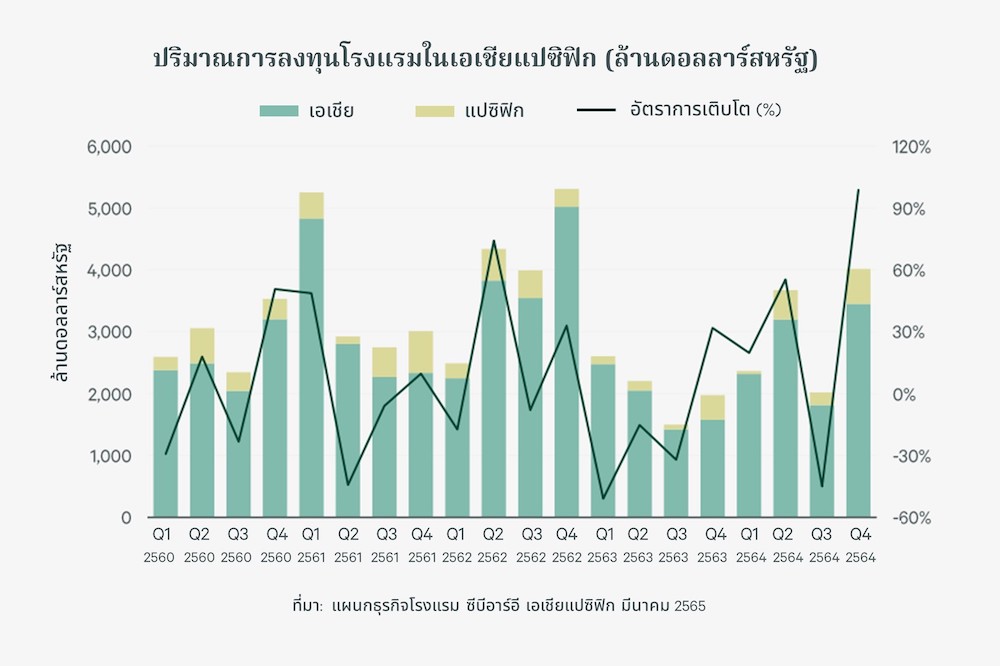
Source: CBRE Asia Pacific Hotel Business Department, March 2022
“Hotels are one of the markets poised to benefit from the reopening of international borders in this region. For investors looking to generate higher returns, the hotel market offers attractive investment returns relative to risks, along with opportunities to reposition in the market. Additionally, hotels are increasingly viewed as assets that can help mitigate inflation risks, as they offer daily room rentals rather than monthly or yearly leases like other types of real estate,” said Steve Carroll, Head of CBRE's Hotel Business in Asia Pacific.
CBRE has observed rapid growth in the hotel market, making it one of the most attractive sectors for investors seeking value-add opportunities. Consequently, the reopening of borders and the easing of travel restrictions have led various investors, such as Real Estate Investment Trusts (REITs), private equity, and off-market investors, to acquire more hotels to enhance services for guests, anticipating pent-up demand from tourists. Some hotels are also being transformed into office spaces and co-living areas.
CBRE has noted an increasing trend of converting hotels into co-living spaces, particularly in Hong Kong and Singapore, where there is a demand for affordable housing amid a rigid rental market. Arthakawi Chusaeng, Head of CBRE's Hotel Business in Thailand, commented, “In Thailand, hotel owners and developers are adjusting space usage for maximum benefit, considering new living patterns after experiencing the COVID-19 pandemic, while some may seek opportunities to sell their hotels.”
“For the hotels that remain operational, many service providers and investors have taken advantage of the pandemic period, when occupancy was low, to renovate their hotels in preparation for the return of tourists. They have invested in new technologies, such as smart systems, to create differentiation,” Arthakawi added.
The steady recovery is due to countries across the region relaxing travel restrictions and reopening borders. The vacation rental market in Southeast Asia is expected to benefit from the long-accumulated travel demand, leading to a recovery in the tourism business. Tourists' desire to visit destinations with ample outdoor spaces has resulted in occupancy rates and room prices in several hotels, such as those in the Maldives, returning to pre-pandemic levels.
CBRE anticipates a significant increase in investment demand in the resort or vacation hotel segment in the second half of 2022, as competition heats up with investors expecting full recovery in occupancy rates and tourist numbers. Conversely, investors remain cautious about hotel investments in urban areas, which are expected to recover more slowly, as companies continue to be wary of travel expenses.
Some lenders in certain countries have a more positive outlook on the hotel market, with major financial institutions in Australia and Japan increasing lending to experienced hotel investors. Price expectations, including various discounts, are anticipated to be adjusted in the coming months as hotel cash flows begin to recover to pre-pandemic levels.
“As the hotel market is poised for recovery, hotels must prepare to welcome various types of tourists returning post-pandemic. Moreover, technology will play an increasingly important role, both in enhancing hygiene and safety for leisure travelers and improving the efficiency of meeting rooms and business gatherings for corporate travelers. The growing awareness of environmental and social issues among consumers is another trend that will drive the adoption of ESG (Environmental, Social, and Governance) principles in the hotel market and shape future transactions,” Carroll added.