Proptech: The Future Trend of the Housing Market
|
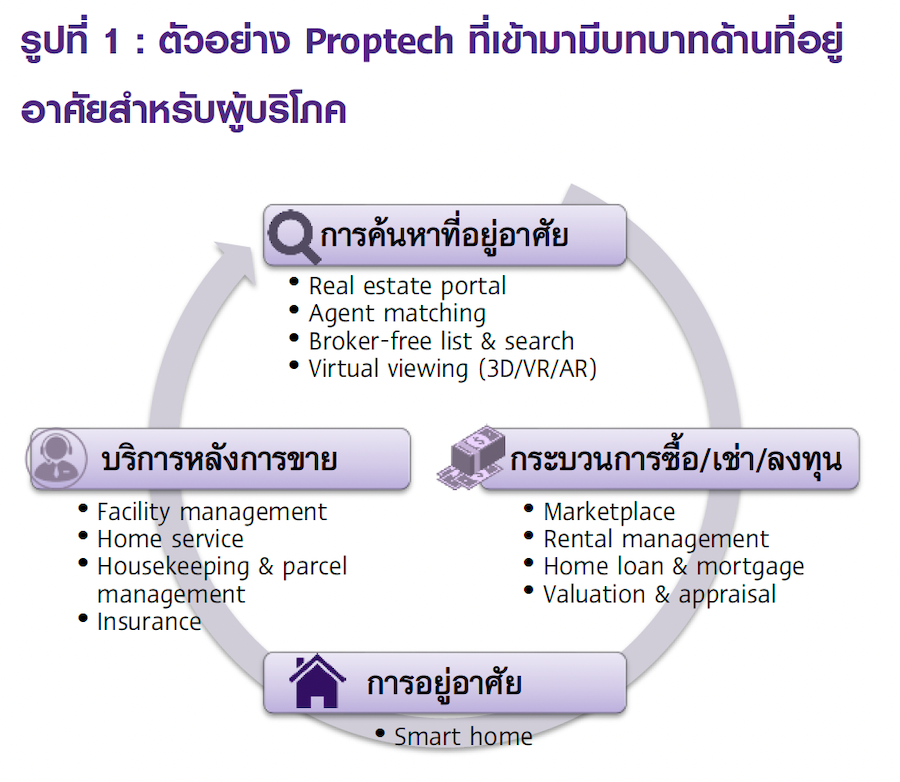
Proptech Benefits Both Consumers and Housing Developers Proptech facilitates convenience for consumers, from searching for housing, purchasing/renting/investing, living in the property, to post-sale services. At the same time, Proptech plays a role in enhancing the efficiency of housing developers' businesses, including marketing projects through various platforms and utilizing matching platforms to connect buyers with developers. Additionally, it has led to the development of smart homes and the use of applications to manage amenities within housing projects. Online Transactions and an Aging Society Drive Increased Use of Proptech Online transactions in the housing sector, especially during the COVID-19 pandemic, have accelerated the adoption of Proptech by housing developers across various aspects, covering the entire housing market ecosystem. This includes searching for properties, virtual project viewings, purchasing processes, proactive marketing through different platforms, and online financial transactions. However, there are still significant limitations to online housing transactions, particularly regarding regulations. If regulations are relaxed, it will further support the trend towards end-to-end online transactions through Proptech in the future. Moreover, the shift towards an aging society is another crucial factor that encourages the increased use of Proptech, particularly smart homes, to enhance convenience, create suitable environments, and improve safety for the elderly. This includes the use of automation systems, sensors, and alerts to better meet their living needs. Using Proptech to Address Specific Resident Issues Can Differentiate Developers The needs or problems of different resident groups vary significantly. For example, developing automation systems, sensors, and alerts for the elderly will differ from those for families with young children or pets. Therefore, analyzing the specific needs or problems of residents and using Proptech to address these issues within the ecosystem and regulatory framework will help create differentiation from other developers and will be a key factor in achieving success in the competitive housing market. How Does Proptech Benefit the Housing Market? Proptech facilitates consumers from searching for housing, purchasing/renting/investing, living in the property, to post-sale services. At the same time, Proptech enhances the efficiency of housing developers' businesses. Property Technology (Proptech) encompasses innovations or technologies such as software, platforms, applications, and digital solutions that improve efficiency and facilitate activities related to real estate, both residential and commercial, from construction, purchasing/renting/investing, living, space utilization, to management.
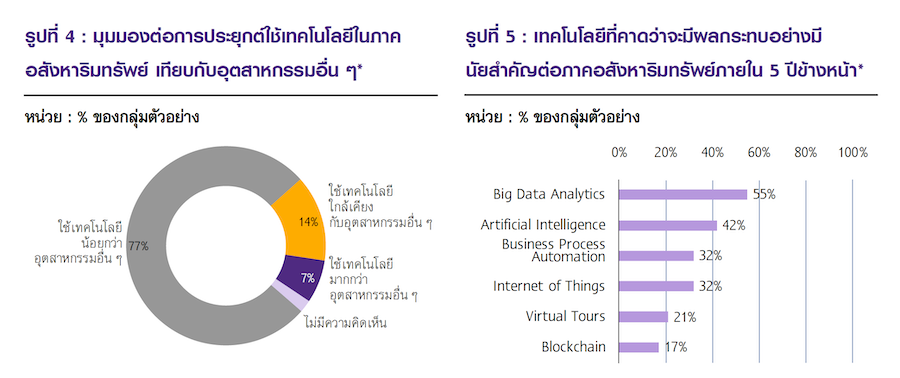
In the housing market, Proptech plays a role in facilitating consumers from: 1) Searching for Housing through various platforms, such as aggregating listings for sale/rent, matching agents with developers, marketing by developers, and virtual project viewings. 2) The Purchasing/Renting/Investing Process through platforms that match buyers/renters with property owners directly, without intermediaries, managing rental aspects, and facilitating financial transactions such as loans and property appraisals. 3) Living by applying smart home technologies, such as automation systems, voice commands, and controlling various systems from inside and outside the property through different devices. And 4) Post-Sale Services, including managing amenities within housing projects, repair services, maintenance, equipment installation, cleaning services, parcel delivery, and home insurance. Currently, the Proptech industry abroad is thriving, especially in the United States, where in 2021, there were 1,340 Proptech companies in the housing sector. Notable examples include Zillow, a comprehensive real estate platform offering services for buying/selling/renting properties and mortgage considerations, connecting various market players, including buyers, sellers, renters, investors, developers, and agents. Zillow utilizes big data analytics and artificial intelligence (AI) to predict the behavior of buyers, sellers, renters, and investors, and has developed a system to match housing needs with property owners specifically, making it one of the most popular real estate platforms in the U.S., with over 135 million listings in its database, an average of 36 million website visits per month, and over 10 million downloads of its app on Google Play. In Thailand's housing market, developers are also adopting Proptech to enhance business efficiency and facilitate buyers, sellers, and renters. This includes marketing housing projects through various platforms and using matching services to connect agents with developers to leverage expertise in selling housing projects and access to diverse buyer segments. Buyers/renters have also utilized platforms to aggregate listings for sale/rent as a means to search for housing information across different locations and price ranges. Additionally, developers are developing smart homes and using applications to manage amenities within housing projects. Today's consumer lifestyle is increasingly intertwined with various technologies, and some technologies overlap with Proptech, leading housing developers to prioritize expanding their scope towards investment or forming partnerships with other technology service providers. This results in the integration of diverse innovations or technologies, including construction tech to enhance construction efficiency, health & wellness tech to facilitate health for residents, the Internet of Things (IoTs) as a key component of smart homes, and fintech to assist in payment for housing and various services, aiming to develop digital solutions that comprehensively facilitate residents. Furthermore, it has been observed that housing developers are increasingly adopting technology to enhance business efficiency, particularly through big data analytics, which plays a role in developing housing to meet the in-depth needs of residents, pricing assessments, investment opportunity analysis, and targeted marketing to potential homebuyers on various platforms using relevant criteria such as housing type, age, income, location, and price level, enabling developers to better reach their target homebuyer segments, thus enhancing their competitive capabilities in selling housing projects in the future. What Factors Are Accelerating the Use of Proptech? The prolonged COVID-19 pandemic has led to the emergence of new normal behaviors, which has accelerated the role of Proptech in the housing market. The pandemic, which began in early 2020, has significantly impacted the housing market, with purchasing power contracting due to economic conditions and restrictions on visiting housing projects during severe outbreaks, resulting in a continuous decline in housing sales since 2020. This situation has prompted housing developers to adjust their strategies, primarily by adopting Proptech to ensure business continuity, including proactive marketing through various platforms and offering virtual project viewings using augmented reality (AR) and virtual reality (VR) technologies to facilitate project visits, thereby increasing sales opportunities amidst restrictions on project viewings during severe outbreaks. Currently, AR and VR technologies have become basic services that most new housing projects offer to facilitate visitors, which can help stimulate housing sales to some extent, although the housing market still faces pressure primarily from reduced purchasing power due to economic conditions. The EIC believes that the prolonged COVID-19 pandemic, which shows no signs of ending, has changed people's behaviors, leading to new normal trends where people spend more time living in their homes, including working from home and online learning, resulting in residents placing greater importance on comfort, safety, and energy efficiency within their homes. Smart home technologies, such as smart appliances, automation systems, voice commands, and controlling various systems through multiple devices, will play a role in addressing living needs, including comfort, safety, and energy efficiency, aligning with the trend that smart homes have become a key selling point that housing developers compete to offer in their housing projects. Additionally, maintaining hygiene, which reduces physical contact with surfaces outside the home and encourages social distancing, will likely change the design of common areas in housing projects. Housing developers will increasingly implement technologies that reduce surface contact, such as sensor systems and automation in common areas. Furthermore, the trend of people spending more time in their homes will lead to an increase in the number of residents utilizing common areas, such as co-working spaces, meeting rooms, and fitness centers. Developers are likely to implement booking systems and user count systems in common areas to help reduce congestion among users. In the near future, the trend of online housing transactions is accelerating, driven by new homebuyer groups, particularly Millennials and Gen Z, who are highly connected to the digital world. The EIC sees that the accelerating trend of online housing transactions is a driving factor for housing developers to adopt Proptech across various aspects, covering the entire housing market ecosystem, from searching for housing, virtual project viewings, purchasing processes, proactive marketing through various platforms, to online financial transactions. It is undeniable that in the near future, the new consumer groups entering the housing market will be Millennials (born 1983-1999) and Gen Z (born 2000-2006). The behaviors of these two consumer groups are highly connected to the digital world, resulting in an increased adoption of technology to facilitate their lifestyles. Therefore, transactions from Millennials and Gen Z in the future will support the growing trend of Proptech usage, potentially evolving into using Proptech for searching housing through platforms that aggregate listings for sale/rent, matching buyers with property owners directly without intermediaries, allowing for quick searches for properties in desired locations and price ranges, maximizing cost savings, and extending to the purchasing process, including virtual viewings and financial transactions such as loans and property appraisals through Proptech as intermediaries facilitating financial transactions. Regarding living arrangements, both Millennials and Gen Z are also likely to increasingly adopt Proptech to facilitate their lifestyles. The work-from-home and online learning trends will lead these groups to spend more time in their homes and utilize common areas more frequently. Therefore, the development of smart homes and the management of various amenities within housing projects through applications that cater to the lifestyles of these consumer groups, such as booking co-working spaces and meeting rooms, parcel delivery services, cleaning services, and the adoption of various Proptech solutions to enhance convenience, will be key factors in attracting home purchases from Millennials and Gen Z. However, significant limitations still exist for online housing transactions, particularly regarding regulations. If regulations are relaxed, it will further support the trend towards end-to-end online transactions through Proptech in the future. Additionally, the transition to an aging society is another key factor that supports the growing trend of Proptech usage, especially smart homes to create suitable environments and enhance safety for the elderly, who represent a significant resident segment that housing developers prioritize as Thailand moves towards an aging society. This includes housing projects targeting families living with the elderly and projects specifically designed for the elderly, which are likely to incorporate smart home technologies to provide convenience, create suitable living environments, and enhance safety for the elderly in various aspects, such as air quality, temperature, and lighting, by utilizing automation systems, sensors, and alerts. Furthermore, developers are collaborating with healthcare service providers and incorporating health technologies (Healthtech) such as telemedicine as selling points for housing projects. It can be said that the transition to an aging society is also a significant factor supporting the growing trend of Proptech usage. What is the Growth Direction of Smart Homes? In addition to the trend of consumer access to technology providing opportunities for the Smart Home market in Thailand to grow significantly, the Smart Home market is also supported by competition among housing developers. In 2021, the proportion of smart home device ownership among Thais was 4.8% of the population, which is still lower than the global average of 13.5%. The market value of smart home devices in Thailand is estimated at $111.1 million, or about 3.63 billion baht, with half of this value attributed to smart appliances, followed by security systems and various control and connectivity devices. The EIC believes that the low proportion of smart home device ownership among Thais compared to the population presents a significant opportunity for the Smart Home market in Thailand to expand in the future, particularly for various intelligent systems within residences, such as electrical systems, security systems, and energy systems that residents can control via voice commands or through devices like smartphones, smartwatches, and tablets. The decreasing prices of smart home devices and control systems will facilitate consumer access to these smart home technologies. In addition to the trend of consumer access to technology providing opportunities for the Smart Home market in Thailand to grow significantly, the Smart Home market is also supported by competition among housing developers who are now incorporating smart home technology as a key selling point for housing projects. This includes using automation systems both within residences and in common areas, such as electrical systems, security systems, energy-saving systems, and automated parking systems, as well as utilizing the Internet of Things (IoTs) to control various systems within residences and record the usage data of smart devices to alert residents of any malfunctions and maintenance needs. The introduction of service robots to assist residents and the management of various amenities within housing projects through applications is also becoming common. Competition in developing Smart Homes among housing developers will likely lead to the evolution of Smart Homes in Thailand towards becoming interconnected systems (Connected Home) or controlling various systems through multiple devices (Integrated Home) rather than the current trend, where smart home technology primarily involves using smart appliances and controlling systems through a single device that residents can install themselves. The EIC believes that forming partnerships with smart device manufacturers will enhance competitive advantages for developers, both in understanding consumer behavior to develop smart homes that meet residents' needs and in accessing the customer base of smart device manufacturers for joint marketing efforts. Moreover, the ongoing intense competition among housing developers, coupled with the decreasing costs of smart home technology, is prompting developers to compete in developing smart homes to attract homebuyers and create value in the eyes of buyers. This trend suggests that smart homes are likely to become a standard feature in new mid-range housing projects, whereas currently, smart homes in Thailand are mostly limited to high-end projects. The EIC sees the development of smart homes for mid-range housing as a new business opportunity for developers in the future. If any developer can manage the costs of developing smart homes for mid-range housing and successfully penetrate the market of homebuyers in this segment, they will have a competitive advantage in expanding their customer base among this significant group of homebuyers. What are the Opportunities and Challenges for Thai Proptech? The real estate sector still applies technology at a low level compared to other industries. Despite the prolonged COVID-19 pandemic, which has accelerated the adoption of technology in the real estate sector, the sector still lags behind other industries in technology application. This is because real estate remains a traditional industry that heavily relies on labor. A survey of stakeholders in the real estate sector across the Asia Pacific region from the 2020 report on Tech Adoption in Asian Real Estate found that 77% of respondents believe that the real estate sector applies technology less than other industries, while 14% believe it is on par with other industries, and only 7% believe it applies technology more than other industries. The technologies that respondents expect to have a significant impact on the real estate sector, enhancing business efficiency and facilitating residents within the next five years, include big data analytics, AI, business process automation, and IoTs, in that order.
Note: *Survey conducted among stakeholders in various real estate sectors, such as property developers, architecture, design, and engineering firms, real estate consulting companies, and investors in the Asia Pacific region, totaling 180 respondents. Source: Analysis by EIC based on data from Tech Adoption in Asian Real Estate by Mingtiandi. The development and use of Proptech in the housing market can create broad economic value not only for the housing market but also for related businesses in the housing supply chain, such as private construction contractors, smart appliances, and electronic products. However, currently, the development and use of Proptech in Thailand's housing market are primarily driven by consumer access to technology trends and competition among housing developers investing in Proptech or forming partnerships with Proptech companies. The challenge for the Thai Proptech market lies in the relatively small number of Proptech companies compared to other industries, leading housing developers to often invest in or partner with foreign Proptech companies. Therefore, accelerating the creation of an ecosystem conducive to Proptech development in Thailand is a crucial issue to consider. The government may play a role in developing Proptech companies and promoting Proptech usage through various measures, such as encouraging investment and providing funding sources for startups, reducing corporate income tax for housing developers investing in Thai Proptech startups, and promoting investment and reducing corporate income tax for manufacturers of related electronic products. The needs or problems of different resident groups vary, and using Proptech to address specific issues for residents can help differentiate developers from others. Housing developers may highlight the advantages of using Proptech both within residences and in common areas, enhancing convenience, improving living conditions, and creating a better environment while also helping to save on energy costs. This will create value in the eyes of homebuyers and encourage them to make purchasing decisions more easily. Additionally, the needs or problems of different resident groups vary. For example, developing automation systems, sensors, and alerts for the elderly will differ from those for families with young children or pets. Therefore, analyzing the specific needs or problems of residents and using Proptech to address these issues within the ecosystem and regulatory framework will help create differentiation from other developers and will be a key factor in achieving success in selling housing amidst ongoing competition in the housing market in the future. Analysis by: https://www.scbeic.com/th/detail/product/8127 |