Real Estate Data Center Indicates 'Inflation-Debt' May Weigh on Housing Purchasing Power
The Real Estate Information Center of the Government Housing Bank predicts that in 2022, the real estate business will begin to improve, but we must keep an eye on risks from rising interest rates, COVID-19, household debt at a high level of 90% of GDP, and inflation that may affect the purchasing power for housing this year.

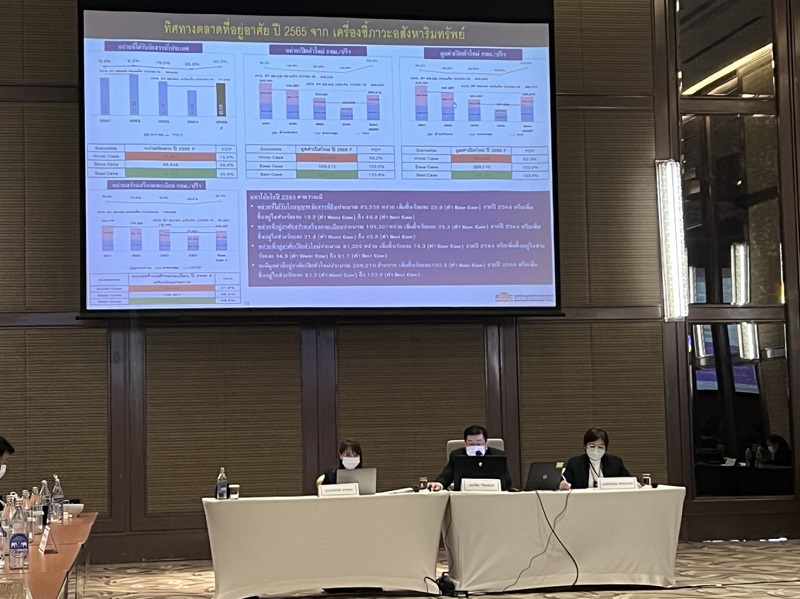
Dr. Vichai Viratthakhan, Inspector of the Government Housing Bank and Acting Director of the Real Estate Information Center stated that in 2022, the business is expected to start improving, with the overall real estate market index projected to increase by 14.2% from 2021. It is estimated that in 2022, in the Bangkok metropolitan area, around 81,226 new housing units will be launched, an increase of 74.3% from 2021, with a total value of approximately 389.21 billion baht.
The number of low-rise projects continues to exceed that of condominiums due to higher demand from buyers. Meanwhile, condominiums are expected to gradually recover as inventory decreases and rising land prices compel developers to build condominiums that align with purchasing power.
Regarding property transfers, it is expected that in 2022, there will be approximately 332,192 transfers, an increase of 25.1%. The transfer of low-rise properties is expected to rise by 24.6%, while condominium transfers will increase by 26.1%, totaling around 909.864 billion baht, up 13.3% from 2021.
As for new personal housing loans nationwide, it is projected that in 2022, the value of new personal housing loans will be approximately 627.548 billion baht, with outstanding personal housing loans expected to reach around 4.748 trillion baht, an increase of about 5.5%.
However, the real estate sector still faces both positive and negative factors, particularly the risks from negative factors that need to be monitored. These include the likelihood of interest rates rising four times this year, the ongoing COVID-19 pandemic, especially the Omicron variant, which remains uncertain in terms of its severity, household debt at a high level of 90% of GDP, the slow recovery of employment and income for the public, and the increase in non-performing loans (NPL) from financial institutions, which may lead to more cautious lending practices. Additionally, rising construction costs may cause new housing prices to increase, and the tourism sector's economic recovery is still lagging behind due to the lack of foreign tourists.
On the other hand, positive factors expected to support the growth of the real estate market include government stimulus measures. These include reducing transfer fees and mortgage registration fees to 0.01%, as well as extending these measures to second-hand homes, relaxing the loan-to-value (LTV) measures by the Bank of Thailand, which will facilitate the purchase of second and third homes for living and investment, and sufficient liquidity in banks for new loans, while developers continue to offer promotions and discounts.
In 2022, caution is advised; if there is a significant outbreak of COVID-19 requiring lockdowns, it may hinder the real estate market's recovery. Second-hand homes may become substitutes for new homes. Additionally, labor shortages could delay construction and affect delivery schedules, impacting the backlog for developers. If NPLs arise, financial institutions may adopt stricter lending policies in 2022, affecting homebuyers with weaker financial positions.