Fed Raises Interest Rates: Will It Cause Stock Market Decline and Economic Collapse? (Statistical Data Suggests Otherwise)
After the Fed indicated that it might raise interest rates soon due to rising inflation concerns, analysts and economists from various institutions began predicting negative outcomes, leading to widespread anxiety about the direction of the money and capital markets, as well as the overall economy. Consequently, risky asset markets experienced a significant downturn. In this article, we will analyze whether the events that the market is worried about are likely to occur, using statistical data.
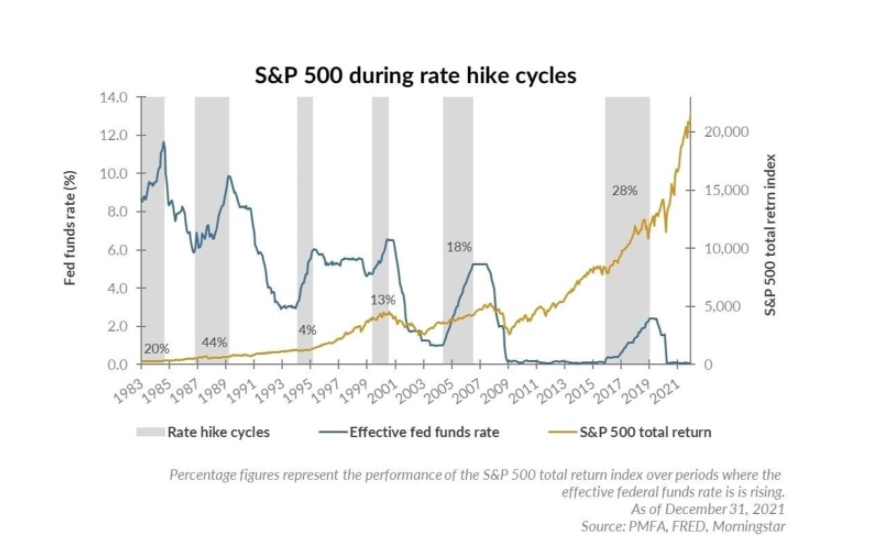
Point 1: Does the Fed's increase in policy interest rates actually lead to stock market declines and economic collapse?
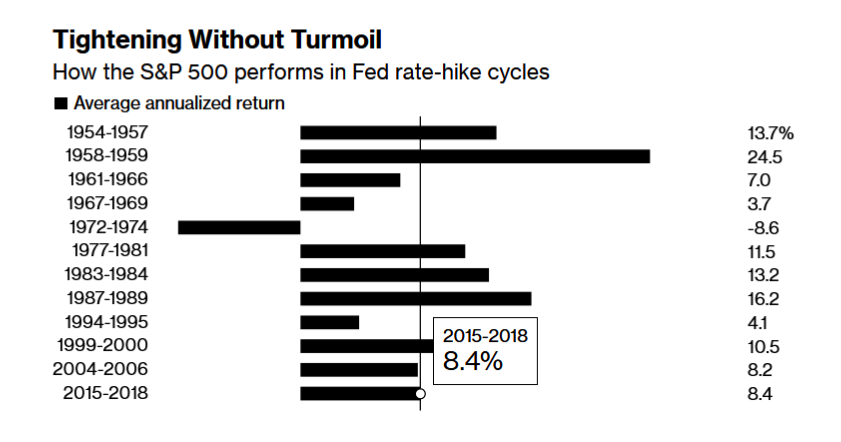
Answer: There is no statistical evidence that the Fed's increase in policy interest rates leads to stock market declines. On the contrary, the stock market has historically increased by an average of 9.4% per year during such periods.
Figure 1: S&P 500 Returns During Fed Interest Rate Hikes
Source: Bloomberg article, Trust Advisory Services
Question 2: In the short term, does an increase in interest rates affect the stock market?
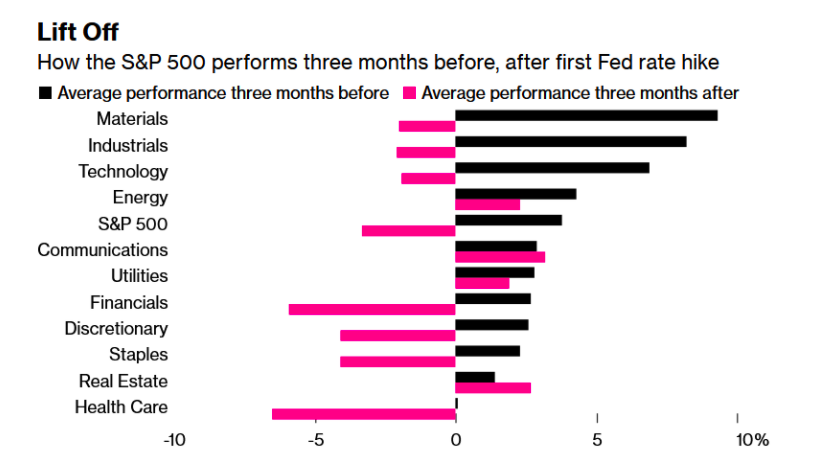
Answer: In the short term, just before and after the first interest rate hike, the market may experience some volatility. Statistics show that in the three months leading up to the hike, the stock market typically rises by 5-10%, and in the three months following, it usually declines slightly, averaging no more than 5%.
Figure 2: Stock Market Volatility Before and After the First Interest Rate Hike
Source: Bloomberg article
Question 3: Why does the stock market still rise after the Fed raises interest rates? Shouldn't the economy and speculation slow down?
Answer: The Fed's decision to raise interest rates is primarily based on its confidence in economic data. The recently announced US GDP growth for Q4 2021 was 6.9%. A strong economy allows the stock market to rise, which is not surprising.
Question 4: When might the stock market decline again?
Answer: Historical data shows that after the interest rates have been raised to their peak in a cycle, there may be a reduction in rates within an average of 1-2 years. During this period, the Fed views the economy as weak, necessitating a rate cut to stimulate growth, which could lead to a decline in the stock market.
Figure 3: After the Fed Completes Rate Hikes, the Period When Rates Begin to Fall is Often When the Stock Market Corrects
Question 5: Will the rising inflation rate (currently at 7%) be temporary or permanent, and will it lead to economic collapse?
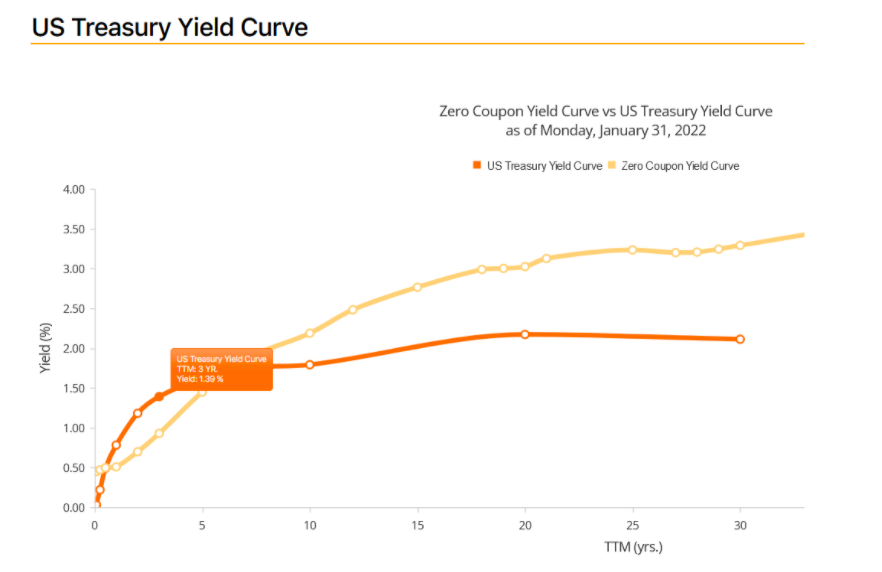
Answer: It is likely that the inflation increase will be temporary. Typically, when analyzing long-term inflation rates, predictions can be made based on the bond market, as institutional investors are prevalent and tend to forecast inflation accurately. If inflation is high, bond yields usually rise to compensate for the decrease in purchasing power due to inflation.
Recent data shows that the yield on 10-year US Treasuries is still around 2%, indicating that long-term inflation is expected to be around 2%.
Figure 4: US Treasury Yield Curve
Source: Thai BMA
In Summary
1. The Fed's interest rate hikes are actually beneficial for the stock market (averaging a 8.4% increase per year during rate hikes).
2. The Fed raises interest rates because it is confident in the overall strength of the economy, which is a positive sign.
3. The stock market may decline after the Fed completes its rate hikes and begins to lower rates to stimulate a weakening economy.
4. The rising inflation is likely to be short-term, with long-term inflation expected to return to around 2%, as predicted by the bond market.