Risk Management in Investments for 2022
Article by Oranong Chaitong
CEO of Prospect REIT Management Co., Ltd.
Manager of the Prospect Logistics and Industrial Property Fund (PROSPECT)
The past year, 2021, has been another challenging year for all of us. However, it is commendable that many have managed to move forward this year. For those who are still stuck in the past year, I believe it’s time to move on and start anew. Let’s discuss how we can approach investments this year.
With the rapid changes brought about by the COVID-19 pandemic, everyone has likely experienced various changes in their lives, which may now seem normal, including working from home (WFH) and the uncertainties in both the stock market and emerging markets like cryptocurrency. Personally, I believe that this year should be a time for us to reflect on the risks we faced last year as important lessons and prepare to tackle them, rather than lamenting over things that cannot be changed.
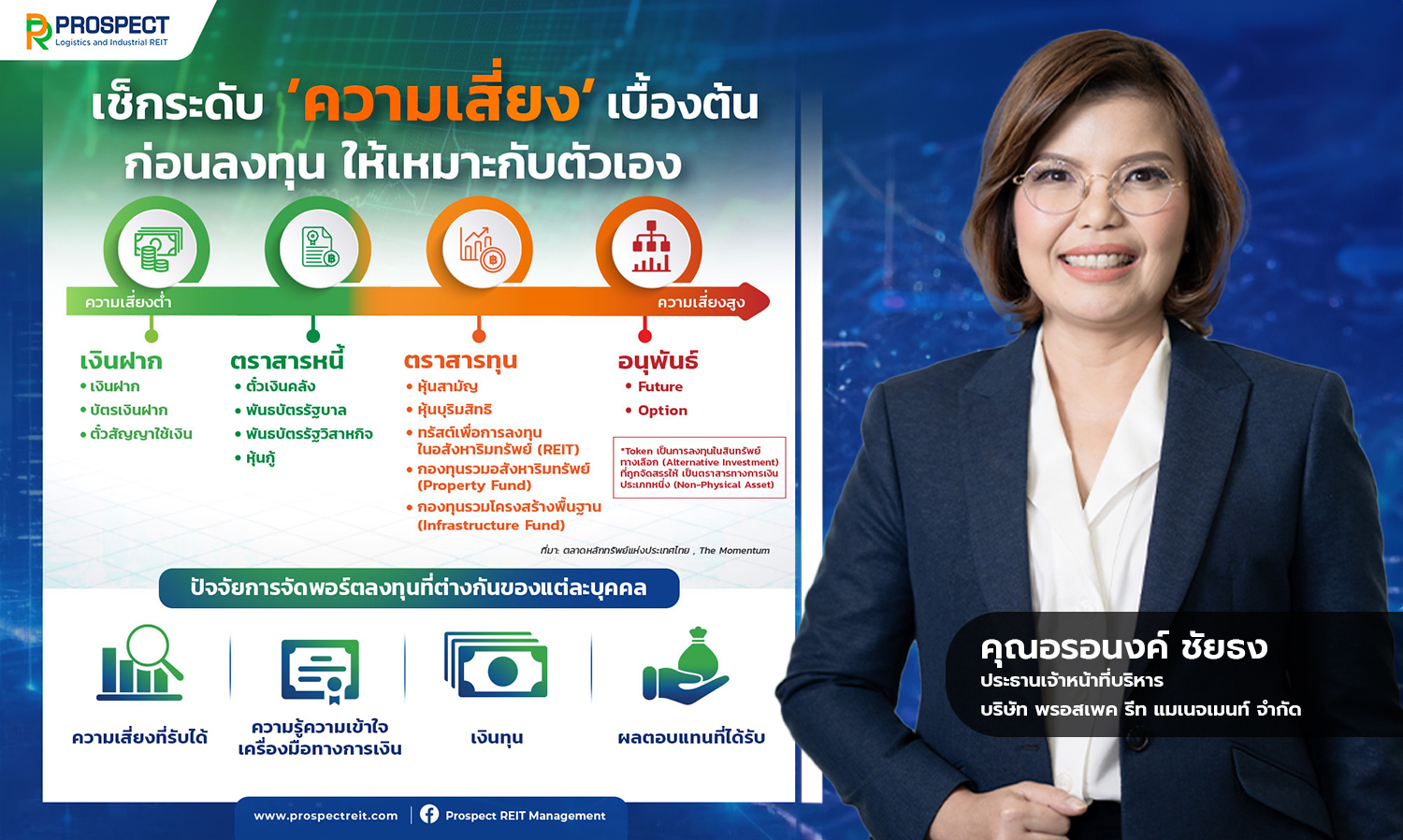
The main recommendation I would like to share for investing this year, based on my personal opinion and experiences that have proven effective, is risk management. This concept can be applied in all eras and has helped many survive until today. Risk Management refers to the methods of managing various events that may occur, predicting and mitigating potential negative impacts. There are many strategies available in literature, but I personally advocate for the 4T Risk Management Strategy, which I will briefly explain below.

1. Take (Accept) - This involves accepting the risks that investors are willing to take, both at the portfolio level and for individual stocks. There should be contingency plans for worse-than-expected scenarios, including budgeting for potential losses. For instance, setting an acceptable investment value that can withstand stock volatility, whether through stock quality assessments or future returns. Additionally, having a backup plan to average down costs can be beneficial if the perceived risks are acceptable for long-term investment.
2. Treat (Reduce or Control) - This type of risk is still acceptable but requires finding ways to control it from escalating. Ideally, it involves reducing the risk to a manageable level. For example, controlling the proportion of each stock in the portfolio to prevent any single stock from having too high a weight, whether at 10% or 20%, to mitigate the impact of any significant declines on the overall portfolio. Selling off portions of certain stocks can also help limit potential losses.
3. Transfer (Share or Diversify) - This is an acceptable risk but requires additional processes for transferring or diversifying the risk or responsibilities to others. This could involve insuring a business or diversifying investments in the portfolio to include fundamentally strong stocks, those with consistent and good returns, and high-growth stocks that align with the investor's risk tolerance.
4. Terminate (Stop or Avoid) - This is an unacceptable risk that necessitates stopping or taking action to avoid events that pose risks. For instance, if certain stocks significantly impact the overall portfolio value, it’s essential to assess whether those stocks still maintain their quality or adhere to the initial investment plan. If circumstances have changed, it may be necessary to decide to cut losses on certain stocks, as holding onto them could lead to further future losses.
While the recommended investment approach for 2022 emphasizes increased risk management, it’s crucial not to overlook the importance of the quality of each security. Additionally, information plays a vital role in enhancing the effectiveness of investment decisions. Even though we prioritize risk management, it is ultimately aimed at achieving quality and sustainable investments, helping to alleviate investment concerns. However, if investors are overly anxious, it may hinder portfolio growth. Therefore, it is essential for investors to manage their portfolios in line with their own risk tolerance.