Thai Industrial and Logistics Space Market Moves in Different Directions
The Thai industrial and logistics space market is often regarded as a standout market compared to others for real estate developers and investors during uncertain times. CBRE, a global real estate consulting firm, revealed that while the industrial and logistics market is experiencing better growth than other commercial markets, it is not entirely smooth sailing. There are both growth aspects and challenges that can be improved with supportive government policies and appropriate business expansion strategies.
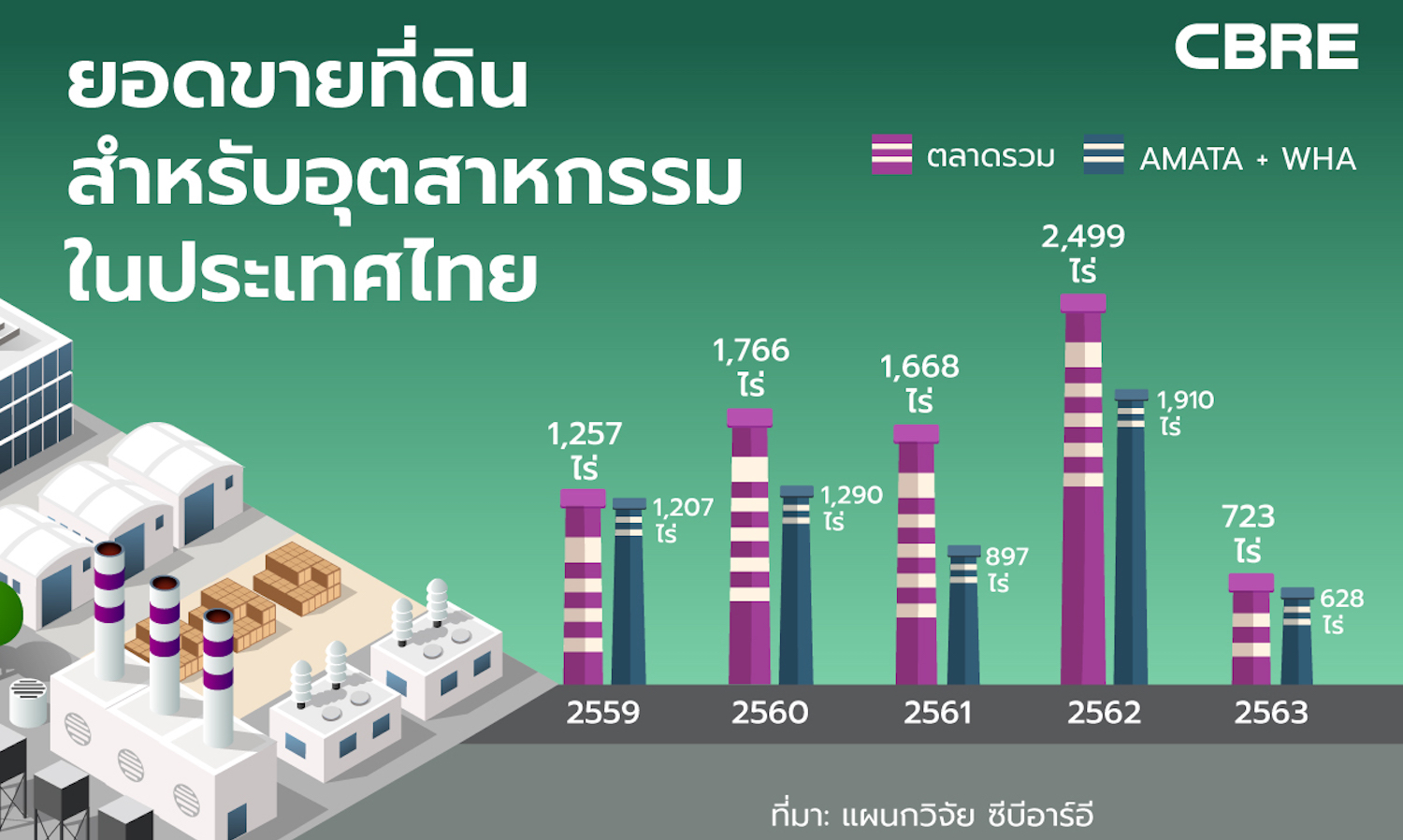
Mr. Adam Bell, Head of Industrial and Logistics at CBRE Thailand, stated, “Before the COVID-19 pandemic, the China Plus One model showed that manufacturers wanted to diversify their supply chains and relocate production outside mainland China due to rising labor costs, the need to mitigate risks, and trade disputes. It was anticipated that Thailand, Vietnam, and Malaysia would be the primary beneficiaries. However, to date, land sales in Thailand's industrial estates have not reflected this trend. In assessing Thailand's success in attracting foreign direct investment (FDI), we look at land sales in industrial estates from 2016 to 2020 by major real estate developers like WHA Corporation and Amata Corporation, which revealed that land sales did not demonstrate the benefits Thailand gained from the China Plus One model.”
Vietnam has been more successful in attracting investment due to its advantages, such as a large, young workforce and low wage rates, making it more appealing to labor-intensive manufacturers compared to Thailand.

Mr. Adam Bell, Head of Industrial and Logistics at CBRE Thailand
“Although Thailand may no longer compete on labor costs, it still has advantages over Vietnam in other areas, such as well-developed infrastructure, professionally managed industrial estates, a pool of skilled suppliers and labor, and over 40 years of experience in attracting foreign direct investment, which should help Thailand benefit from the China Plus One model,” Mr. Adam added.
CBRE believes there is significant pent-up demand for industrial land, especially in large industrial estates in the Eastern Seaboard. However, due to current travel restrictions from the COVID-19 pandemic and the difficulties faced by Chinese nationals traveling abroad, Thailand will still have to wait to reap the benefits from potential foreign direct investment.
One clear area of growth in the industrial and logistics space market is the warehouse market, which has expanded over the years due to the growth of e-commerce. The pandemic has significantly accelerated this growth, as e-commerce companies are experiencing exponential expansion due to a shift in consumer spending towards online shopping during lockdowns and the encouragement to work and stay at home. CBRE believes that government economic stimulus measures focused on the industrial and logistics space market can unlock the growth potential of the warehouse market and alleviate zoning challenges currently faced by warehouses.
Mr. Paul Srivarakul, CEO of aCommerce, previously commented to the Bangkok Post that the e-commerce business in Thailand is growing at an extraordinary rate. The growth in 2020 alone was remarkable, even though only 3-4% of all retail stores in the market had transitioned online. Many brands and retailers are rapidly adapting by incorporating technology, resulting in e-commerce sales increasing significantly from 5-8% pre-COVID-19 to 25-30% currently.
This growth has driven massive demand for warehouse space from major e-commerce companies like aCommerce, JD.Com, Shopee, and Lazada to store products before distributing them to customers nationwide.
Mr. Adam added, “In the future, there will still be challenges ahead, but they are positive challenges stemming from the rapid growth of the market. With the nature of e-commerce business operations, prime locations must be close to cities and easily accessible. The ideal locations for e-commerce warehouses are along Bangna-Trad Road between km 18 and km 23, which connects Bangkok, Suvarnabhumi Airport, and Laem Chabang deep-sea port. This area falls within the zoning for large warehouses favored by e-commerce companies. CBRE has found that this location is currently facing a shortage of large land available for development, and the existing land prices make warehouse development challenging.”
“Certain types of businesses in the warehouse market, such as e-commerce, have seen significant growth during the pandemic. However, in the coming years, CBRE expects warehouse rental rates to trend upward. Project developers and tenants may need to start looking for alternative locations with lower rents or land prices that can offset the disadvantages of less favorable locations. This is a challenge arising from positive changes. With government policies on urban planning and land use expansion, Thailand could regain its competitive advantage in the regional warehouse market,” Mr. Adam concluded.