Agricultural Plants for Alternative Protein Production: Addressing Supply Sustainability
• The Kasikorn Research Center believes that agricultural plants with potential to be used as raw materials for producing plant-based protein, the food of the future for Thailand, include mung beans, sunflower sprouts, black sesame, jasmine brown rice, and straw mushrooms. These are evaluated based on the following criteria:
1) They are plants with high protein levels comparable to meat protein, containing 13-23% protein by weight.
2) They are plants that Thailand has the potential to produce in terms of yield, good market prices, short harvesting periods, and local varieties.
3) They are plants supported by the government, which will ensure supply sustainability, generate income for Thai farmers, and create future alternative protein products made in Thailand. Additionally, this will reduce reliance on imported soybeans, which are projected to have a market value of around 300-500 million baht in 2021 as the main raw material for Thailand's future food protein production.
• The Kasikorn Research Center notes that it may not be easy to select any one agricultural plant to serve as a raw material for producing plant-based protein food in Thailand. Certainly, operators may need to consider additional challenges beyond weighing the quality and price of the chosen agricultural plant against popular raw materials in the market. Each type of agricultural plant has its own advantages and disadvantages, which may require operators to fill in the gaps in each supply chain to achieve greater completeness.
•Alternative Protein has become a future food trend as health-conscious consumers become more aware of environmental issues and sustainability. This has led to a growing preference for alternative protein sources to replace meat, which requires significant resources for production and contributes to greenhouse gas emissions. This trend is gaining popularity globally, especially in Western countries. However, alternative protein food in Thailand is still relatively new and holds significant business opportunities, primarily recognized in the form of plant-based protein. Currently, large and medium-sized enterprises, as well as startups, have entered this market. However, on the supply side of plant protein, there is a significant issue regarding raw materials, as the main raw material for producing plant protein popular abroad is soybeans, which contain up to 36% protein by weight. Thailand relies almost entirely on imports, affecting supply sustainability and causing soybean prices to fluctuate with the global market. The Kasikorn Research Center estimates that in 2021, the value of soybeans as the main raw material for Thailand's future food protein production may be around 300-500 million baht. Although this is not a large amount, accounting for only 0.6-1.0% of the total soybean market value in Thailand, it reflects the unsustainable supply issue since Thailand must import soybeans. Therefore, it would be highly beneficial if Thailand could promote its potential plants to be used as raw materials for producing plant-based protein food, replacing soybeans, and not just as a contract manufacturer but also to develop its own plant protein products, leveraging Thailand's diverse agricultural resources to generate income for Thai farmers and ensure supply sustainability.
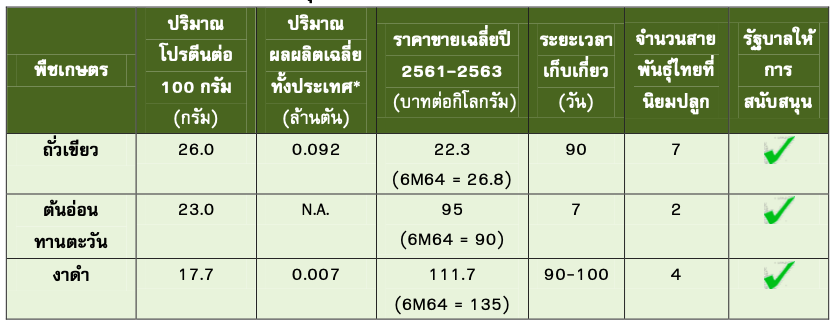
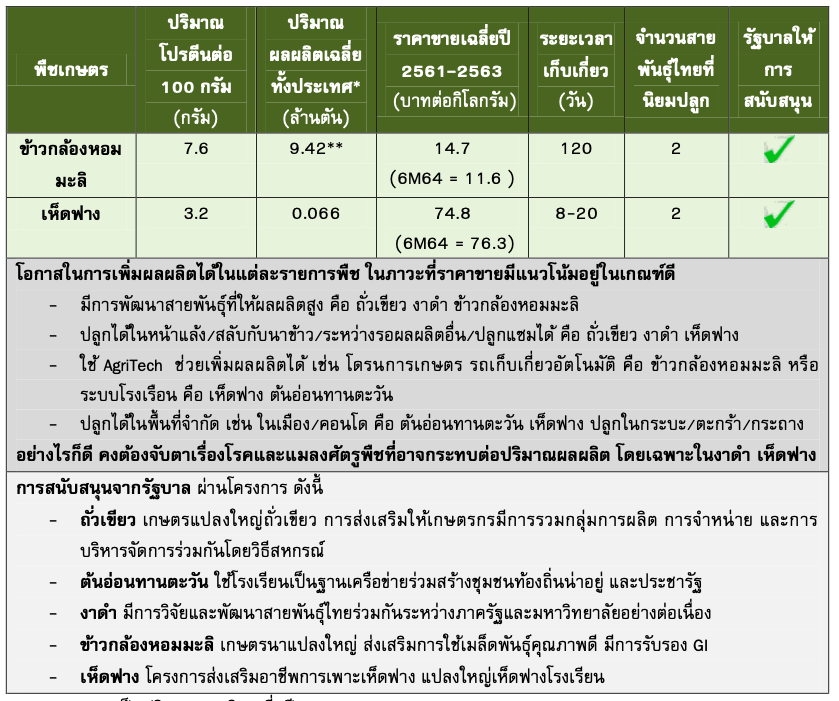
• The Kasikorn Research Center identifies potential agricultural plants for use as raw materials for producing plant-based protein food in Thailand, including mung beans, sunflower sprouts, black sesame, jasmine brown rice, and straw mushrooms, based on the following analysis criteria: 1) They are plants with high protein levels comparable to meat protein, containing around 13-23 grams of protein per 100 grams of food weight; 2) They are plants that Thailand has production potential in terms of yield, good market prices, short harvesting periods, and local varieties; and 3) They are plants supported by the government, with details as follows:
Potential Agricultural Plants for Use as Raw Materials in Producing Plant-Based Protein Food of the Future in Thailand
Note:
* Average yield for the year 2020
** Yield of jasmine brown rice
Source: Office of Agricultural Economics, Department of Health, and Department of Agriculture, compiled by the Kasikorn Research Center
Additionally, Thailand has other high-protein plants with potential that are well-priced and have short harvesting periods, such as hemp, which is currently a plant to watch according to global trends, as well as local plants like krang mushrooms, which are high-protein plants commonly grown in the southern region. All of these plants could potentially drive production to become economic crops in the future, contributing to a diverse range of plant-based protein products.
• Nevertheless, the Kasikorn Research Center believes that it may not be easy to select any one agricultural plant to use as a raw material for producing plant-based protein food in Thailand. Certainly, operators may need to consider additional challenges beyond weighing the quality and price of the chosen plant against popular raw materials in the market, such as soybeans. Each agricultural plant has its own advantages and disadvantages, which may require operators to fill in the gaps in each supply chain to achieve greater completeness. Additionally, operators must monitor price fluctuations that may impact production costs. However, for high-priced plant items, while they may affect the higher raw material prices for operators, they will help operators plan production systematically based on a continuous supply of upstream products, which will also require quality management of the produce.
As for the challenges in producing upstream agricultural plants, the use of AgriTech is still not widespread, and there is a need to accelerate its adoption to enhance production efficiency in terms of quality and quantity. This applies to plants that may be grown on a smaller scale, such as sunflower sprouts and straw mushrooms, by shifting to greenhouse or vertical farming. For larger-scale crops like rice, drones and automated harvesting vehicles may be used. Furthermore, the price of certain agricultural products that may decrease at times could also affect decisions regarding planting these crops in the future.
In summary, amidst the growing demand for plant-based protein products in line with global trends, Thailand's ability to promote agricultural plants as raw materials for producing plant-based protein food of the future represents a means of ensuring raw material supply stability to replace imported soybeans, which have fluctuating prices in the global market. The potential plants include mung beans, sunflower sprouts, black sesame, jasmine brown rice, and straw mushrooms. However, it is certainly not an easy task, as each plant has its own advantages and disadvantages. Therefore, operators must consider additional challenges beyond weighing the quality and price of the chosen plants against popular raw materials in the market.
Moreover, on the demand side for plant protein in Thailand, it is still in the early stages. Therefore, the key to rapidly growing the plant protein market in Thailand will depend on research and development of plant protein products from each key raw material to meet the requirements for taste, texture, nutritional value, appearance, palatability, and allergen risk. Additionally, creating more interest through content marketing strategies, such as storytelling about products (e.g., jasmine brown rice sourced from quality production areas in the northeastern region like the Kula Ronghai area, which is certified as a Geographical Indication (GI) product, as well as being certified organic), will further enhance the selling points for consumers. Furthermore, building a recognizable brand through marketing in both domestic and export markets will help clarify the customer base. Meanwhile, support from the government in terms of agricultural producers through the use of modern agricultural technology, maintaining price stability for agricultural products, as well as providing tax incentives and investment assistance for plant-based protein food operators will be crucial for the sustainable growth of the entire supply chain of future plant-based protein food in Thailand.